Research & Development World

  • R&D World Home
  • Topics
    • Aerospace
    • Automotive
    • Biotech
    • Careers
    • Chemistry
    • Environment
    • Energy
    • Life Science
    • Material Science
    • R&D Management
    • Physics
  • Technology
    • 3D Printing
    • A.I./Robotics
    • Software
    • Battery Technology
    • Controlled Environments
      • Cleanrooms
      • Graphene
      • Lasers
      • Regulations/Standards
      • Sensors
    • Imaging
    • Nanotechnology
    • Scientific Computing
      • Big Data
      • HPC/Supercomputing
      • Informatics
      • Security
    • Semiconductors
  • R&D Market Pulse
  • R&D 100
    • 2025 R&D 100 Award Winners
    • 2025 Professional Award Winners
    • 2025 Special Recognition Winners
    • R&D 100 Awards Event
    • R&D 100 Submissions
    • Winner Archive
  • Resources
    • Research Reports
    • Digital Issues
    • Educational Assets
    • R&D Index
    • Subscribe
    • Video
    • Webinars
    • Content submission guidelines for R&D World
  • Global Funding Forecast
  • Top Labs
  • Advertise
  • SUBSCRIBE

Nano-Droplets Crucial to Control of Membrane Formation

By Eindhoven University of Technology | February 20, 2019

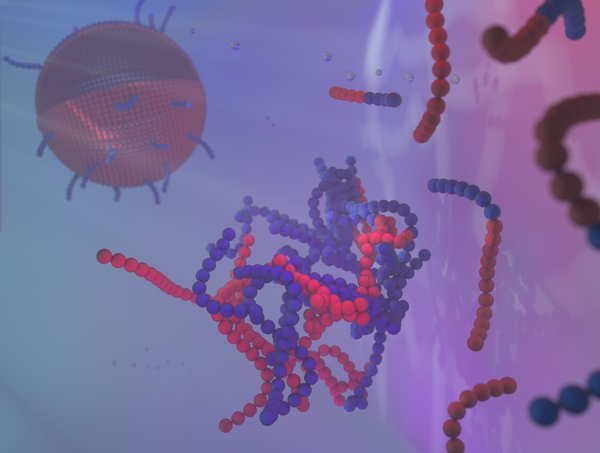
Artist impression of amphiphilic self-assembly from dissolved molecules (right, foreground), the formation of a nano-droplet (middle), into a liposome (left, far back). Image: Giorgio Gasco.

The creation of membranes is of enormous importance in biology, but also in many chemical applications developed by humans. These membranes are shaped spontaneously when soap-like molecules in water join together.

Researchers at Eindhoven University of Technology now have a clear picture of the entire process. Membrane formation turns out to start with nano-droplets in the water with a higher concentration of soap-like molecules. If you can control those nanodroplets, you can control shape, thickness and size of the membranes. This is of great importance for, among other things, the development of new nanomedicines.

The results are published in Nature Chemistry.

Biological membranes, and man-made variants, consist of amphiphilic molecules, of which soap is an example. These molecules have a head that bonds with water, but a tail that turns away from water. You can imagine that a group of such molecules in water, preferably puts the tails together, and sticks the heads out, towards the water. Similar processes also dominate the creation of membranes. Often they are spherical, like liposomes, so you can, for example, put a medicine in it. And also the ultimate membrane, the cell wall, is constructed in a similar way.

Until now, the formation of ‘micelles’ was considered to be the first step in membrane formation. A micelle is an extremely small spherical structure (about 100 nanometers) of amphiphilic molecules – all with the tails inwards and the heads outwards.

However, researchers at Eindhoven University of Technology discovered a different beginning: the formation of nano-droplets in water with a higher concentration of amphiphilic molecules. At the interface of that drop, the amphiphilic molecules, as it were, take each others’ hands: first they form spheres, which then change into cylinders or plates, and then a closed membrane is created that encloses the nano-droplet. With this so-called “self-assembly” process, the droplet has become a liposome.

The research team predicted this outcome on the basis of a mathematical model and computer simulations, and then confirmed it with a very special form of electron microscopy. With Liquid-Phase Electron Microscopy they could make videos of the formation of liposomes. Because regular amphiphilic molecules are too small for even this form of microscopy to see, the researchers used much larger molecules that work in the same way (block copolymers).

According to the researchers, their new insights are fundamental to better control the self-assembly of membranes. They expect to see the knowledge reflected in a wide range of applications. Professor Nico Sommerdijk, one of the researchers, is thinking of, among other things, nanomedicine, including better ways to deliver cancer medicines to the right place in the body, by encapsulating them in liposomes.
Related Articles Read More >

R&D 100 winner LLNL achieves 1,000x speed boost in 3D nanofabrication
CEA-Leti achieves 400°C CMOS fabrication milestone for 3D chip stacking
The 2025 R&D 100 Finalists are here
New nanotechnology method increases microalgae biofuel yield by 300%
rd newsletter
EXPAND YOUR KNOWLEDGE AND STAY CONNECTED
Get the latest info on technologies, trends, and strategies in Research & Development.
RD 25 Power Index

R&D World Digital Issues

Fall 2025 issue

Browse the most current issue of R&D World and back issues in an easy to use high quality format. Clip, share and download with the leading R&D magazine today.

R&D 100 Awards
Research & Development World
  • Subscribe to R&D World Magazine
  • Sign up for R&D World’s newsletter
  • Contact Us
  • About Us
  • Drug Discovery & Development
  • Pharmaceutical Processing
  • Global Funding Forecast

Copyright © 2026 WTWH Media LLC. All Rights Reserved. The material on this site may not be reproduced, distributed, transmitted, cached or otherwise used, except with the prior written permission of WTWH Media
Privacy Policy | Advertising | About Us

Search R&D World

  • R&D World Home
  • Topics
    • Aerospace
    • Automotive
    • Biotech
    • Careers
    • Chemistry
    • Environment
    • Energy
    • Life Science
    • Material Science
    • R&D Management
    • Physics
  • Technology
    • 3D Printing
    • A.I./Robotics
    • Software
    • Battery Technology
    • Controlled Environments
      • Cleanrooms
      • Graphene
      • Lasers
      • Regulations/Standards
      • Sensors
    • Imaging
    • Nanotechnology
    • Scientific Computing
      • Big Data
      • HPC/Supercomputing
      • Informatics
      • Security
    • Semiconductors
  • R&D Market Pulse
  • R&D 100
    • 2025 R&D 100 Award Winners
    • 2025 Professional Award Winners
    • 2025 Special Recognition Winners
    • R&D 100 Awards Event
    • R&D 100 Submissions
    • Winner Archive
  • Resources
    • Research Reports
    • Digital Issues
    • Educational Assets
    • R&D Index
    • Subscribe
    • Video
    • Webinars
    • Content submission guidelines for R&D World
  • Global Funding Forecast
  • Top Labs
  • Advertise
  • SUBSCRIBE