NANO Nuclear Space Inc., a subsidiary of NANO Nuclear Energy, is designing a nuclear reactor for the Moon. James Walker, CEO of NANO Nuclear Energy, says they can get it there by 2030.
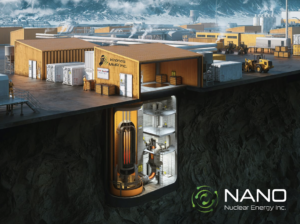
Credit: NANO Nuclear Energy
There are several challenges associated with a lunar reactor, Walker said. The payload has to be smaller for launch, the operation has to be as simple and autonomous as possible and dealing with radiation, which degrades materials.
The challenges of lunar deployment
“One factor that we have to consider within the design of the system is that it needs to be able to be fueled very simply, outside of an Earth environment in low gravity, by either encumbered people or by very simplistic robots that were able to do the refueling exercise,” Walker said. “It’s going to have to be very simple, because it’s going to have to be done by people in space suits.”
He mentioned that NASA’s expertise with robots could be an important asset in this regard. “Robots could very, very easily refuel this system,” Walker said.
Ideally, the reactor would not need regular maintenance, he added. It could be operated remotely, from a lunar base or even from Earth.
“AI could play a big, important part in monitoring and remote intervention,” Walker said. “Say you needed to keep some sort of computer system running, or experiments running on the Moon, and you had to leave the reactor operational, you would need to be able to monitor the behavior of that reactor from a remote location that might even be as far as Earth.”
NANO Nuclear is planning to demonstrate its reactor, called LOKI, at Idaho National Laboratory’s DOME facility by 2027. NASA’s target for a lunar surface reactor is the early 2030s, and NANO Nuclear’s timeline aligns with this goal, Walker said. NANO Nuclear would have to get a NASA or DOE contract to land the reactor on the Moon.
Competitors like Westinghouse and IX, a joint venture between X-energy and Intuitive Machines, are also vying for that contract. In 2022, IX, Lockheed Martin and Westinghouse were awarded Phase 1 contracts.
NANO Nuclear also has an interest in working with private companies like Blue Origin that are looking to partner with NASA.
How TRISO fuel increases safety
NANO Nuclear’s LOKI reactor, which is designed for space deployment, is a smaller version of its KRONOS reactor. KRONOS gave the company an advanced design with technological developments that it could transpose onto LOKI, Walker said.
“It’s arguable that we sit in a very commanding lead in the space race for reactor systems, just by virtue of the fact that we have put so much work in developing our KRONOS reactor,” he said.

James Walker, CEO of NANO Nuclear Energy. Credit: NANO Nuclear Energy
The reactor uses TRISO fuel: Tri-structural Isotropic particle fuel. In TRISO fuel, each fuel particle consists of a uranium core surrounded by layers of carbon and ceramic coatings. The outer layers act as a containment vessel for each particle, preventing meltdowns.
The ceramic coatings are designed to withstand temperatures up to 1,600 degrees Celsius, allowing them to contain radioactive fission products during severe accidents. This feature could also make TRISO fuel safer during space travel.
“For instance, even if you were to put our fuel into a space shuttle, and the space shuttle were to blow up for whatever reason. You would have a dispersal of a contained fuel source, and you would avoid a significant radiation incident or hazard,” Walker said.
For a reactor on the Moon, this means that a reactor failure would not permanently destroy the asset and render the site uninhabitable. The fact that the fuel’s containment is intrinsic to the material itself, not dependent on active cooling systems or human intervention, means its safety does not decrease if systems fail.
TRISO is increasingly the fuel choice across the advanced nuclear industry because of these properties.
Why nuclear?
Nuclear may be the best option for energy on the Moon. Options like dams and wind power are impossible on the Moon, leaving few alternatives.
“If you’re looking at something like gas or coal or diesel now, you would only get a very reduced and small amount of lifetime from taking that fuel all the way up into space and then being able to utilize it in a very, very remote setting before you exhaust it. And you’re not going to run continuous missions back and forward from space shuttles for very limited use,” Walker said.
Solar is one of the viable alternatives, but it comes with its own problems. Due to the lunar cycle, any solar panels on the Moon would experience darkness for two weeks at a time, and batteries lack the capacity to support an entire base through those periods. The lunar environment also presents challenges. Temperatures cycle between minus 173 degrees Celsius and 127 degrees Celsius, and the surface experiences high-energy particle flux during solar events, both of which degrade solar panel performance.
Intuitive Machines is developing Stirling power conversion technology for space with its START program. However, Stirling engines are a power conversion technology, not an energy source. They need a heat source, which could be nuclear or solar thermal.
“Nuclear is really the only solution to long-term deployment of any manned facility in space,” Walker said.
Nuclear power is agnostic to location, continuous and scalable, making it an ideal option for powering a lunar base.