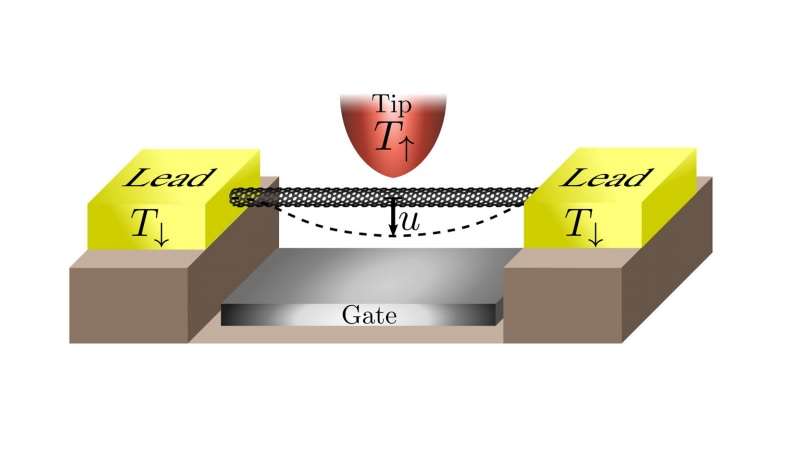
In the proposed system, a carbon nanotube is suspended between two leads, below a tip electrode, and above a gate. The pair of leads and the tip are two separate electron reservoirs with different temperatures. Electrons can tunnel between the nanotube and the reservoirs. Although electron exchange between the two reservoirs is prevented, electron-electron interaction couples the two reservoirs, allowing for a heat flow. (Credit: A. Vikström et al)
Illustrating the unusual way things work on the nanoscale, scientists have designed a new nanoelectromechanical system (NEMS) that produces mechanical motion due to the interactions between electrons—yet unlike similar systems, this system does not require any electric current. Instead, the electron-electron interactions couple two electron reservoirs of different temperatures, which generates a heat flow between them that causes a suspended carbon nanotube to vibrate.
The researchers, A. Vikström and coauthors from Chalmers University of Technology in Göteborg, Sweden, and the B. Verkin Institute for Low Temperature Physics and Engineering of the National Academy of Sciences of Ukraine in Kharkov, Ukraine, have published a paper on the NEMS device in a recent issue of Physical Review Letters.
“Microscopic devices which combine electronics with mechanics—MEMS (microelectromechanical systems)—are ubiquitous in the modern world,” Vikström told Phys.org. “The sensors inside our smart phones which determine acceleration, orientation, etc., are good examples. As electronic devices become smaller, there is an ongoing endeavor to replace such microscopic structures with nanoscopic ones—NEMS. Our research belongs in this category; we propose, model, and study new NEMS devices. The NEMS heat engine that we have suggested is special in that it converts a heat flow into mechanical motion without requiring nor generating an electrical current.”
Although there have been other proposals in which single-electron phenomena cause mechanical vibrations in NEMS devices, these mechanisms typically require an electric current. If that current is blocked, then these mechanisms no longer work.
The new proposed mechanism differs in that it intentionally blocks any electric current. The system consists of a carbon nanotube suspended between two electrode leads, with the pair of leads acting as one electron reservoir. A tip electrode above the nanotube acts as a second reservoir, containing electrons with opposite spin as the electrons in the first reservoir. Electrons can tunnel freely from their reservoirs to the nanotube and back. But because the electrons from different reservoirs have opposite spins, they cannot travel to the opposite reservoir, and so there is no charge transfer.
Things start to get interesting when the electron reservoirs have different temperatures. Then when cold electrons from one reservoir and hot electrons from the other reservoir tunnel to the nanotube, they interact and heat is transferred from the hot to the cold electrons. When the cold electrons tunnel back to their cold reservoir, they carry extra energy, while the hot electrons return to their hot reservoir with less energy.
If the tip reservoir is hotter than the electrode reservoir, then the resulting heat flow will slightly deflect the suspended nanotube toward this reservoir. By bringing the nanotube and tip reservoir closer together, this deflection increases the tunneling rate between them. The increased tunneling produces a feedback mechanism, but with a delayed response, causing the nanotube to vibrate. Eventually the vibration amplitude stabilizes since the pumping efficiency decreases with amplitude. By adjusting the temperatures of the reservoirs, the researchers showed that the direction and strength of the feedback mechanism can be controlled, and the vibrations can be either pumped or damped.
Since the system uses heat flow to generate mechanical motion, it effectively acts as a nanoscale heat engine. The engine’s efficiency increases as the temperature difference increases, and the researchers estimate that the maximum efficiency is a few percent, limited by geometric factors rather than temperature difference. The researchers expect that the system could have a variety of uses.
“If you consider the general concept of a heat engine and imagine it in the context of an electronic circuit, it is easy to imagine the benefits,” Vikström said. “Heat is always present in electrical circuits as a by-product. Such heat is usually just waste energy, but if you could harness it to, say, power other integrated NEMS devices, you would have a more energy efficient system.”
The researchers explain that the proposed design could be experimentally realized using existing techniques. They suggest that the vibrations could be detected by applying a magnetic field perpendicular to the nanotube’s motion, which would cause a charge on the nanotube to experience a force that alternates with the deflection. The alternating current it would generate could then be measured, providing evidence of the nanotube’s vibrations.