Research & Development World

  • R&D World Home
  • Topics
    • Aerospace
    • Automotive
    • Biotech
    • Careers
    • Chemistry
    • Environment
    • Energy
    • Life Science
    • Material Science
    • R&D Management
    • Physics
  • Technology
    • 3D Printing
    • A.I./Robotics
    • Software
    • Battery Technology
    • Controlled Environments
      • Cleanrooms
      • Graphene
      • Lasers
      • Regulations/Standards
      • Sensors
    • Imaging
    • Nanotechnology
    • Scientific Computing
      • Big Data
      • HPC/Supercomputing
      • Informatics
      • Security
    • Semiconductors
  • R&D Market Pulse
  • R&D 100
    • 2025 R&D 100 Award Winners
    • 2025 Professional Award Winners
    • 2025 Special Recognition Winners
    • R&D 100 Awards Event
    • R&D 100 Submissions
    • Winner Archive
  • Resources
    • Research Reports
    • Digital Issues
    • Educational Assets
    • Subscribe
    • Video
    • Webinars
    • Content submission guidelines for R&D World
  • Global Funding Forecast
  • Top Labs
  • Advertise
  • SUBSCRIBE

Nanosized Container with Photoswitches Jettisons Cargo upon Irradiation

By Tokyo Institute of Technology | April 29, 2019

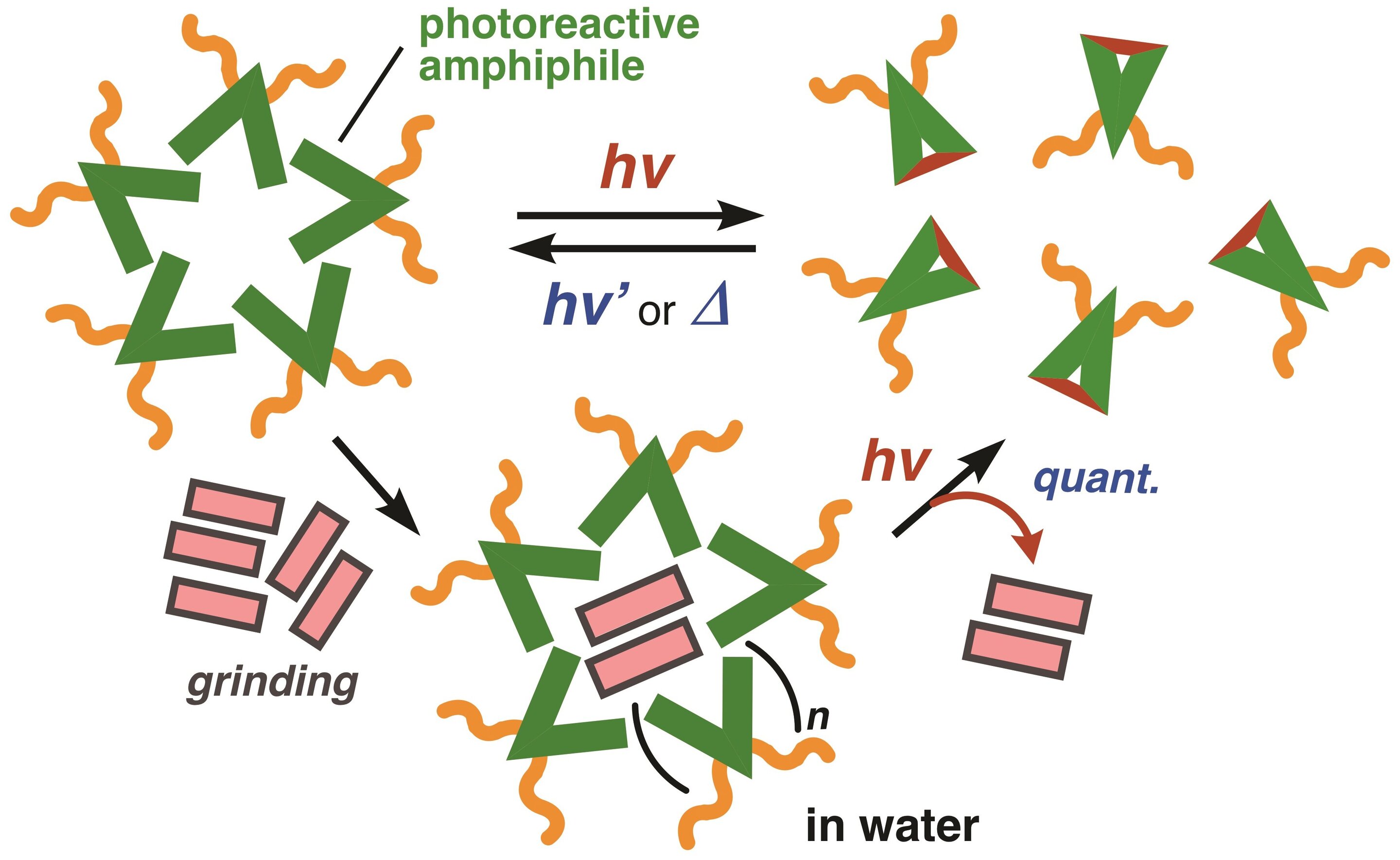
Schematic representation of guest uptake via grinding and release of the guest upon irradiation in water. The container can be regenerated by light irradiation or heating. Image: Tokyo Tech

Researchers at Tokyo Tech have developed a nanosized container bearing photoswitches that takes up hydrophobic compounds of various size and shape in water and subsequently releases them quantitatively by non-invasive light stimulus. The installed switches allow reusing of the container after successful release of the cargo. The novel system represents a versatile platform for future developments in fields such as materials chemistry and biomedicine.

Researchers at Tokyo Tech’s Laboratory for Chemistry and Life Science have developed a micelle-type nano-container that can be switched between its assembled and disassembled state via simple light irradiation. The light stimulus induces a structural change in the amphiphilic subunits, which closes their integrated binding pocket and simultaneously results in disassembly.

In a recent publication in Nature Communications, Lorenzo Catti (JSPS/Humboldt postdoctoral fellow), Natsuki Kishida, Michito Yoshizawa and co-workers successfully demonstrate how to combine the use of water and light, both essential ingredients for life, in an environmentally benign delivery system.

“Water and light are abundant and clean resources on earth,” Yoshizawa says. “Active use of both of them in synthetic and materials chemistry has seldom been accomplished so far but is an urgent necessity for the development of sustainable modern technologies.”

The achievement is grounded in a small design change in the subunit of the nanosized container. By moving the two polyaromatic panels on a previous amphiphilic compound one carbon atom closer together, the authors enabled a photochemical reaction between the panels that results in quantitative closing of the binding pocket. In addition, the group was able to show that this reaction is partially and fully reversible by light irradiation and heating, respectively.

The study is part of the group’s ongoing development effort towards environmentally benign nanoflask systems with controllable functionality. The new system can be considered an “aromatic micelle,” a concept that was introduced by the group in 2013.

Uptake of water-insoluble guest molecules into the container was shown to be easily achievable via a simple grinding protocol. Addition of water to the resulting solids gave characteristically colored solutions, which displayed UV-visible absorption bands assignable to the bound guest molecules. The flexible character of the nano-container allowed the uptake of a wide variety of compounds, such as rod-shaped and planar dyes and spherical fullerenes, in water.

Quantitative release of the guest compounds could be achieved via irradiation of the aqueous solution for 10 min at room temperature. The released, water-insoluble guests could furthermore be successfully recovered via simple filtration, giving rise to a clear colorless solution containing only the closed amphiphiles.

“In a biomedical context, the developed system holds great promise for future progress in non-invasive delivery of biomolecules and synthetic drugs,” Yoshizawa concluded.

Future improvements of the system are aimed at allowing a weaker light source for irradiation, which will bring the system one step closer to the envisioned in-vivo delivery application.
Related Articles Read More >

Researchers developed quantum nanosensors that can measure the temperature of a single cell
Overcoming the 100-nanometer barrier: New microbottle resonators scale up optical trapping
R&D 100 winner LLNL achieves 1,000x speed boost in 3D nanofabrication
CEA-Leti achieves 400°C CMOS fabrication milestone for 3D chip stacking
rd newsletter
EXPAND YOUR KNOWLEDGE AND STAY CONNECTED
Get the latest info on technologies, trends, and strategies in Research & Development.

R&D World Digital Issues

Fall 2025 issue

Browse the most current issue of R&D World and back issues in an easy to use high quality format. Clip, share and download with the leading R&D magazine today.

R&D 100 Awards
Research & Development World
  • Subscribe to R&D World Magazine
  • Sign up for R&D World’s newsletter
  • Contact Us
  • About Us
  • Drug Discovery & Development
  • Pharmaceutical Processing
  • Global Funding Forecast

Copyright © 2026 WTWH Media LLC. All Rights Reserved. The material on this site may not be reproduced, distributed, transmitted, cached or otherwise used, except with the prior written permission of WTWH Media
Privacy Policy | Advertising | About Us

Search R&D World

  • R&D World Home
  • Topics
    • Aerospace
    • Automotive
    • Biotech
    • Careers
    • Chemistry
    • Environment
    • Energy
    • Life Science
    • Material Science
    • R&D Management
    • Physics
  • Technology
    • 3D Printing
    • A.I./Robotics
    • Software
    • Battery Technology
    • Controlled Environments
      • Cleanrooms
      • Graphene
      • Lasers
      • Regulations/Standards
      • Sensors
    • Imaging
    • Nanotechnology
    • Scientific Computing
      • Big Data
      • HPC/Supercomputing
      • Informatics
      • Security
    • Semiconductors
  • R&D Market Pulse
  • R&D 100
    • 2025 R&D 100 Award Winners
    • 2025 Professional Award Winners
    • 2025 Special Recognition Winners
    • R&D 100 Awards Event
    • R&D 100 Submissions
    • Winner Archive
  • Resources
    • Research Reports
    • Digital Issues
    • Educational Assets
    • Subscribe
    • Video
    • Webinars
    • Content submission guidelines for R&D World
  • Global Funding Forecast
  • Top Labs
  • Advertise
  • SUBSCRIBE