Research & Development World

  • R&D World Home
  • Topics
    • Aerospace
    • Automotive
    • Biotech
    • Careers
    • Chemistry
    • Environment
    • Energy
    • Life Science
    • Material Science
    • R&D Management
    • Physics
  • Technology
    • 3D Printing
    • A.I./Robotics
    • Software
    • Battery Technology
    • Controlled Environments
      • Cleanrooms
      • Graphene
      • Lasers
      • Regulations/Standards
      • Sensors
    • Imaging
    • Nanotechnology
    • Scientific Computing
      • Big Data
      • HPC/Supercomputing
      • Informatics
      • Security
    • Semiconductors
  • R&D Market Pulse
  • R&D 100
    • 2026 R&D 100 Award Winners
    • 2026 Professional Award Winners
    • 2026 Special Recognition Winners
    • R&D 100 Awards Event
    • R&D 100 Submissions
    • Winner Archive
  • Resources
    • Research Reports
    • Digital Issues
    • Educational Assets
    • Subscribe
    • Video
    • Webinars
    • PharmSci360
    • Content submission guidelines for R&D World
  • Global Funding Forecast
  • Top Labs
  • Advertise
  • SUBSCRIBE

Nanotube Growth Moving in The Right Direction

By Lawrence Livermore National Laboratory | February 13, 2017

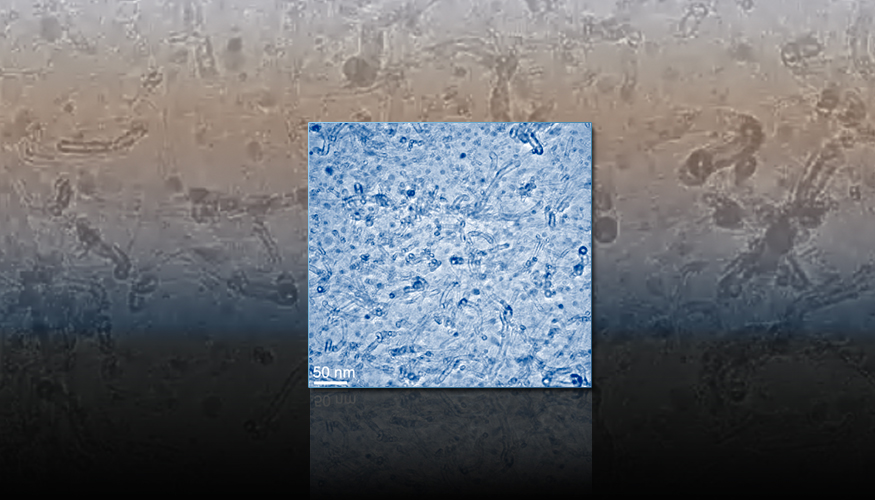
This transmission electron microscope image shows growth of a dense carbon nanotube population. Source: LLNL

For the first time, Lawrence Livermore National Laboratory scientists and collaborators have captured a movie of how large populations of carbon nanotubes grow and align themselves.

Understanding how carbon nanotubes (CNT) nucleate, grow and self-organize to form macroscale materials is critical for application-oriented design of next-generation supercapacitors, electronic interconnects, separation membranes and advanced yarns and fabrics.

New research by LLNL scientist Eric Meshot and colleagues from Brookhaven National Laboratory(link is external) (BNL) and Massachusetts Institute of Technology (MIT) has demonstrated direct visualization of collective nucleation and self-organization of aligned carbon nanotube films inside of an environmental transmission electron microscope (ETEM).

In a pair of studies reported in recent issues of Chemistry of Materials and ACS Nano, the researchers leveraged a state-of-the-art kilohertz camera in an aberration-correction ETEM at BNL to capture the inherently rapid processes that govern the growth of these exciting nanostructures.

Among other phenomena discovered, the researchers are the first to provide direct proof of how mechanical competition among neighboring carbon nanotubes can simultaneously promote self-alignment while also frustrating and limiting growth.

“This knowledge may enable new pathways toward mitigating self-termination and promoting growth of ultra-dense and aligned carbon nanotube materials, which would directly impact several application spaces, some of which are being pursued here at the Laboratory,” Meshot said.

Meshot has led the CNT synthesis development at LLNL for several projects, including those supported by the Laboratory Directed Research and Development (LDRD) program and the Defense Threat Reduction Agency (DTRA) that use CNTs as fluidic nanochannels for applications ranging from single-molecule detection to macroscale membranes for breathable and protective garments.
Related Articles Read More >

The Space Systems Division (05)-developed Parallelogram Synchronized Truss Assembly (PaSTA), seen Aug. 12, 2025, is a mechanism that will be integrated into the Life-Extension In-orbit Servicer (LEXI) and Astroscale Prototype Servicer for Refueling (APS-R) spacecrafts.
One SwRI R&D 100 winner turns buckled fiberglass into a spacecraft truss. The other models freight rail with 900 hours of BNSF field data
Researchers develop sawdust-based foam as polystyrene bans force industry to adapt
Researchers develop compostable PLA that potentially could be used for biomedical applications
Elkem Silicones rebrands as Bluestar Silicones after ownership change
rd newsletter
EXPAND YOUR KNOWLEDGE AND STAY CONNECTED
Get the latest info on technologies, trends, and strategies in Research & Development.

R&D World Digital Issues

Fall 2025 issue

Browse the most current issue of R&D World and back issues in an easy to use high quality format. Clip, share and download with the leading R&D magazine today.

R&D 100 Awards
Research & Development World
  • Subscribe to R&D World Magazine
  • Sign up for R&D World’s newsletter
  • Contact Us
  • About Us
  • Drug Discovery & Development
  • Pharmaceutical Processing
  • Global Funding Forecast

Copyright © 2026 Arrowfly LLC. All Rights Reserved. The material on this site may not be reproduced, distributed, transmitted, cached or otherwise used, except with the prior written permission of Arrowfly
Privacy Policy | Advertising | About Us

Search R&D World

  • R&D World Home
  • Topics
    • Aerospace
    • Automotive
    • Biotech
    • Careers
    • Chemistry
    • Environment
    • Energy
    • Life Science
    • Material Science
    • R&D Management
    • Physics
  • Technology
    • 3D Printing
    • A.I./Robotics
    • Software
    • Battery Technology
    • Controlled Environments
      • Cleanrooms
      • Graphene
      • Lasers
      • Regulations/Standards
      • Sensors
    • Imaging
    • Nanotechnology
    • Scientific Computing
      • Big Data
      • HPC/Supercomputing
      • Informatics
      • Security
    • Semiconductors
  • R&D Market Pulse
  • R&D 100
    • 2026 R&D 100 Award Winners
    • 2026 Professional Award Winners
    • 2026 Special Recognition Winners
    • R&D 100 Awards Event
    • R&D 100 Submissions
    • Winner Archive
  • Resources
    • Research Reports
    • Digital Issues
    • Educational Assets
    • Subscribe
    • Video
    • Webinars
    • PharmSci360
    • Content submission guidelines for R&D World
  • Global Funding Forecast
  • Top Labs
  • Advertise
  • SUBSCRIBE