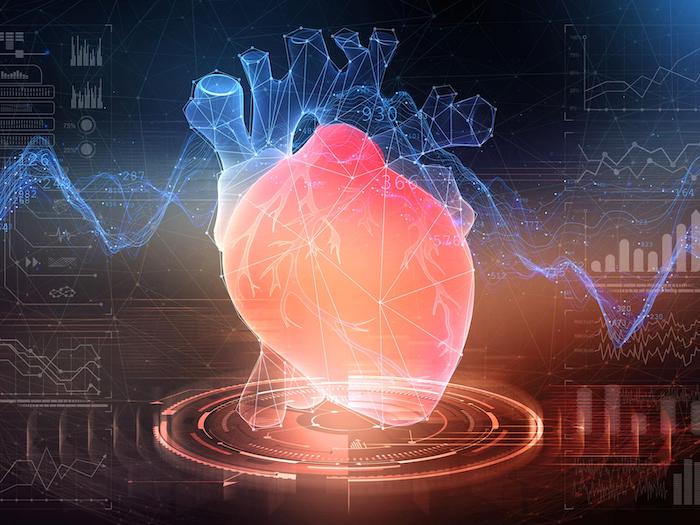
PNNL scientists working with Stanford researchers have put forth a new approach to incorporate medical knowledge into AI systems, improving the accuracy of patient diagnosis dramatically.
Artificial intelligence will never replace a doctor. However, researchers at the Department of Energy’s Pacific Northwest National Laboratory have taken a big step toward the day when AI can help physicians predict medical events. A new approach developed by PNNL scientists improves the accuracy of patient diagnosis up to 20 percent when compared to other embedding approaches.
The PNNL approach seeks to capture and recreate the types of connections physicians do naturally when they apply a lifetime of learning and knowledge to the patient standing in front of them in the exam room. The goal: Use the laboratory’s robust AI capabilities in machine learning and deep learning to improve patient care and save lives.
PNNL scientists recently discussed their new approach in a paper presented at the Data Science for Healthcare workshop at the SIGKDD Conference on Knowledge Discovery and Data Mining.
At the heart of the development is a data set PNNL created in collaboration with Stanford University of over 300,000 medical concepts defined by SNOMED Clinical Terms, a collection of standard medical terms, codes, synonyms and definitions used by medical researchers and practitioners. PNNL developed a graph-based learning method grounded on these terms that outperformed current models. The code is available as an open-source download.
“If you think it’s hard translating doctors’ handwriting, try translating their medical knowledge into computer speak,” observes Robert Rallo, a computer scientist at PNNL who leads the PNNL team applying artificial intelligence to health care. “The tough part is combining multiple types of data. Computer-friendly data like blood work numbers or diagnosis codes are easier than unstructured data like chart notes or images from X-rays or MRIs.”
Rallo and the rest of the PNNL team are creating ways to fuse the many different types of health care data with an AI tool known as a knowledge graph as part of the PNNL-funded project Deep Care.
“A knowledge graph is what doctors have in their minds when they are diagnosing you,” said Rallo. “Doctors see relationships based on years of training and experience. This is their mental model that creates links between symptoms and diseases. We are translating a symbolic representation of medical knowledge like that into something we can feed to machine-learning algorithms together with patient data.”
PNNL computer scientist Khushbu Agarwal stresses AI will not replace doctors. Instead, AI will be a decision support tool. The models will have access to more data and more connections than can be stored in any human brain. Far more than a database, the models may even detect connections a doctor observing a set of random symptoms may not consider initially. But doctors shouldn’t be expected to take the output of a model at face value. Sutanay Choudhury, a computer scientist at PNNL, is focused on the interpretability of these models. He is working to build a tool that can explain its reasoning, predictions and recommendations using understandable examples that doctors will interpret. Such explanations increase trust in the model, which the PNNL team envisions will someday be deployed at medical clinics.
As part of the next phase of its research, the PNNL team is working with a new data set as part of a collaboration between the Veterans Administration and the Department of Energy. The VA-DOE Big Data Science Initiative created a secure computing environment for analyses of medical data and includes new approaches to study suicide, cardiovascular disease and prostate cancer.
About PNNL
Pacific Northwest National Laboratory draws on signature capabilities in chemistry, Earth sciences, and data analytics to advance scientific discovery and create solutions to the nation’s toughest challenges in energy resiliency and national security. Founded in 1965, PNNL is operated by Battelle for the U.S. Department of Energy’s Office of Science. DOE’s Office of Science is the single largest supporter of basic research in the physical sciences in the United States and is working to address some of the most pressing challenges of our time. For more information, visit PNNL’s News Center. Follow us on Facebook, LinkedIn, and Twitter.
Looking for opportunity to join AI team at PNNL.
Two things. 1. You ought to be thinking about how to graft emotional intelligence into those without
lineage of emotionally mature parenting……I could.
2. Feeding starving people in Africa doesn’t improve their quality of life w/o teaching them how
to do it themselves w/o taking advantage of them.
3. I applaud your work. It’s almost as good as mapping “what really happens.” 😉
4. Implicit within actions are the future……it would be nice to roll a couple of nice futures
into some ordinary actions. Peoples’ minds are as ants crawling on a Mobius strip w/no
idea as to how to make a direct step w/o taking the journey directly….seeing the two sides
simultaneously…..you bore me.