Researchers at the Korea Institute of Materials Science (KIMS) have developed a ceramic membrane manufacturing process that operates effectively at 2 bar, five times lower pressure than conventional nanofiltration systems, while achieving 99.8% dye removal with selective salt permeability. This technology combines novel mutual doping and co-sintering techniques to address the limitations of conventional water-treatment membranes, which typically require high energy consumption and complex processing. The team published their research in the Journal of Membrane Science.
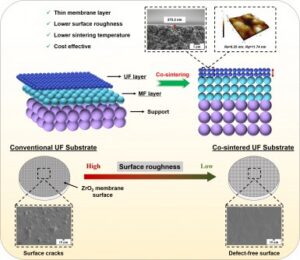
Development of defect-controlled ultra-flat ceramic membrane fabrication technology using a co-sintering process. Credit: KIMS
Ceramic membranes are essential materials for water treatment in extreme environments due to their chemical and thermal stability, with applications including industrial wastewater treatment, seawater desalination and the production of ultrapure water for semiconductor processes.
However, conventional manufacturing methods require complex processes involving repeated coating of multiple membrane layers onto the substrate followed by high-temperature sintering, resulting in significant energy consumption. In addition, surface roughness generated during these processes frequently causes microcracks in the upper separation layer, leading to performance degradation. Furthermore, nanofiltration membranes typically operate only under high pressure, around 10 bar, which increases operating costs and limits their industrial applicability.
Process innovation cuts energy
The KIMS team’s approach centers on two complementary techniques: mutual doping, which enhances interparticle bonding by mixing particles across membrane layers, and co-sintering, which fires all layers simultaneously rather than sequentially. This integrated process reduced sintering temperatures from 1,300°C to approximately 1,000°C while improving particle sinterability. Critical to the performance gains was a dramatic reduction in surface roughness, from 24.49 nm to 11.74 nm, which fundamentally suppresses microcrack formation in the separation layer.
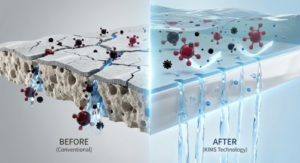
Development of an ultra-flat, defect-free nanofiltration membrane fabrication technology that eliminates surface roughness and cracks. Credit: KIMS
In addition, the research team secured a zirconia (ZrO₂)-based loose nanofiltration membrane material technology capable of delivering high separation performance even under low-pressure conditions. By coating an aqueous zirconia solution onto the smooth substrate formed through the mutual doping process, they produced a membrane in which both size-exclusion effects from fine pores and electrostatic repulsion operate simultaneously. This membrane removes more than 99.8% of dyes from dye-containing wastewater while selectively allowing salt ions to pass through, even at low pressures comparable to tap-water conditions (2 bar).
Next-generation water-treatment applications
The technology resolves the long-standing challenge of separating ions and dyes, a limitation of conventional commercial membranes, expanding water treatment from simple contaminant removal to resource recovery. The high water permeability significantly improves processing efficiency, while the chemical stability of ceramics and strong flux recovery characteristics enhance both membrane lifetime and economic viability.
The technology can be applied to fields requiring highly precise water purification, such as the treatment of dyeing wastewater in the textile industry and the production of ultrapure water for semiconductor processes. In particular, its high-efficiency operation makes it possible to significantly reduce energy costs and carbon emissions in large-scale water treatment plants. By securing core technologies in the ceramic membrane market, a field traditionally led by advanced countries, the innovation is expected to lessen dependence on imports and expand its application as a strategic technology for responding to global environmental regulations.
“The significance of this work lies in securing both low-pressure-operable material technology and a manufacturing process capable of implementing it without defects,” said Hong-Ju Lee, Senior Researcher and principal investigator at KIMS, “We will continue our efforts not only to localize high-value ceramic membranes that have been entirely import-dependent, but also to advance this technology toward leading the global market in the future.”
The research team is currently focusing on scale-up studies for large-area ceramic membrane fabrication and mass production based on the secured technology, and has completed domestic and international patent filings for the core technologies involved. Moving forward, they plan to verify industrial applicability through pilot-scale demonstrations and pursue technology transfer to relevant companies.