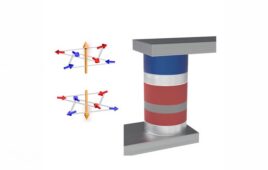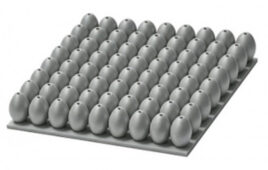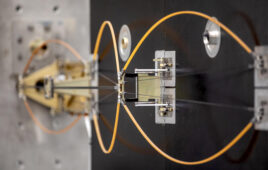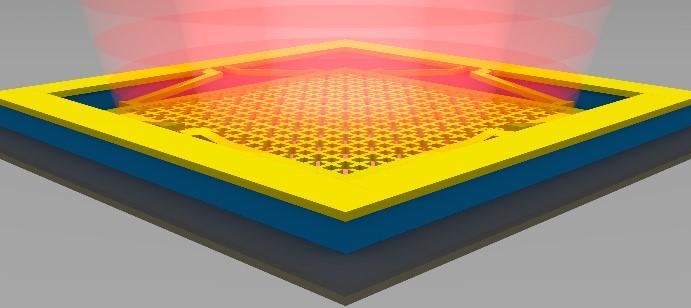
This illustration shows the room temperature MEMS metamaterial, which can achieve reconfigurable infrared intensities equivalent to a temperature change of nearly 20 degrees Celsius. Source: Xinyu Liu, Duke University
A new reconfigurable device that emits patterns of thermal infrared light in a fully controllable manner could one day make it possible to collect waste heat at infrared wavelengths and turn it into usable energy.
The new technology could be used to improve thermophotovoltaics, a type of solar cell that uses infrared light, or heat, rather than the visible light absorbed by traditional solar cells. Scientists have been working to create thermophotovoltaics that are practical enough to harvest the heat energy found in hot areas, such as around furnaces and kilns used by the glass industry. They could also be used to turn heat coming from vehicle engines into energy to charge a car battery, for example.
“Because the infrared energy emission, or intensity, is controllable, this new infrared emitter could provide a tailored way to collect and use energy from heat,” said Willie J. Padilla of Duke University, North Carolina. “There is a great deal of interest in utilizing waste heat, and our technology could improve this process.”
The new device is based on metamaterials, synthetic materials that exhibit exotic properties not available from natural materials. Padilla and doctoral student Xinyu Liu used a metamaterial engineered to absorb and emit infrared wavelengths with very high efficiency. By combining it with the electronically controlled movement available from microelectromechanical systems (MEMS), the researchers created the first metamaterial device with infrared emission properties that can be quickly changed on a pixel-by-pixel basis.
As reported in The Optical Society’s journal for high impact research, Optica, the new infrared-emitting device consists of an 8 × 8 array of individually controllable pixels, each measuring 120 X 120 microns. They demonstrated the MEMS metamaterial device by creating a “D” that is visible with an infrared camera.
The researchers report that their infrared emitter can achieve a range of infrared intensities and can display patterns at speeds of up to 110 kHz, or more than 100,000 times per second. Scaling up the technology could allow it to be used to create dynamic infrared patterns for friend or foe identification during combat.
No heat involved
In contrast to methods typically used to achieve variable infrared emission, the new technology emits tunable infrared energies without any change in temperature. Since the material is neither heated nor cooled, the device can be used at room temperature while other methods require high operating temperatures. Although experiments with natural materials have been successful at room-temperature, they are limited to narrow infrared spectral ranges.
“In addition to allowing room-temperature operation, using metamaterials makes it simple to scale throughout the infrared wavelength range and into the visible or lower frequencies,” said Padilla. “This is because the device’s properties are achieved by the geometry, not by the chemical nature of the constituent materials that we’re using.”
The new reconfigurable infrared emitter consists of a movable top layer of patterned metallic metamaterial and a bottom metallic layer that remains stationary. The device absorbs infrared photons and emits them with high efficiency when the two layers are touching but emits less infrared energy when the two layers are apart. An applied voltage controls the movement of the top layer, and the amount of infrared energy emitted depends on the exact voltage applied.
Dynamic infrared emission
Using an infrared camera, the researchers demonstrated that they could dynamically modify the number of infrared photons coming off the surface of the MEMS metamaterial over a range of intensities equivalent to a temperature change of nearly 20 degrees Celsius.
The researchers say that they could modify the metamaterial patterns used in the top layer to create different colored infrared pixels that would be each be tunable in intensity. This could allow the creation of infrared pixels that are similar to the RGB pixels used in a TV. They are now working to scale up the technology by making a device with more pixels — as many as 128 X 128 — and increasing the size of the pixels.
“In principle, an approach similar to ours could be used to create many kinds of dynamic effects from reconfigurable metamaterials,” said Padilla. “This could be used to achieve a dynamic infrared optical cloak or a negative refractive index in the infrared, for example.”