Research & Development World

  • R&D World Home
  • Topics
    • Aerospace
    • Automotive
    • Biotech
    • Careers
    • Chemistry
    • Environment
    • Energy
    • Life Science
    • Material Science
    • R&D Management
    • Physics
  • Technology
    • 3D Printing
    • A.I./Robotics
    • Software
    • Battery Technology
    • Controlled Environments
      • Cleanrooms
      • Graphene
      • Lasers
      • Regulations/Standards
      • Sensors
    • Imaging
    • Nanotechnology
    • Scientific Computing
      • Big Data
      • HPC/Supercomputing
      • Informatics
      • Security
    • Semiconductors
  • R&D Market Pulse
  • R&D 100
    • 2026 R&D 100 Award Winners
    • 2026 Professional Award Winners
    • 2026 Special Recognition Winners
    • R&D 100 Awards Event
    • R&D 100 Submissions
    • Winner Archive
  • Resources
    • Research Reports
    • Digital Issues
    • Educational Assets
    • Subscribe
    • Video
    • Webinars
    • PharmSci360
    • Content submission guidelines for R&D World
  • Global Funding Forecast
  • Top Labs
  • Advertisers
    • Advertise
    • PR Submissions
    • Eblast Submissions
  • SUBSCRIBE

New Kinds of Metallic Glass Created with Shrinking Technique

By William Weir, Yale University | December 8, 2017

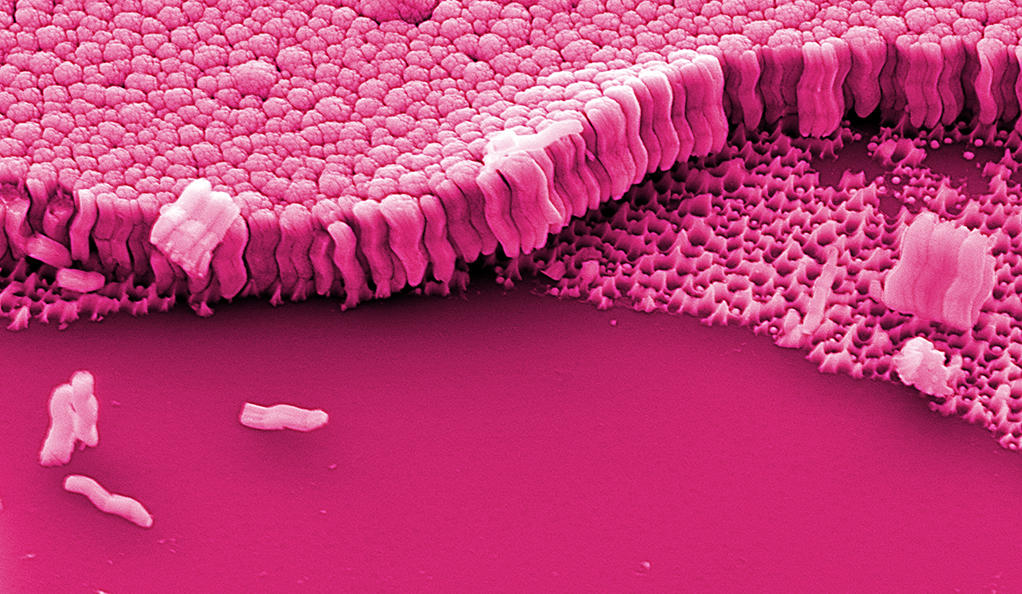
Yale researchers have discovered a method for creating a new kind of metallic glass, a class of materials made from complex alloys.

By shrinking samples of metallic glass to nanoscale size, Yale researchers have discovered they can create new materials with potentially new applications.

The research, published in Nature Communications, was conducted as part of Yale’s Center for Research on Interface Structures and Phenomena (CRISP), and led by Judy Cha, the Carol and Douglas Melamed Assistant Professor of Mechanical Engineering & Materials Science, and Jan Schroers, professor of mechanical engineering & materials science.

Metallic glasses are a relatively new class of materials made from complex, multicomponent alloys. They have the moldable pliability of plastics, but the strengths of metals. When metallic glasses cool from a liquid to a solid, their atoms settle into a random arrangement and do not crystallize the way traditional metals do. Cha said they discovered a new form of metallic glasses by making metallic-glass rods so small that there is no room for the nuclei — a phenomenon the researchers call “nucleus starvation” — leading to a new crystalline phase. The rods are less than 35 nanometers in diameter, more than 2,000 times smaller than a human hair.

“This gives us a handle to control the number of nuclei we provide in the sample,” says Cha, who works in the Energy Sciences Institute on Yale’s West Campus. “When it doesn’t have any nuclei — despite the fact that nature tells us that there should be one — it generates this brand new crystalline phase that we’ve never seen before. It’s a way to create a new material out of the old.”

The researchers used the Transmission Electron Microscope at the Yale Institute for Nanoscience and Quantum Engineering to observe the crystallization process in the materials. By controlling the diameter of the metallic-glass nanorods, the researchers were able to tune the number of nuclei present and tailor the crystalline phases.

“As we were doing this, more and more interesting phenomena popped up,” Cha says. “We’re unearthing all these interesting phenomena that occur at the nanoscale.”

Metallic glasses are already being used for a number of applications, including phone casings and golf clubs, but there is still much for researchers to learn about these materials. Cha says one of the next steps is to learn more about this new crystalline phase, how to better control it, and what kinds of properties can result from it. The discovery also opens up new possibilities for different chemical compounds that have already been developed by conventional methods, she says.

“We don’t really know a lot about these systems, and when we work with them in smaller, nanometer scales, then a new science and a new physics emerge,” she says. “That’s exciting because it tells us that there are these new playgrounds emerging that we simply haven’t paid much attention to before, and that there is still more to be explored.”

The study’s other authors are Sungwoo Sohn, Yujun Xie, and Yeonwoong Jung, all from Yale.

Source: Yale University

Related Articles Read More >

Researchers developed quantum nanosensors that can measure the temperature of a single cell
Overcoming the 100-nanometer barrier: New microbottle resonators scale up optical trapping
R&D 100 winner LLNL achieves 1,000x speed boost in 3D nanofabrication
CEA-Leti achieves 400°C CMOS fabrication milestone for 3D chip stacking
rd newsletter
EXPAND YOUR KNOWLEDGE AND STAY CONNECTED
Get the latest info on technologies, trends, and strategies in Research & Development.

R&D World Digital Issues

Fall 2026 issue

Browse the most current issue of R&D World and back issues in an easy to use high quality format. Clip, share and download with the leading R&D magazine today.

R&D 100 Awards
Research & Development World
  • Subscribe to R&D World Magazine
  • Sign up for R&D World’s newsletter
  • Contact Us
  • About Us
  • Drug Discovery & Development
  • Pharmaceutical Processing
  • Global Funding Forecast

Copyright © 2026 Arrowfly LLC. All Rights Reserved. The material on this site may not be reproduced, distributed, transmitted, cached or otherwise used, except with the prior written permission of Arrowfly
Privacy Policy | Advertising | About Us

Search R&D World

  • R&D World Home
  • Topics
    • Aerospace
    • Automotive
    • Biotech
    • Careers
    • Chemistry
    • Environment
    • Energy
    • Life Science
    • Material Science
    • R&D Management
    • Physics
  • Technology
    • 3D Printing
    • A.I./Robotics
    • Software
    • Battery Technology
    • Controlled Environments
      • Cleanrooms
      • Graphene
      • Lasers
      • Regulations/Standards
      • Sensors
    • Imaging
    • Nanotechnology
    • Scientific Computing
      • Big Data
      • HPC/Supercomputing
      • Informatics
      • Security
    • Semiconductors
  • R&D Market Pulse
  • R&D 100
    • 2026 R&D 100 Award Winners
    • 2026 Professional Award Winners
    • 2026 Special Recognition Winners
    • R&D 100 Awards Event
    • R&D 100 Submissions
    • Winner Archive
  • Resources
    • Research Reports
    • Digital Issues
    • Educational Assets
    • Subscribe
    • Video
    • Webinars
    • PharmSci360
    • Content submission guidelines for R&D World
  • Global Funding Forecast
  • Top Labs
  • Advertisers
    • Advertise
    • PR Submissions
    • Eblast Submissions
  • SUBSCRIBE