Research & Development World

  • R&D World Home
  • Topics
    • Aerospace
    • Automotive
    • Biotech
    • Careers
    • Chemistry
    • Environment
    • Energy
    • Life Science
    • Material Science
    • R&D Management
    • Physics
  • Technology
    • 3D Printing
    • A.I./Robotics
    • Software
    • Battery Technology
    • Controlled Environments
      • Cleanrooms
      • Graphene
      • Lasers
      • Regulations/Standards
      • Sensors
    • Imaging
    • Nanotechnology
    • Scientific Computing
      • Big Data
      • HPC/Supercomputing
      • Informatics
      • Security
    • Semiconductors
  • R&D Market Pulse
  • R&D 100
    • 2026 R&D 100 Award Winners
    • 2026 Professional Award Winners
    • 2026 Special Recognition Winners
    • R&D 100 Awards Event
    • R&D 100 Submissions
    • Winner Archive
  • Resources
    • Research Reports
    • Digital Issues
    • Educational Assets
    • Subscribe
    • Video
    • Webinars
    • PharmSci360
    • Content submission guidelines for R&D World
  • Global Funding Forecast
  • Top Labs
  • Advertise
  • SUBSCRIBE

New material captures and releases CO2 in response to visible light

By Julia Rock-Torcivia | February 19, 2026

Researchers in the Netherlands, Italy and Poland have developed a new porous material that can selectively capture carbon dioxide and release it in response to visible light. Their work was published in PNAS last month. 
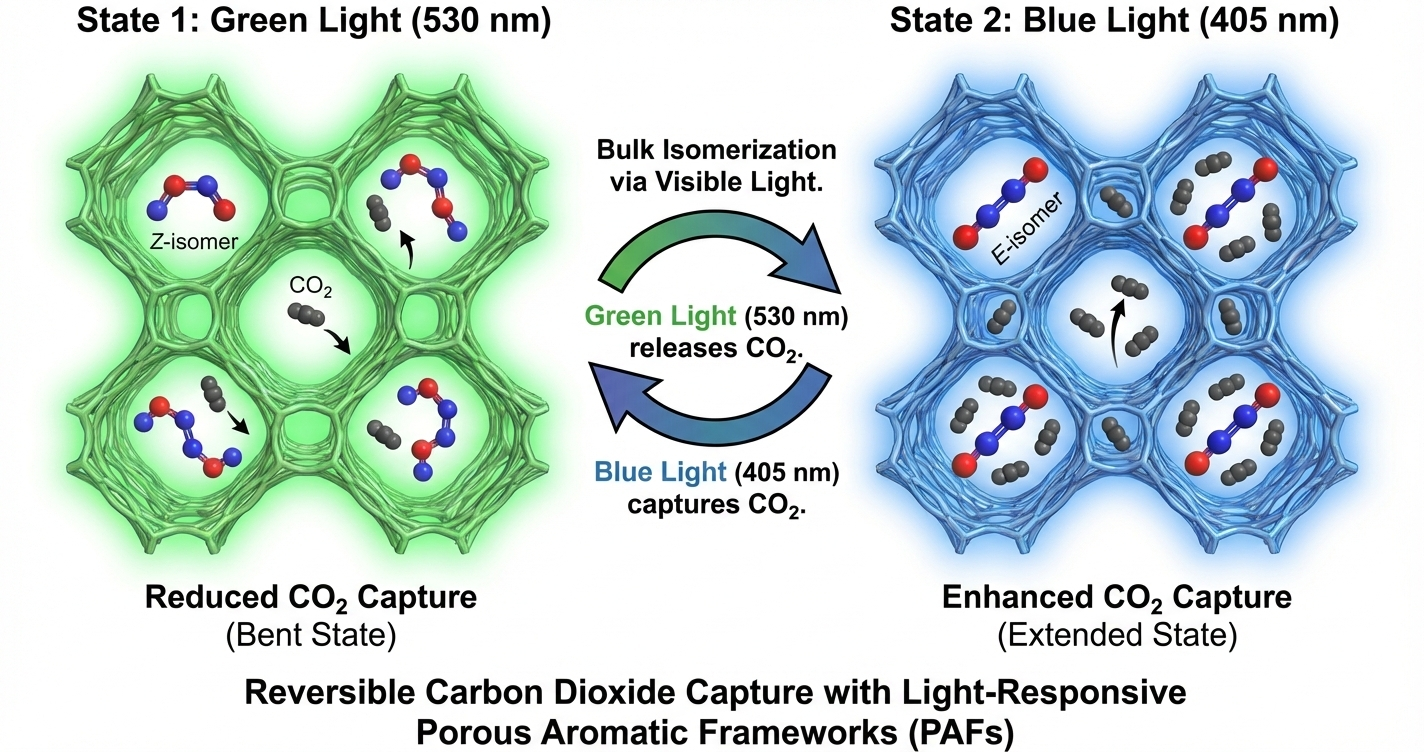
Created with Gemini

The work combines porous framework materials and light-responsive functional groups. Ben Feringa, who shared the 2016 chemistry Nobel Prize, and his team used 3D structures held together by rigid carbon-carbon bonds called porous aromatic frameworks (PAFs). PAFs are made through irreversible chemical reactions, making them almost impossible to destroy. 

The team created the first azobenzene-containing porous material that shows bulk isomerization with exposure to visible light. The material switches between the E isomer, an extended configuration, and the Z isomer, a bent configuration. 

The researchers found that irradiating the material with green light (530 nm) caused the pendant group of o-fluoroazobenzene to transform almost entirely from the E isomer to the Z isomer. In this state, the structure adsorbed up to 14% less carbon dioxide than its E isomer. Irradiation with blue light (405 nm) returned the groups to the E isomer and restored the carbon-capture capacity. 

Other azobenzene-containing porous materials have only shown photoswitching on their surface, making this the first to show the switching throughout the material. The researchers used a combination of diffuse-reflectance UV/Vis, DRIFT spectroscopy and solid-state NMR spectroscopy to quantify the bulk photoisomerization. 

Previously, most photoresponsive materials have required UV light, which causes the material to degrade. This system works with low-energy visible light, offering better penetration, safer operation and does not degrade the material. 

Traditional porous materials are manipulated with temperature rather than light. This makes the transformation process much slower, as it can take hours for a material to cool down or heat up. Being able to manipulate the carbon capacity of the material with light makes the transformation almost instantaneous. 

This new material could have applications in carbon capture, photochemical manipulation of reactions, separation technology and catalysis. 
Related Articles Read More >

The Space Systems Division (05)-developed Parallelogram Synchronized Truss Assembly (PaSTA), seen Aug. 12, 2025, is a mechanism that will be integrated into the Life-Extension In-orbit Servicer (LEXI) and Astroscale Prototype Servicer for Refueling (APS-R) spacecrafts.
One SwRI R&D 100 winner turns buckled fiberglass into a spacecraft truss. The other models freight rail with 900 hours of BNSF field data
Researchers develop sawdust-based foam as polystyrene bans force industry to adapt
Researchers develop compostable PLA that potentially could be used for biomedical applications
Elkem Silicones rebrands as Bluestar Silicones after ownership change
rd newsletter
EXPAND YOUR KNOWLEDGE AND STAY CONNECTED
Get the latest info on technologies, trends, and strategies in Research & Development.

R&D World Digital Issues

Fall 2025 issue

Browse the most current issue of R&D World and back issues in an easy to use high quality format. Clip, share and download with the leading R&D magazine today.

R&D 100 Awards
Research & Development World
  • Subscribe to R&D World Magazine
  • Sign up for R&D World’s newsletter
  • Contact Us
  • About Us
  • Drug Discovery & Development
  • Pharmaceutical Processing
  • Global Funding Forecast

Copyright © 2026 Arrowfly LLC. All Rights Reserved. The material on this site may not be reproduced, distributed, transmitted, cached or otherwise used, except with the prior written permission of Arrowfly
Privacy Policy | Advertising | About Us

Search R&D World

  • R&D World Home
  • Topics
    • Aerospace
    • Automotive
    • Biotech
    • Careers
    • Chemistry
    • Environment
    • Energy
    • Life Science
    • Material Science
    • R&D Management
    • Physics
  • Technology
    • 3D Printing
    • A.I./Robotics
    • Software
    • Battery Technology
    • Controlled Environments
      • Cleanrooms
      • Graphene
      • Lasers
      • Regulations/Standards
      • Sensors
    • Imaging
    • Nanotechnology
    • Scientific Computing
      • Big Data
      • HPC/Supercomputing
      • Informatics
      • Security
    • Semiconductors
  • R&D Market Pulse
  • R&D 100
    • 2026 R&D 100 Award Winners
    • 2026 Professional Award Winners
    • 2026 Special Recognition Winners
    • R&D 100 Awards Event
    • R&D 100 Submissions
    • Winner Archive
  • Resources
    • Research Reports
    • Digital Issues
    • Educational Assets
    • Subscribe
    • Video
    • Webinars
    • PharmSci360
    • Content submission guidelines for R&D World
  • Global Funding Forecast
  • Top Labs
  • Advertise
  • SUBSCRIBE