Research & Development World

  • R&D World Home
  • Topics
    • Aerospace
    • Automotive
    • Biotech
    • Careers
    • Chemistry
    • Environment
    • Energy
    • Life Science
    • Material Science
    • R&D Management
    • Physics
  • Technology
    • 3D Printing
    • A.I./Robotics
    • Software
    • Battery Technology
    • Controlled Environments
      • Cleanrooms
      • Graphene
      • Lasers
      • Regulations/Standards
      • Sensors
    • Imaging
    • Nanotechnology
    • Scientific Computing
      • Big Data
      • HPC/Supercomputing
      • Informatics
      • Security
    • Semiconductors
  • R&D Market Pulse
  • R&D 100
    • 2025 R&D 100 Award Winners
    • 2025 Professional Award Winners
    • 2025 Special Recognition Winners
    • R&D 100 Awards Event
    • R&D 100 Submissions
    • Winner Archive
  • Resources
    • Research Reports
    • Digital Issues
    • Educational Assets
    • R&D Index
    • Subscribe
    • Video
    • Webinars
    • Content submission guidelines for R&D World
  • Global Funding Forecast
  • Top Labs
  • Advertise
  • SUBSCRIBE

New Robot Has a Human Touch

By Cornell University | December 13, 2016

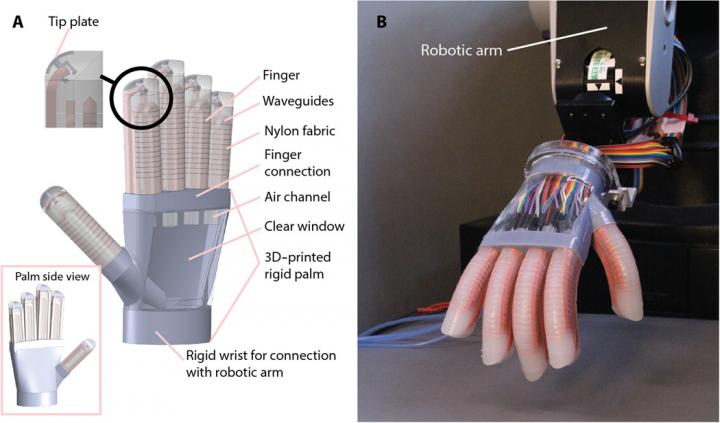
(A) Schematic of hand structure and components; (B) image of the fabricated hand mounted on a robotic arm with each finger actuated at ΔP = 100 kPa. Source: Cornell University

Most robots achieve grasping and tactile sensing through motorized means, which can be excessively bulky and rigid. A Cornell University group has devised a way for a soft robot to feel its surroundings internally, in much the same way humans do.

A group led by Robert Shepherd, assistant professor of mechanical and aerospace engineering and principal investigator of Organic Robotics Lab, has published a paper describing how stretchable optical waveguides act as curvature, elongation and force sensors in a soft robotic hand.

Doctoral student Huichan Zhao is lead author of “Optoelectronically Innervated Soft Prosthetic Hand via Stretchable Optical Waveguides,” which is featured in the debut edition of Science Robotics.

“Most robots today have sensors on the outside of the body that detect things from the surface,” Zhao said. “Our sensors are integrated within the body, so they can actually detect forces being transmitted through the thickness of the robot, a lot like we and all organisms do when we feel pain, for example.”

Optical waveguides have been in use since the early 1970s for numerous sensing functions, including tactile, position and acoustic. Fabrication was originally a complicated process, but the advent over the last 20 years of soft lithography and 3-D printing has led to development of elastomeric sensors that are easily produced and incorporated into a soft robotic application.

Shepherd’s group employed a four-step soft lithography process to produce the core (through which light propagates), and the cladding (outer surface of the waveguide), which also houses the LED (light-emitting diode) and the photodiode.

The more the prosthetic hand deforms, the more light is lost through the core. That variable loss of light, as detected by the photodiode, is what allows the prosthesis to “sense” its surroundings.

“If no light was lost when we bend the prosthesis, we wouldn’t get any information about the state of the sensor,” Shepherd said. “The amount of loss is dependent on how it’s bent.”

The group used its optoelectronic prosthesis to perform a variety of tasks, including grasping and probing for both shape and texture. Most notably, the hand was able to scan three tomatoes and determine, by softness, which was the ripest.

Related Articles Read More >

Lab automation didn’t replace technicians: It split them in two
Maryland set for first subsea internet cable: AWS’s 320+ Tbps “Fastnet” to Ireland
CSIRO, MLA and Google host global competition
Meta Logo
Meta cuts 600 AI roles months after reports of $100M+ offers to top recruits
rd newsletter
EXPAND YOUR KNOWLEDGE AND STAY CONNECTED
Get the latest info on technologies, trends, and strategies in Research & Development.
RD 25 Power Index

R&D World Digital Issues

Fall 2024 issue

Browse the most current issue of R&D World and back issues in an easy to use high quality format. Clip, share and download with the leading R&D magazine today.

Research & Development World
  • Subscribe to R&D World Magazine
  • Sign up for R&D World’s newsletter
  • Contact Us
  • About Us
  • Drug Discovery & Development
  • Pharmaceutical Processing
  • Global Funding Forecast

Copyright © 2025 WTWH Media LLC. All Rights Reserved. The material on this site may not be reproduced, distributed, transmitted, cached or otherwise used, except with the prior written permission of WTWH Media
Privacy Policy | Advertising | About Us

Search R&D World

  • R&D World Home
  • Topics
    • Aerospace
    • Automotive
    • Biotech
    • Careers
    • Chemistry
    • Environment
    • Energy
    • Life Science
    • Material Science
    • R&D Management
    • Physics
  • Technology
    • 3D Printing
    • A.I./Robotics
    • Software
    • Battery Technology
    • Controlled Environments
      • Cleanrooms
      • Graphene
      • Lasers
      • Regulations/Standards
      • Sensors
    • Imaging
    • Nanotechnology
    • Scientific Computing
      • Big Data
      • HPC/Supercomputing
      • Informatics
      • Security
    • Semiconductors
  • R&D Market Pulse
  • R&D 100
    • 2025 R&D 100 Award Winners
    • 2025 Professional Award Winners
    • 2025 Special Recognition Winners
    • R&D 100 Awards Event
    • R&D 100 Submissions
    • Winner Archive
  • Resources
    • Research Reports
    • Digital Issues
    • Educational Assets
    • R&D Index
    • Subscribe
    • Video
    • Webinars
    • Content submission guidelines for R&D World
  • Global Funding Forecast
  • Top Labs
  • Advertise
  • SUBSCRIBE