Research & Development World

  • R&D World Home
  • Topics
    • Aerospace
    • Automotive
    • Biotech
    • Careers
    • Chemistry
    • Environment
    • Energy
    • Life Science
    • Material Science
    • R&D Management
    • Physics
  • Technology
    • 3D Printing
    • A.I./Robotics
    • Software
    • Battery Technology
    • Controlled Environments
      • Cleanrooms
      • Graphene
      • Lasers
      • Regulations/Standards
      • Sensors
    • Imaging
    • Nanotechnology
    • Scientific Computing
      • Big Data
      • HPC/Supercomputing
      • Informatics
      • Security
    • Semiconductors
  • R&D Market Pulse
  • R&D 100
    • 2026 R&D 100 Award Winners
    • 2026 Professional Award Winners
    • 2026 Special Recognition Winners
    • R&D 100 Awards Event
    • R&D 100 Submissions
    • Winner Archive
  • Resources
    • Research Reports
    • Digital Issues
    • Educational Assets
    • Subscribe
    • Video
    • Webinars
    • PharmSci360
    • Content submission guidelines for R&D World
  • Global Funding Forecast
  • Top Labs
  • Advertisers
    • Advertise
    • PR Submissions
    • Eblast Submissions
  • SUBSCRIBE

New solar cells serve free lunch

By R&D Editors | September 24, 2014

Professor Qi and members of his research unit developed a hybrid deposition method to produce perovskite solar cells. The new, semi-transparent design for solar cells could allow windows to generate energy from the sun.One of the most common complaints about solar power is solar panels are still too expensive to be worth the investment. Many researchers have responded by making solar cells, the tile-like components of solar panels that absorb and transfer energy, more efficient and longer lasting. But even the longest living solar cells that most effectively convert sunlight to energy will not become common if they are prohibitively expensive. Therefore, Professor Yabing Qi, the head of the Energy Materials and Surface Sciences Unit at the Okinawa Institute of Science and Technology Graduate University, has a different idea: make solar cells using a type of semiconductor called perovskite materials, which are, in Qi’s words, “dirt cheap.” If solar cells are cheap enough, Qi reasons that people will want to use them for the immediate payback in energy savings. Now Professor Qi and members of his research unit have developed a new method for making perovskite solar cells worthy of attention, and The Royal Society of Chemistry published their findings September 5, 2014 in their journal, Energy & Environmental Science.

Qi’s new method uses what he calls hybrid deposition to create perovskite solar cells, made from a mixture of inexpensive organic and inorganic raw materials. In addition, his solar cell is about a thousand times thinner than a silicon solar cell, and therefore uses far less material. Qi estimates that for the same price, he could either buy raw materials to build 1,000-m2 of his solar cell, or he could buy about 20 wafers of crystallized silicon, to build 0.16-m2 of traditional solar panels. “Silicon is not rare,” Qi explains, “but processing silicon requires expensive equipment and sophisticated steps demanding high temperature, vacuum, or high pressure, and that makes crystallized silicon very expensive.” In contrast, the hybrid deposition process uses less energy to produce a solar cell at a far lower temperature. In fact, Qi envisions manufacturing the new solar cells using a low-cost printing process. The process would deposit the materials onto thin sheets of PET plastic very quickly to make large quantities of cheap solar cells. Qi does not yet know the limits of his hybrid cells, but optimists in his field hope that they could reach 20% efficiency. This means that that the solar cells will convert 20% of the energy they absorb from the sun into usable energy, which is comparable to the best silicon solar panels on the market.

The extremely thin perovskite cell that Qi and his lab designed measures merely 135 nm and reaches an efficiency of 9.9%. Because these films are semitransparent, Qi hopes to use them on windows, as a sort of lightweight set of blinds. “It will be a window and at the same time it will be a solar cell,” he says. “Some of the light could go through and the rest will be absorbed. Then, a certain percentage of the absorbed light will be converted to electricity.”

If solar cells are cheap enough, consumers will reap almost immediate benefits even if the solar cells are not the most efficient, because their savings on air conditioning and electricity will offset the expense.  “If it’s so cheap that it is like wallpaper, then you might as well use it,” said Qi. “It’s like a free gift. It’s an investment with a lot of payback.”
Fabrication of semi-transparent perovskite films with centimeter-scale superior uniformity by the hybrid deposition method

Source: Okinawa Institute of Science and Technology

Related Articles Read More >

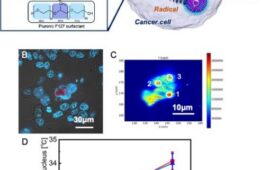
Researchers developed quantum nanosensors that can measure the temperature of a single cell
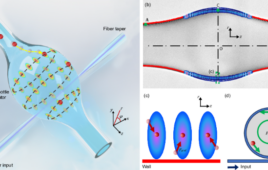
Overcoming the 100-nanometer barrier: New microbottle resonators scale up optical trapping
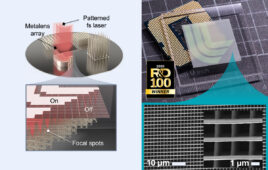
R&D 100 winner LLNL achieves 1,000x speed boost in 3D nanofabrication
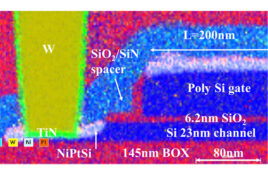
CEA-Leti achieves 400°C CMOS fabrication milestone for 3D chip stacking
rd newsletter
EXPAND YOUR KNOWLEDGE AND STAY CONNECTED
Get the latest info on technologies, trends, and strategies in Research & Development.

R&D World Digital Issues

Fall 2026 issue

Browse the most current issue of R&D World and back issues in an easy to use high quality format. Clip, share and download with the leading R&D magazine today.

R&D 100 Awards
Research & Development World
  • Subscribe to R&D World Magazine
  • Sign up for R&D World’s newsletter
  • Contact Us
  • About Us
  • Drug Discovery & Development
  • Pharmaceutical Processing
  • Global Funding Forecast

Copyright © 2026 Arrowfly LLC. All Rights Reserved. The material on this site may not be reproduced, distributed, transmitted, cached or otherwise used, except with the prior written permission of Arrowfly
Privacy Policy | Advertising | About Us

Search R&D World

  • R&D World Home
  • Topics
    • Aerospace
    • Automotive
    • Biotech
    • Careers
    • Chemistry
    • Environment
    • Energy
    • Life Science
    • Material Science
    • R&D Management
    • Physics
  • Technology
    • 3D Printing
    • A.I./Robotics
    • Software
    • Battery Technology
    • Controlled Environments
      • Cleanrooms
      • Graphene
      • Lasers
      • Regulations/Standards
      • Sensors
    • Imaging
    • Nanotechnology
    • Scientific Computing
      • Big Data
      • HPC/Supercomputing
      • Informatics
      • Security
    • Semiconductors
  • R&D Market Pulse
  • R&D 100
    • 2026 R&D 100 Award Winners
    • 2026 Professional Award Winners
    • 2026 Special Recognition Winners
    • R&D 100 Awards Event
    • R&D 100 Submissions
    • Winner Archive
  • Resources
    • Research Reports
    • Digital Issues
    • Educational Assets
    • Subscribe
    • Video
    • Webinars
    • PharmSci360
    • Content submission guidelines for R&D World
  • Global Funding Forecast
  • Top Labs
  • Advertisers
    • Advertise
    • PR Submissions
    • Eblast Submissions
  • SUBSCRIBE