Research & Development World

  • R&D World Home
  • Topics
    • Aerospace
    • Automotive
    • Biotech
    • Careers
    • Chemistry
    • Environment
    • Energy
    • Life Science
    • Material Science
    • R&D Management
    • Physics
  • Technology
    • 3D Printing
    • A.I./Robotics
    • Software
    • Battery Technology
    • Controlled Environments
      • Cleanrooms
      • Graphene
      • Lasers
      • Regulations/Standards
      • Sensors
    • Imaging
    • Nanotechnology
    • Scientific Computing
      • Big Data
      • HPC/Supercomputing
      • Informatics
      • Security
    • Semiconductors
  • R&D Market Pulse
  • R&D 100
    • 2026 R&D 100 Award Winners
    • 2026 Professional Award Winners
    • 2026 Special Recognition Winners
    • R&D 100 Awards Event
    • R&D 100 Submissions
    • Winner Archive
  • Resources
    • Research Reports
    • Digital Issues
    • Educational Assets
    • Subscribe
    • Video
    • Webinars
    • PharmSci360
    • Content submission guidelines for R&D World
  • Global Funding Forecast
  • Top Labs
  • Advertise
  • SUBSCRIBE

Building bones from wood

By R&D Editors | November 9, 2012

European research has investigated ways of transforming complex, organised natural products such as wood to make materials suitable for rebuilding the human skeletal system.

The metamorphosis of wood to a ceramic that is identical to the mineral part of bone tissue hydroxyapatite takes place at the molecular or nano-level. The EU-funded “New bio-ceramisation processes applied to vegetable hierarchical structures” (TEM-PLANT) project aims to develop and apply novel processes to hierarchical materials like wood to produce smart ceramics that behave like bone and ligaments.

TEM-PLANT developed several types of materials with huge practical potential. These included bone scaffolding to help bone regrowth with properties very like the real thing. There is a strong possibility that the new scaffolding concept could make an appearance in the clinic in the next 5 to 10 years.

Success has also been achieved for that all-important soft skeletal tissue. The project team have shown in vivo that natural polymers can be processed to produce regenerative scaffolds for both ligaments and tendons.

At the molecular level, TEM-PLANT has investigated the very nuts and bolts of transforming hierarchically structured materials like wood. Chemo-physical phenomena have been identified behind the self-assembling and mineralisation processes required to achieve the modification of raw materials.

For the future, these new processes have a much wider application than simply replacing human skeletal parts. Materials that possess high values for both tensile and compressive strength as well as toughness like bone are very rare. Furthermore, using the innovative techniques developed by TEM-PLANT, new materials that maintain their properties at high temperature and under mechanical stress can be produced.

TEM-PLANT has devised processes that will improve bone and ligament substitution. Wider uses of biomorphic materials include catalytic converters, space vehicles and aircraft engine parts. An added bonus is that the concepts meet up-to-date environmental and recycling requirements.

Research details at National Research Council of Italy

Source: Cordis
Related Articles Read More >

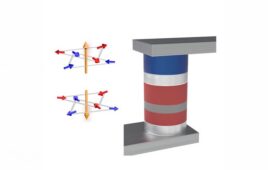
Illustration of an antiferromagnetic tunnel junction pillar beside the two spin configurations of platinum-manganese that store a bit.
Northwestern and Western Digital demonstrate a new way to write magnetic memory
Eggshell-inspired shield cut projectile speed by 65% in simulation, but light-gas gun testing has not confirmed it 
The Space Systems Division (05)-developed Parallelogram Synchronized Truss Assembly (PaSTA), seen Aug. 12, 2025, is a mechanism that will be integrated into the Life-Extension In-orbit Servicer (LEXI) and Astroscale Prototype Servicer for Refueling (APS-R) spacecrafts.
One SwRI R&D 100 winner turns buckled fiberglass into a spacecraft truss. The other models freight rail with 900 hours of BNSF field data
Researchers develop sawdust-based foam as polystyrene bans force industry to adapt
rd newsletter
EXPAND YOUR KNOWLEDGE AND STAY CONNECTED
Get the latest info on technologies, trends, and strategies in Research & Development.

R&D World Digital Issues

Fall 2026 issue

Browse the most current issue of R&D World and back issues in an easy to use high quality format. Clip, share and download with the leading R&D magazine today.

R&D 100 Awards
Research & Development World
  • Subscribe to R&D World Magazine
  • Sign up for R&D World’s newsletter
  • Contact Us
  • About Us
  • Drug Discovery & Development
  • Pharmaceutical Processing
  • Global Funding Forecast

Copyright © 2026 Arrowfly LLC. All Rights Reserved. The material on this site may not be reproduced, distributed, transmitted, cached or otherwise used, except with the prior written permission of Arrowfly
Privacy Policy | Advertising | About Us

Search R&D World

  • R&D World Home
  • Topics
    • Aerospace
    • Automotive
    • Biotech
    • Careers
    • Chemistry
    • Environment
    • Energy
    • Life Science
    • Material Science
    • R&D Management
    • Physics
  • Technology
    • 3D Printing
    • A.I./Robotics
    • Software
    • Battery Technology
    • Controlled Environments
      • Cleanrooms
      • Graphene
      • Lasers
      • Regulations/Standards
      • Sensors
    • Imaging
    • Nanotechnology
    • Scientific Computing
      • Big Data
      • HPC/Supercomputing
      • Informatics
      • Security
    • Semiconductors
  • R&D Market Pulse
  • R&D 100
    • 2026 R&D 100 Award Winners
    • 2026 Professional Award Winners
    • 2026 Special Recognition Winners
    • R&D 100 Awards Event
    • R&D 100 Submissions
    • Winner Archive
  • Resources
    • Research Reports
    • Digital Issues
    • Educational Assets
    • Subscribe
    • Video
    • Webinars
    • PharmSci360
    • Content submission guidelines for R&D World
  • Global Funding Forecast
  • Top Labs
  • Advertise
  • SUBSCRIBE