Research & Development World

  • R&D World Home
  • Topics
    • Aerospace
    • Automotive
    • Biotech
    • Careers
    • Chemistry
    • Environment
    • Energy
    • Life Science
    • Material Science
    • R&D Management
    • Physics
  • Technology
    • 3D Printing
    • A.I./Robotics
    • Software
    • Battery Technology
    • Controlled Environments
      • Cleanrooms
      • Graphene
      • Lasers
      • Regulations/Standards
      • Sensors
    • Imaging
    • Nanotechnology
    • Scientific Computing
      • Big Data
      • HPC/Supercomputing
      • Informatics
      • Security
    • Semiconductors
  • R&D Market Pulse
  • R&D 100
    • 2026 R&D 100 Award Winners
    • 2026 Professional Award Winners
    • 2026 Special Recognition Winners
    • R&D 100 Awards Event
    • R&D 100 Submissions
    • Winner Archive
  • Resources
    • Research Reports
    • Digital Issues
    • Educational Assets
    • Subscribe
    • Video
    • Webinars
    • PharmSci360
    • Content submission guidelines for R&D World
  • Global Funding Forecast
  • Top Labs
  • Advertise
  • SUBSCRIBE

Better batteries from waste sulfur

By R&D Editors | April 15, 2013

A University of Arizona-led research team has discovered a simple process for making a new lightweight plastic from the inexpensive and abundant element sulfur. The petri dish on the left contains the plastic. The yellow powder on the right is sulfur. The team has already made a lithium-sulfur battery—the type of next- generation battery that is lighter and cheaper than those currently used in electric and hybrid cars. Image: Jared Griebel/ Pyun laboratory, University of ArizonaA new chemical process can transform waste sulfur into a lightweight plastic that may improve batteries for electric cars, reports a University of Arizona-led team. The new plastic has other potential uses, including optical uses.

The team has successfully used the new plastic to make lithium-sulfur batteries.

“We’ve developed a new, simple, and useful chemical process to convert sulfur into a useful plastic,” lead researcher Jeffrey Pyun says.

Next-generation lithium-sulfur, or Li-S, batteries will be better for electric and hybrid cars and for military uses because they are more efficient, lighter, and cheaper than those currently used, says Pyun, a UA associate professor of chemistry and biochemistry.

The new plastic has great promise as something that can be produced easily and inexpensively on an industrial scale, he says.

The team’s discovery could provide a new use for the sulfur left over when oil and natural gas are refined into cleaner-burning fuels.

Although there are some industrial uses for sulfur, the amount generated from refining fossil fuels far outstrips the current need for the element. Some oil refineries, such as those in Ft. McMurray in Alberta, are accumulating yellow mountains of waste sulfur.

“There’s so much of it we don’t know what to do with it,” says Pyun. He calls the left-over sulfur “the garbage of transportation.”

About one-half pound of sulfur is left over for every 19 gallons of gasoline produced from fossil fuels, calculates co-author Jared Griebel, a UA chemistry and biochemistry doctoral candidate.

The researchers have filed an international patent for their new chemical process and for the new polymeric electrode materials for Li-S batteries.

The team’s research article is published online in Nature Chemistry.

Pyun wanted to apply his expertise as a chemist to energy-related research. He knew about the world’s glut of elemental sulfur at fossil fuel refineries—so he focused on how chemistry could use the cheap sulfur to satisfy the need for good Li-S batteries.

He and his colleagues tried something new: transforming liquid sulfur into a useful plastic that eventually could be produced easily on an industrial scale.

Sulfur poses technical challenges. It doesn’t easily form the stable long chains of molecules, known as polymers, needed make a moldable plastic, and most materials don’t dissolve in sulfur.

Pyun and his colleagues identified the chemicals most likely to polymerize sulfur and girded themselves for the long process of testing those chemicals one by one by one. More than 20 chemicals were on the list.

They got lucky.

“The first one worked—and nothing else thereafter,” Pyun says.

Even though the first experiment worked, the scientists needed to try the other chemicals on their list to see if others worked better and to understand more about working with liquid sulfur.

They’ve dubbed their process “inverse vulcanization” because it requires mostly sulfur with a small amount of an additive. Vulcanization is the chemical process that makes rubber more durable by adding a small amount of sulfur to rubber.

The new plastic performs better in batteries than elemental sulfur, Pyun says, because batteries with cathodes made of elemental sulfur can be used and recharged only a limited number of times before they fail.

The new plastic has electrochemical properties superior to those of the elemental sulfur now used in Li-S batteries, the researchers report. The team’s batteries exhibited high specific capacity (823 mAh/g at 100 cycles) and enhanced capacity retention.

Several companies have expressed interest in the new plastic and the new battery, Pyun says.

The team’s next step is comparing properties of the new plastic to existing plastics and exploring other practical applications such as photonics for the new plastic.

Source: University of Arizona
Related Articles Read More >

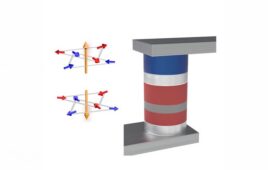
Illustration of an antiferromagnetic tunnel junction pillar beside the two spin configurations of platinum-manganese that store a bit.
Northwestern and Western Digital demonstrate a new way to write magnetic memory
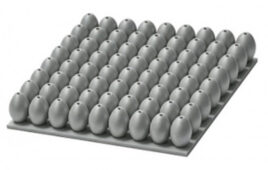
Eggshell-inspired shield cut projectile speed by 65% in simulation, but light-gas gun testing has not confirmed it 
The Space Systems Division (05)-developed Parallelogram Synchronized Truss Assembly (PaSTA), seen Aug. 12, 2025, is a mechanism that will be integrated into the Life-Extension In-orbit Servicer (LEXI) and Astroscale Prototype Servicer for Refueling (APS-R) spacecrafts.
One SwRI R&D 100 winner turns buckled fiberglass into a spacecraft truss. The other models freight rail with 900 hours of BNSF field data
Researchers develop sawdust-based foam as polystyrene bans force industry to adapt
rd newsletter
EXPAND YOUR KNOWLEDGE AND STAY CONNECTED
Get the latest info on technologies, trends, and strategies in Research & Development.

R&D World Digital Issues

Fall 2026 issue

Browse the most current issue of R&D World and back issues in an easy to use high quality format. Clip, share and download with the leading R&D magazine today.

R&D 100 Awards
Research & Development World
  • Subscribe to R&D World Magazine
  • Sign up for R&D World’s newsletter
  • Contact Us
  • About Us
  • Drug Discovery & Development
  • Pharmaceutical Processing
  • Global Funding Forecast

Copyright © 2026 Arrowfly LLC. All Rights Reserved. The material on this site may not be reproduced, distributed, transmitted, cached or otherwise used, except with the prior written permission of Arrowfly
Privacy Policy | Advertising | About Us

Search R&D World

  • R&D World Home
  • Topics
    • Aerospace
    • Automotive
    • Biotech
    • Careers
    • Chemistry
    • Environment
    • Energy
    • Life Science
    • Material Science
    • R&D Management
    • Physics
  • Technology
    • 3D Printing
    • A.I./Robotics
    • Software
    • Battery Technology
    • Controlled Environments
      • Cleanrooms
      • Graphene
      • Lasers
      • Regulations/Standards
      • Sensors
    • Imaging
    • Nanotechnology
    • Scientific Computing
      • Big Data
      • HPC/Supercomputing
      • Informatics
      • Security
    • Semiconductors
  • R&D Market Pulse
  • R&D 100
    • 2026 R&D 100 Award Winners
    • 2026 Professional Award Winners
    • 2026 Special Recognition Winners
    • R&D 100 Awards Event
    • R&D 100 Submissions
    • Winner Archive
  • Resources
    • Research Reports
    • Digital Issues
    • Educational Assets
    • Subscribe
    • Video
    • Webinars
    • PharmSci360
    • Content submission guidelines for R&D World
  • Global Funding Forecast
  • Top Labs
  • Advertise
  • SUBSCRIBE