Research & Development World

  • R&D World Home
  • Topics
    • Aerospace
    • Automotive
    • Biotech
    • Careers
    • Chemistry
    • Environment
    • Energy
    • Life Science
    • Material Science
    • R&D Management
    • Physics
  • Technology
    • 3D Printing
    • A.I./Robotics
    • Software
    • Battery Technology
    • Controlled Environments
      • Cleanrooms
      • Graphene
      • Lasers
      • Regulations/Standards
      • Sensors
    • Imaging
    • Nanotechnology
    • Scientific Computing
      • Big Data
      • HPC/Supercomputing
      • Informatics
      • Security
    • Semiconductors
  • R&D Market Pulse
  • R&D 100
    • 2026 R&D 100 Award Winners
    • 2026 Professional Award Winners
    • 2026 Special Recognition Winners
    • R&D 100 Awards Event
    • R&D 100 Submissions
    • Winner Archive
  • Resources
    • Research Reports
    • Digital Issues
    • Educational Assets
    • Subscribe
    • Video
    • Webinars
    • PharmSci360
    • Content submission guidelines for R&D World
  • Global Funding Forecast
  • Top Labs
  • Advertise
  • SUBSCRIBE

Antioxidant with a long shelf life

By R&D Editors | June 17, 2013

ETH Zurich's researchers coupled gallic acid with silicon dioxide nanoparticles to stabilize the antioxidant. Image: Edisa Balje / ETH ZurichThere is a lot of talk about antioxidants. These chemical compounds are found in many fruit and vegetable varieties, coffee, tea and red wine, and are generally regarded as healthy. After all, antioxidants protect the body’s own proteins and the genetic substance from oxidation. Antioxidants are also used in industry, including as food additives to preserve items for longer or exploit the health aspect as a selling point. They are in food packaging or car tyres to prevent the synthetic material or rubber from becoming brittle. And in the cosmetics industry creams with antioxidants are advertised as anti-aging products.

The problem in using antioxidants, however, is that many of these molecules are not actually very stable in themselves. For instance, they are oxidized in the presence oxygen and gradually lose their antioxidant effect. Researchers under Yiannis Deligiannakis, a visiting professor at the Institute of Process Engineering, have now developed a special nanoantioxidant that is considerably more stable than its conventional counterparts, which means it can be stored more easily and is effective in smaller amounts.

Nanoparticles prevent interaction

The ETH-Zurich scientists’ nanoantioxidant is composed of a silicon dioxide nanoparticle and the naturally occurring antioxidant gallic acid, whereby the two parts are firmly bonded. “Gallic acid is one of the molecules with the best antioxidant activity,” explains Georgios Sotiriou, who was involved in the project as a postdoc at the Institute of Process Engineering before moving to Harvard University. However, as with other antioxidants, gallic acid molecules soon lose their effect, especially since they like to latch onto other gallic acid molecules and thus deactivate each other. By combining them with the silicon dioxide, however, the researchers were able to suppress this process. After all, the large nanoparticles compared to the gallic acid molecules prevent the latter from interacting with each other: for reasons of space, they are no more capable of doing so than passengers in two hot-air balloons are of reaching out and touching each other.

“Our nanoantioxidant has the same outstanding effect as gallic acid, but can be sold as a product with a long shelf life for industry,” says Deligiannakis. Moreover, the nanoantioxidant is temperature-resistant and could thus protect food that is pasteurised or polymers that are produced at high temperatures. Conventional antioxidants become inactive at these temperatures.

A safe combination

The researchers have now patented their new product and are currently in talks with industrial partners with regard to licensing. The scientists do not expect any major hurdles as far as the safety of the molecule is concerned: both gallic acid and the silicon dioxide nanoparticles are deemed harmless, have been approved by the authorities—including for use in food—and are in active usage. The scientists thus expect tests to confirm that the combination molecule is also safe for cosmetics and food.

Antioxidant and Antiradical SiO2 Nanoparticles Covalently Functionalized with Gallic Acid

Source: ETH Zurich
Related Articles Read More >

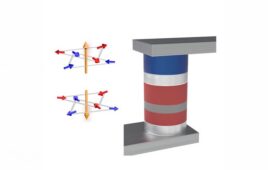
Illustration of an antiferromagnetic tunnel junction pillar beside the two spin configurations of platinum-manganese that store a bit.
Northwestern and Western Digital demonstrate a new way to write magnetic memory
Eggshell-inspired shield cut projectile speed by 65% in simulation, but light-gas gun testing has not confirmed it 
The Space Systems Division (05)-developed Parallelogram Synchronized Truss Assembly (PaSTA), seen Aug. 12, 2025, is a mechanism that will be integrated into the Life-Extension In-orbit Servicer (LEXI) and Astroscale Prototype Servicer for Refueling (APS-R) spacecrafts.
One SwRI R&D 100 winner turns buckled fiberglass into a spacecraft truss. The other models freight rail with 900 hours of BNSF field data
Researchers develop sawdust-based foam as polystyrene bans force industry to adapt
rd newsletter
EXPAND YOUR KNOWLEDGE AND STAY CONNECTED
Get the latest info on technologies, trends, and strategies in Research & Development.

R&D World Digital Issues

Fall 2026 issue

Browse the most current issue of R&D World and back issues in an easy to use high quality format. Clip, share and download with the leading R&D magazine today.

R&D 100 Awards
Research & Development World
  • Subscribe to R&D World Magazine
  • Sign up for R&D World’s newsletter
  • Contact Us
  • About Us
  • Drug Discovery & Development
  • Pharmaceutical Processing
  • Global Funding Forecast

Copyright © 2026 Arrowfly LLC. All Rights Reserved. The material on this site may not be reproduced, distributed, transmitted, cached or otherwise used, except with the prior written permission of Arrowfly
Privacy Policy | Advertising | About Us

Search R&D World

  • R&D World Home
  • Topics
    • Aerospace
    • Automotive
    • Biotech
    • Careers
    • Chemistry
    • Environment
    • Energy
    • Life Science
    • Material Science
    • R&D Management
    • Physics
  • Technology
    • 3D Printing
    • A.I./Robotics
    • Software
    • Battery Technology
    • Controlled Environments
      • Cleanrooms
      • Graphene
      • Lasers
      • Regulations/Standards
      • Sensors
    • Imaging
    • Nanotechnology
    • Scientific Computing
      • Big Data
      • HPC/Supercomputing
      • Informatics
      • Security
    • Semiconductors
  • R&D Market Pulse
  • R&D 100
    • 2026 R&D 100 Award Winners
    • 2026 Professional Award Winners
    • 2026 Special Recognition Winners
    • R&D 100 Awards Event
    • R&D 100 Submissions
    • Winner Archive
  • Resources
    • Research Reports
    • Digital Issues
    • Educational Assets
    • Subscribe
    • Video
    • Webinars
    • PharmSci360
    • Content submission guidelines for R&D World
  • Global Funding Forecast
  • Top Labs
  • Advertise
  • SUBSCRIBE