Research & Development World

  • R&D World Home
  • Topics
    • Aerospace
    • Automotive
    • Biotech
    • Careers
    • Chemistry
    • Environment
    • Energy
    • Life Science
    • Material Science
    • R&D Management
    • Physics
  • Technology
    • 3D Printing
    • A.I./Robotics
    • Software
    • Battery Technology
    • Controlled Environments
      • Cleanrooms
      • Graphene
      • Lasers
      • Regulations/Standards
      • Sensors
    • Imaging
    • Nanotechnology
    • Scientific Computing
      • Big Data
      • HPC/Supercomputing
      • Informatics
      • Security
    • Semiconductors
  • R&D Market Pulse
  • R&D 100
    • 2025 R&D 100 Award Winners
    • 2025 Professional Award Winners
    • 2025 Special Recognition Winners
    • R&D 100 Awards Event
    • R&D 100 Submissions
    • Winner Archive
  • Resources
    • Research Reports
    • Digital Issues
    • Educational Assets
    • Subscribe
    • Video
    • Webinars
    • Content submission guidelines for R&D World
  • Global Funding Forecast
  • Top Labs
  • Advertise
  • SUBSCRIBE

Penn Engineering Research Gives Optical Switches the ‘Contrast’ of Electronic Transistors

By University of Pennsylvania | February 1, 2018

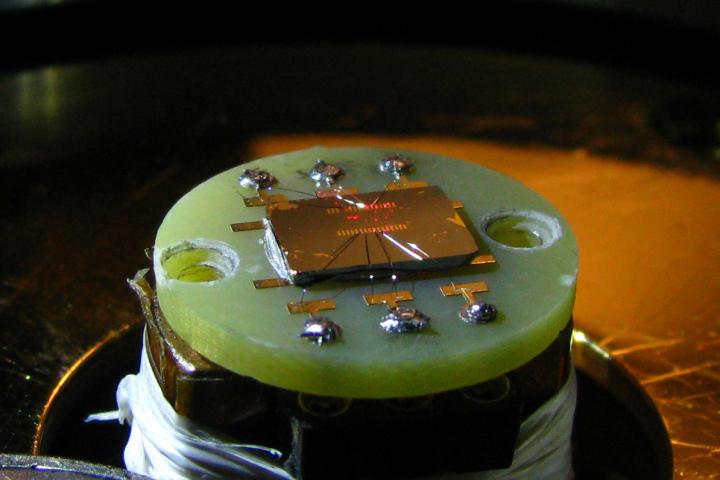
Ritesh Agarwal’s research on photonic computing has been focused on finding the right combination and physical configuration of materials that can amplify and mix light waves in ways that are analogous to electronic computer components. ???????In a paper published in Nature Communications, he and his colleagues have taken an important step: precisely controlling the mixing of optical signals via tailored electric fields, and obtaining outputs with a near perfect contrast and extremely large on/off ratios. Those properties are key to the creation of a working optical transistor. Credit: Sajal Dhara

Current computer systems represent bits of information, the 1’s and 0’s of binary code, with electricity. Circuit elements, such as transistors, operate on these electric signals, producing outputs that are dependent on their inputs.

As fast and powerful as computers have become, Ritesh Agarwal, professor in the Department of Materials Science and Engineering in the University of Pennsylvania’s School of Engineering and Applied Science, knows they could be more powerful. The field of photonic computing aims to achieve that goal by using light as the medium.

Agarwal’s research on photonic computing has been focused on finding the right combination and physical configuration of materials that can amplify and mix light waves in ways that are analogous to electronic computer components.

In a paper published in Nature Communications, he and his colleagues have taken an important step: precisely controlling the mixing of optical signals via tailored electric fields, and obtaining outputs with a near perfect contrast and extremely large on/off ratios. Those properties are key to the creation of a working optical transistor.

“Currently, to compute ‘5+7,’ we need to send an electrical signal for ‘5’ and an electrical signal for ‘7,’ and the transistor does the mixing to produce an electrical signal for ’12,'” Agarwal said. “One of the hurdles in doing this with light is that materials that are able to mix optical signals also tend to have very strong background signals as well. That background signal would drastically reduce the contrast and on/off ratios leading to errors in the output.”

With background signals washing out the intended output, necessarily computational qualities for optical transistors, such as their on/off ratio, modulation strength and signal mixing contrast have all been extremely poor. Electric transistors have high standards for these qualities to prevent errors.

The search for materials that can serve in optical transistors is complicated by additional property requirements. Only “nonlinear” materials are capable of this kind of optical signal mixing.

To address this issue, Agarwal’s research group started by finding a system which has no background signal to start: a nanoscale “belt” made out of cadmium sulfide. Then, by applying an electrical field across the nanobelt, Agarwal and his colleagues were able to introduce optical nonlinearities to the system that enable a signal mixing output that was otherwise zero.

“Our system turns on from zero to extremely large values, and hence has perfect contrast, as well as large modulation and on/off ratios,” Agarwal said. “Therefore, for the first time, we have an optical device with output that truly resembles an electronic transistor.”

With one of the key components coming into focus, the next steps toward a photonic computer will involve integrating them with optical interconnects, modulators, and detectors in order to demonstrate actual computation.

Related Articles Read More >

New metal-organic material can capture water from atmosphere
Sandia scientists develop rapid PFAS test using desorption electrospray ionization 
Colored scanning electron microscopy image showing multiple high-index-facet high-entropy alloy nanoparticles. Image courtesy of Northwestern.
Northwestern unravels a key surface-control problem in high-entropy alloy catalysts
The cloud Is democratizing atomistic simulation, but advantage still comes from execution
rd newsletter
EXPAND YOUR KNOWLEDGE AND STAY CONNECTED
Get the latest info on technologies, trends, and strategies in Research & Development.

R&D World Digital Issues

Fall 2025 issue

Browse the most current issue of R&D World and back issues in an easy to use high quality format. Clip, share and download with the leading R&D magazine today.

R&D 100 Awards
Research & Development World
  • Subscribe to R&D World Magazine
  • Sign up for R&D World’s newsletter
  • Contact Us
  • About Us
  • Drug Discovery & Development
  • Pharmaceutical Processing
  • Global Funding Forecast

Copyright © 2026 WTWH Media LLC. All Rights Reserved. The material on this site may not be reproduced, distributed, transmitted, cached or otherwise used, except with the prior written permission of WTWH Media
Privacy Policy | Advertising | About Us

Search R&D World

  • R&D World Home
  • Topics
    • Aerospace
    • Automotive
    • Biotech
    • Careers
    • Chemistry
    • Environment
    • Energy
    • Life Science
    • Material Science
    • R&D Management
    • Physics
  • Technology
    • 3D Printing
    • A.I./Robotics
    • Software
    • Battery Technology
    • Controlled Environments
      • Cleanrooms
      • Graphene
      • Lasers
      • Regulations/Standards
      • Sensors
    • Imaging
    • Nanotechnology
    • Scientific Computing
      • Big Data
      • HPC/Supercomputing
      • Informatics
      • Security
    • Semiconductors
  • R&D Market Pulse
  • R&D 100
    • 2025 R&D 100 Award Winners
    • 2025 Professional Award Winners
    • 2025 Special Recognition Winners
    • R&D 100 Awards Event
    • R&D 100 Submissions
    • Winner Archive
  • Resources
    • Research Reports
    • Digital Issues
    • Educational Assets
    • Subscribe
    • Video
    • Webinars
    • Content submission guidelines for R&D World
  • Global Funding Forecast
  • Top Labs
  • Advertise
  • SUBSCRIBE