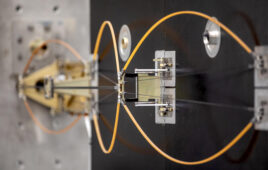
K500 superconducting cyclotron at Texas A&M University that achieved the first sightings of flourine-14. (Photo credit: Robert Tribble) |

Like
gravity, the strong interaction is a fundamental force of nature. It is
the essential “glue” that holds atomic nuclei—composed of protons and
neutrons— together to form atoms, the building blocks of nearly all the
visible matter in the universe. Despite its prevalence in nature,
researchers are still searching for the precise laws that govern the
strong force. However, the recent discovery of an extremely exotic,
short-lived nucleus called fluorine-14 in laboratory experiments may
indicate that scientists are gaining a better grasp of these rules.
Fluorine-14
comprises nine protons and five neutrons. It exists for a tiny fraction
of a second before a proton “drips” off, leaving an oxygen-13 nucleus
behind. A team of researchers led by James Vary, a professor of physics
at Iowa State University, first predicted the properties of fluorine-14
with the help of scientists in Lawrence Berkeley National Laboratory’s
(Berkeley Lab’s) Computational Research Division, as well as
supercomputers at the National Energy Research Scientific Computing
Center (NERSC) and the Oak Ridge Leadership Computing Facility. These
fundamental predictions served as motivations for experiments conducted
by Vladilen Goldberg’s team at Texas A&M’s Cyclotron Institute,
which achieved the first sightings of fluorine-14.
“This
is a true testament to the predictive power of the underlying theory,”
says Vary. “When we published our theory a year ago, fluorine-14 had
never been observed experimentally. In fact, our theory helped the team
secure time on their newly commissioned cyclotron to conduct their
experiment. Once their work was done, they saw virtually perfect
agreement with our theory.”
He
notes that the ability to reliably predict the properties of exotic
nuclei with supercomputers helps pave the way for researchers to
cost-effectively improve designs of nuclear reactors, to predict results
from next generation accelerator experiments that will produce rare and
exotic isotopes, as well as to better understand phenomena such as
supernovae and neutron stars.
This graph shows the flourine-14 supercomputer predictions (far-left) and experimental results (center). The striking similarities between these graphs indicate that researchers are gaining a better understanding of the precise laws that govern the strong force. (Image credt: James Vary) |

“We
will never be able to travel to a neutron star and study it up close,
so the only way to gain insights into its behavior is to understand how
exotic nuclei like fluorine-14 behave and scale up,” says Vary.
Developing a computer code to simulate the strong force
Including
fluorine-14, researchers have so far discovered about 3,000 nuclei in
laboratory experiments and suspect that 6,000 more could still be
created and studied. Understanding the properties of these nuclei will
give researchers insights into the strong force, which could in turn be
applied to develop and improve future energy sources.
With
these goals in mind, the Department of Energy’s Scientific Discovery
through Advanced Computing (SciDAC) program brought together teams of
theoretical physicists, applied mathematicians, computer scientists and
students from universities and national laboratories to create a
computational project called the Universal Nuclear Energy Density
Functional (UNEDF), which uses supercomputers to predict and understand
behavior of a wide range of nuclei, including their reactions, and to
quantify uncertainties. In fact, fluorine-14 was simulated with a code
called Many Fermion Dynamics–nuclear (MFDn) that is part of the UNEDF
project.
According
to Vary, much of this code was developed on NERSC systems over the past
two decades. “We started by calculating how two or three neutrons and
protons interact, then built up our interactions from there to predict
the properties of exotic nuclei like fluorine-14 with nine protons and
five neutrons,” says Vary. “We actually had these capabilities for some
time, but were waiting for computing power to catch up. It wasn’t until
the past three or four years that computing power became available to
make the runs.”
Through the SciDAC program, Vary’s team partnered with Ng and other scientists in Berkeley Lab’s CRD