Research & Development World

  • R&D World Home
  • Topics
    • Aerospace
    • Automotive
    • Biotech
    • Careers
    • Chemistry
    • Environment
    • Energy
    • Life Science
    • Material Science
    • R&D Management
    • Physics
  • Technology
    • 3D Printing
    • A.I./Robotics
    • Software
    • Battery Technology
    • Controlled Environments
      • Cleanrooms
      • Graphene
      • Lasers
      • Regulations/Standards
      • Sensors
    • Imaging
    • Nanotechnology
    • Scientific Computing
      • Big Data
      • HPC/Supercomputing
      • Informatics
      • Security
    • Semiconductors
  • R&D Market Pulse
  • R&D 100
    • 2025 R&D 100 Award Winners
    • 2025 Professional Award Winners
    • 2025 Special Recognition Winners
    • R&D 100 Awards Event
    • R&D 100 Submissions
    • Winner Archive
  • Resources
    • Research Reports
    • Digital Issues
    • Educational Assets
    • R&D Index
    • Subscribe
    • Video
    • Webinars
    • Content submission guidelines for R&D World
  • Global Funding Forecast
  • Top Labs
  • Advertise
  • SUBSCRIBE

R&D 100 winner of the day: Field-Programmable Imaging Array

By Heather Hall | August 3, 2022

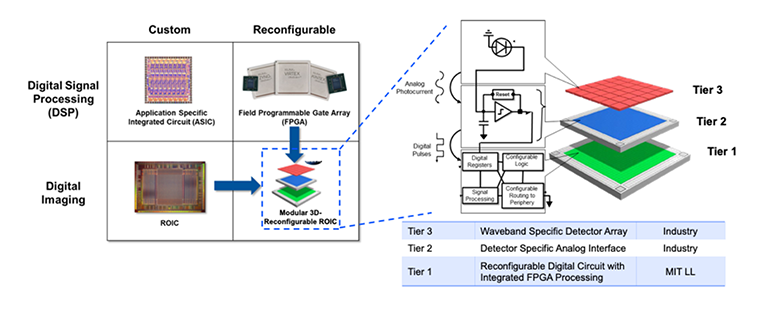
The left side of the figure illustrates a motivation for the FPIA; bringing the flexibility and reuse of the FPGA to the imaging world. The right side shows the stacked FPIA architecture, where detector array, analog interface and digital processing tiers are integrated into a single image sensor.

The Field Programmable Imaging Array (FPIA), from MIT Lincoln Laboratory, is a first-in-class device that allows designers of niche sensing applications access to unprecedented on-chip computational resources. The reconfigurable nature of the FPIA allows designers to mix and match disparate functionality to create innovative solutions to problems. Once a front end for a specific detector type is integrated, the design cycle for new applications of that detector type is greatly shortened from the existing status quo, allowing quick prototyping of new system concepts.

The objective of the FPIA is to serve processing-intensive imaging applications by creating a stacked architecture with a highly capable reconfigurable digital component that can be adapted to any type of optical detector. The high cost of this advanced digital component can be amortized over multiple applications, while enabling capabilities that would be otherwise out of reach.

The FPIA is a first-of-its-class device. It makes high-performance on-chip digital processing and field-programmability available to a broad spectrum of new imaging applications.
Related Articles Read More >

Behind the win: PHC’s Sokolowski on building a better cell culture monitor
Los Alamos’ R&D 100-winning EpiEarth platform helps predict the global outbreaks early
R&D 100 winner LLNL achieves 1,000x speed boost in 3D nanofabrication
Still celebrating the 2025 R&D 100 winners
rd newsletter
EXPAND YOUR KNOWLEDGE AND STAY CONNECTED
Get the latest info on technologies, trends, and strategies in Research & Development.
RD 25 Power Index

R&D World Digital Issues

Fall 2025 issue

Browse the most current issue of R&D World and back issues in an easy to use high quality format. Clip, share and download with the leading R&D magazine today.

R&D 100 Awards
Research & Development World
  • Subscribe to R&D World Magazine
  • Sign up for R&D World’s newsletter
  • Contact Us
  • About Us
  • Drug Discovery & Development
  • Pharmaceutical Processing
  • Global Funding Forecast

Copyright © 2025 WTWH Media LLC. All Rights Reserved. The material on this site may not be reproduced, distributed, transmitted, cached or otherwise used, except with the prior written permission of WTWH Media
Privacy Policy | Advertising | About Us

Search R&D World

  • R&D World Home
  • Topics
    • Aerospace
    • Automotive
    • Biotech
    • Careers
    • Chemistry
    • Environment
    • Energy
    • Life Science
    • Material Science
    • R&D Management
    • Physics
  • Technology
    • 3D Printing
    • A.I./Robotics
    • Software
    • Battery Technology
    • Controlled Environments
      • Cleanrooms
      • Graphene
      • Lasers
      • Regulations/Standards
      • Sensors
    • Imaging
    • Nanotechnology
    • Scientific Computing
      • Big Data
      • HPC/Supercomputing
      • Informatics
      • Security
    • Semiconductors
  • R&D Market Pulse
  • R&D 100
    • 2025 R&D 100 Award Winners
    • 2025 Professional Award Winners
    • 2025 Special Recognition Winners
    • R&D 100 Awards Event
    • R&D 100 Submissions
    • Winner Archive
  • Resources
    • Research Reports
    • Digital Issues
    • Educational Assets
    • R&D Index
    • Subscribe
    • Video
    • Webinars
    • Content submission guidelines for R&D World
  • Global Funding Forecast
  • Top Labs
  • Advertise
  • SUBSCRIBE