Research & Development World

  • R&D World Home
  • Topics
    • Aerospace
    • Automotive
    • Biotech
    • Careers
    • Chemistry
    • Environment
    • Energy
    • Life Science
    • Material Science
    • R&D Management
    • Physics
  • Technology
    • 3D Printing
    • A.I./Robotics
    • Software
    • Battery Technology
    • Controlled Environments
      • Cleanrooms
      • Graphene
      • Lasers
      • Regulations/Standards
      • Sensors
    • Imaging
    • Nanotechnology
    • Scientific Computing
      • Big Data
      • HPC/Supercomputing
      • Informatics
      • Security
    • Semiconductors
  • R&D Market Pulse
  • R&D 100
    • 2025 R&D 100 Award Winners
    • 2025 Professional Award Winners
    • 2025 Special Recognition Winners
    • R&D 100 Awards Event
    • R&D 100 Submissions
    • Winner Archive
  • Resources
    • Research Reports
    • Digital Issues
    • Educational Assets
    • Subscribe
    • Video
    • Webinars
    • PharmSci360
    • Content submission guidelines for R&D World
  • Global Funding Forecast
  • Top Labs
  • Advertise
  • SUBSCRIBE

Reducing the Radioresistance of Cancer

By Kumamoto University | January 17, 2017

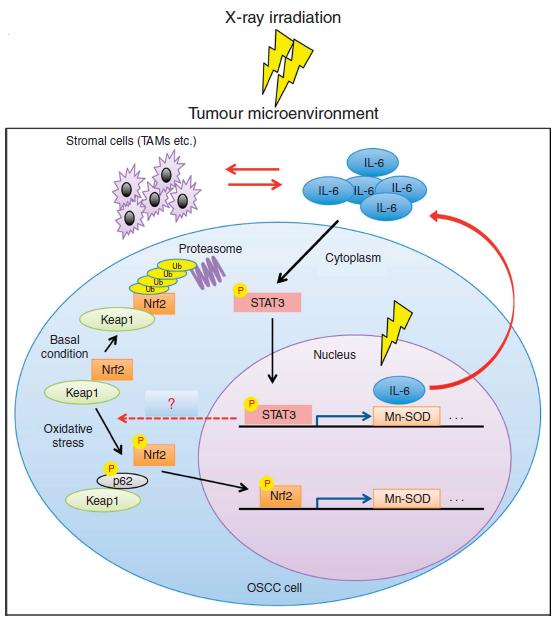
Kumamoto University (Japan) researchers revealed that when oral squamous cell carcinoma (OSCC) cells are exposed to X-ray irradiation, interleukin-6 levels increase and activate the Nrf2-antioxidant pathway. This leads to the production of antioxidants, such as Mn-SOD and IL-6, inside the nucleus and higher cancer cell radioresistance. (Credit: Dr. Yuichiro Matsuoka & Dr. Hideki Nakayama)

Most people recognize that many forms of cancer are treated with radiation therapy. However, some may not realize that there are cancer cells with the ability to survive this type of treatment. Oral squamous cell carcinoma (OSCC) is one of these forms of cancer, and is the reason why researchers from Kumamoto University in Japan began searching for methods to combat resistance to radiotherapy. Rather than going after the cancer cells directly, they attempted to find a way to control the biological mechanisms that aid in radioresistance. This meant looking at interleukin-6 (IL-6), a cytokine known for signaling the inflammatory response, and nuclear factor erythroid 2-related factor 2 (Nrf2), which is a protein that protects against oxidative stress.

Their approach consisted of multiple in vitro experiments on two different cancer cell samples. One sample was derived from tissue specimens taken from consenting patients with advanced OSCC who had undergone chemoradiotherapy (30 Gy total dosage). The other consisted of human OSCC cell lines which were obtained from the Japanese Collection of Research Bioresources Cell Bank (Osaka, Japan). These cells were irradiated with doses of either 6 or 10 Gy.

The results of the experiments provided evidence that IL-6 provides protection from radiation therapy to cancer cells through interaction with the Nrf2-antioxidant pathway. “This interaction and the resulting protection from oxidative damage that we have discovered here is very interesting,” said Professor Hideki Nakayama, one of the research group leaders. “As far as we know, we are the first to discover that IL-6 has such an effect on the Nrf2-antioxidant pathway. We hope new therapies that target IL-6 will give us an advantage over many types of radiation-resistant cancers.”

The majority of the experiments performed were in vitro, which is a limitation of this study. However, research from the same group has already shown in a mouse model that the immunosuppressive drug tocilizumab, a drug currently used for rheumatoid arthritis, is effective against IL-6R as treatment for OSCC. Future research will attempt to expand on the researcher’s idea of reducing the radiation resistance of cancer.

This research can be found in the British Journal of Cancer at nature.com/bjc.

Related Articles Read More >

Purple Glowing Spiral Fractal Background Image, Illustration - Vortex repeating spiral patterns, Symmetrical repeating geometric patterns. Abstract design, black background
Recursion says its Norstella-backed real-time simulation can expand trial eligibility by up to 40%
NIH employees warn of ‘institutionalized destruction’ one year after Bethesda Declaration
Cradle’s CEO on the AI agent boom and the reality of experimental feedback in life sciences
Inside BD’s plan to forecast hospital drug demand with AI while keeping models within bounds
rd newsletter
EXPAND YOUR KNOWLEDGE AND STAY CONNECTED
Get the latest info on technologies, trends, and strategies in Research & Development.

R&D World Digital Issues

Fall 2025 issue

Browse the most current issue of R&D World and back issues in an easy to use high quality format. Clip, share and download with the leading R&D magazine today.

R&D 100 Awards
Research & Development World
  • Subscribe to R&D World Magazine
  • Sign up for R&D World’s newsletter
  • Contact Us
  • About Us
  • Drug Discovery & Development
  • Pharmaceutical Processing
  • Global Funding Forecast

Copyright © 2026 Arrowfly LLC. All Rights Reserved. The material on this site may not be reproduced, distributed, transmitted, cached or otherwise used, except with the prior written permission of Arrowfly
Privacy Policy | Advertising | About Us

Search R&D World

  • R&D World Home
  • Topics
    • Aerospace
    • Automotive
    • Biotech
    • Careers
    • Chemistry
    • Environment
    • Energy
    • Life Science
    • Material Science
    • R&D Management
    • Physics
  • Technology
    • 3D Printing
    • A.I./Robotics
    • Software
    • Battery Technology
    • Controlled Environments
      • Cleanrooms
      • Graphene
      • Lasers
      • Regulations/Standards
      • Sensors
    • Imaging
    • Nanotechnology
    • Scientific Computing
      • Big Data
      • HPC/Supercomputing
      • Informatics
      • Security
    • Semiconductors
  • R&D Market Pulse
  • R&D 100
    • 2025 R&D 100 Award Winners
    • 2025 Professional Award Winners
    • 2025 Special Recognition Winners
    • R&D 100 Awards Event
    • R&D 100 Submissions
    • Winner Archive
  • Resources
    • Research Reports
    • Digital Issues
    • Educational Assets
    • Subscribe
    • Video
    • Webinars
    • PharmSci360
    • Content submission guidelines for R&D World
  • Global Funding Forecast
  • Top Labs
  • Advertise
  • SUBSCRIBE