Research & Development World

  • R&D World Home
  • Topics
    • Aerospace
    • Automotive
    • Biotech
    • Careers
    • Chemistry
    • Environment
    • Energy
    • Life Science
    • Material Science
    • R&D Management
    • Physics
  • Technology
    • 3D Printing
    • A.I./Robotics
    • Software
    • Battery Technology
    • Controlled Environments
      • Cleanrooms
      • Graphene
      • Lasers
      • Regulations/Standards
      • Sensors
    • Imaging
    • Nanotechnology
    • Scientific Computing
      • Big Data
      • HPC/Supercomputing
      • Informatics
      • Security
    • Semiconductors
  • R&D Market Pulse
  • R&D 100
    • 2025 R&D 100 Award Winners
    • 2025 Professional Award Winners
    • 2025 Special Recognition Winners
    • R&D 100 Awards Event
    • R&D 100 Submissions
    • Winner Archive
  • Resources
    • Research Reports
    • Digital Issues
    • Educational Assets
    • Subscribe
    • Video
    • Webinars
    • Content submission guidelines for R&D World
  • Global Funding Forecast
  • Top Labs
  • Advertise
  • SUBSCRIBE

Researchers 3D Print Human Cells Using Magnets

By Kenny Walter | March 26, 2019

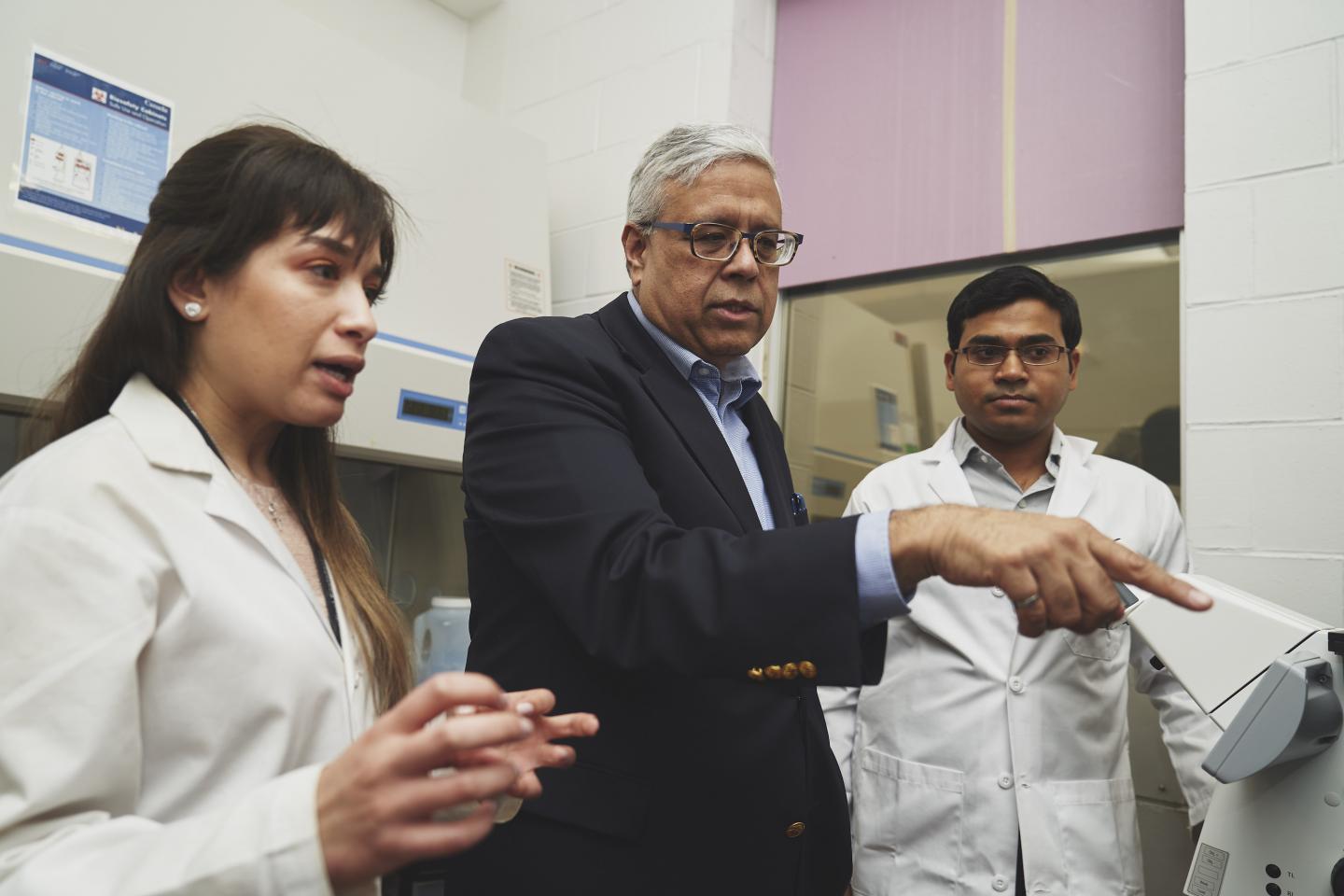
Ishwar Puri, centre, with his research team, Sarah Mishriki, PhD candidate in the School of Biomedical Engineering and lead author, and Rakesh Sahu, a research associate. Credit: Jin Lee, McMaster University, Faculty of Engineering

A new 3D printing technique could allow researchers to create artificial tumors to test new drugs and therapies, ultimately leading to better and more personalized medicine.

Engineers from McMaster University believe the new method could enable them to create realistic 3D cell clusters with several layers of cells to better mimic the conditions inside of the body and eliminate the need for animals to study human diseases.

“We have developed an engineering solution to overcome current biological limitations. It has the potential to expedite tissue engineering technology and regenerative medicine,” Sarah Mishriki, a PhD candidate in the School of Biomedical Engineering and lead author of the study, said in a statement. “The ability to rapidly manipulate cells in a safe, controllable and non-contact manner allows us to create the unique cell landscapes and microarchitectures found in human tissues, without the use of a scaffold.”

The new method uses magnets to rapidly print 3D cell clusters by using the magnetic properties of different materials, including cells. While some materials are strongly susceptible to magnets, others are not.  Materials with a higher magnetic susceptibility experience stronger attraction to a magnet and will move towards it; weakly attracted material with lower susceptibility will be displaced to lower magnetic field regions that lie away from the magnet.

The researchers were able to harness the differences in the magnetic susceptibilities of two materials to concentrate only one within a volume by designing magnetic fields and arranging the magnets in a specific way.

“This magnetic method of producing 3D cell clusters takes us closer to rapidly and economically creating more complex models of biological tissues, speeding discovery in academic labs and technology solutions for industry,” Rakesh Sahu, a research associate, said in a statement.  

The team formulated bioinks by suspending human breast cancer cells in a cell culture medium that contained Gd-DTPA, a magnetic salt hydrate that is used as an MRI contrast agent for humans. Similar to other cells, the breast cancer cells are significantly less attracted by magnets than the Gd-DTPA. When the magnetic field was applied, the salt hydrate moves towards the magnets, displacing the cells in a predetermined area of minimum magnetic field strength, seeding the formation of a 3D cell cluster.

Within just six hours, the researchers were able to use this method and 3D print a cancer tumor and confirmed through testing that the salt hydrate were non-toxic to human cells.

The researchers now hope to develop more complex bioinks that will enable them to print cell clusters that mimic human tissues better.

They also believe that in the future, tumors with cancer cells could be rapidly printed to test drug response during a number of experiments that can be conducted simultaneously. They also hope to further develop their technology so they can 3D print multiple tissues and organs.   

For researchers to study different diseases, test drugs and examine how they impact human cells, they often have to create a single layer of human or animal cells in 2D models. Animal models are also used to track the progression of the disease, but these processes can be both time-consuming and expensive.

The study was published in Research.
Related Articles Read More >

R&D 100 winner LLNL achieves 1,000x speed boost in 3D nanofabrication
Caltech team 3D-prints drug depots deep inside living tissue
What could make MXene a key to ultra-precise, additive-free 3D microprinting?
Industry 4.0 Modern Factory: Facility Operator Controls Workshop Production Line, Uses Computer with Screens Showing Complex UI of Machine Operation Processes, Controllers, Machinery Blueprints
Building the thinking factory: An additive exec on AI, automation, and the skills crisis
rd newsletter
EXPAND YOUR KNOWLEDGE AND STAY CONNECTED
Get the latest info on technologies, trends, and strategies in Research & Development.

R&D World Digital Issues

Fall 2025 issue

Browse the most current issue of R&D World and back issues in an easy to use high quality format. Clip, share and download with the leading R&D magazine today.

R&D 100 Awards
Research & Development World
  • Subscribe to R&D World Magazine
  • Sign up for R&D World’s newsletter
  • Contact Us
  • About Us
  • Drug Discovery & Development
  • Pharmaceutical Processing
  • Global Funding Forecast

Copyright © 2026 WTWH Media LLC. All Rights Reserved. The material on this site may not be reproduced, distributed, transmitted, cached or otherwise used, except with the prior written permission of WTWH Media
Privacy Policy | Advertising | About Us

Search R&D World

  • R&D World Home
  • Topics
    • Aerospace
    • Automotive
    • Biotech
    • Careers
    • Chemistry
    • Environment
    • Energy
    • Life Science
    • Material Science
    • R&D Management
    • Physics
  • Technology
    • 3D Printing
    • A.I./Robotics
    • Software
    • Battery Technology
    • Controlled Environments
      • Cleanrooms
      • Graphene
      • Lasers
      • Regulations/Standards
      • Sensors
    • Imaging
    • Nanotechnology
    • Scientific Computing
      • Big Data
      • HPC/Supercomputing
      • Informatics
      • Security
    • Semiconductors
  • R&D Market Pulse
  • R&D 100
    • 2025 R&D 100 Award Winners
    • 2025 Professional Award Winners
    • 2025 Special Recognition Winners
    • R&D 100 Awards Event
    • R&D 100 Submissions
    • Winner Archive
  • Resources
    • Research Reports
    • Digital Issues
    • Educational Assets
    • Subscribe
    • Video
    • Webinars
    • Content submission guidelines for R&D World
  • Global Funding Forecast
  • Top Labs
  • Advertise
  • SUBSCRIBE