Research & Development World

  • R&D World Home
  • Topics
    • Aerospace
    • Automotive
    • Biotech
    • Careers
    • Chemistry
    • Environment
    • Energy
    • Life Science
    • Material Science
    • R&D Management
    • Physics
  • Technology
    • 3D Printing
    • A.I./Robotics
    • Software
    • Battery Technology
    • Controlled Environments
      • Cleanrooms
      • Graphene
      • Lasers
      • Regulations/Standards
      • Sensors
    • Imaging
    • Nanotechnology
    • Scientific Computing
      • Big Data
      • HPC/Supercomputing
      • Informatics
      • Security
    • Semiconductors
  • R&D Market Pulse
  • R&D 100
    • 2026 R&D 100 Award Winners
    • 2026 Professional Award Winners
    • 2026 Special Recognition Winners
    • R&D 100 Awards Event
    • R&D 100 Submissions
    • Winner Archive
  • Resources
    • Research Reports
    • Digital Issues
    • Educational Assets
    • Subscribe
    • Video
    • Webinars
    • PharmSci360
    • Content submission guidelines for R&D World
  • Global Funding Forecast
  • Top Labs
  • Advertise
  • SUBSCRIBE

Researchers Accidentally Improve Nickel Nanoparticles

By Matt Shipman, North Carolina State University | November 28, 2017

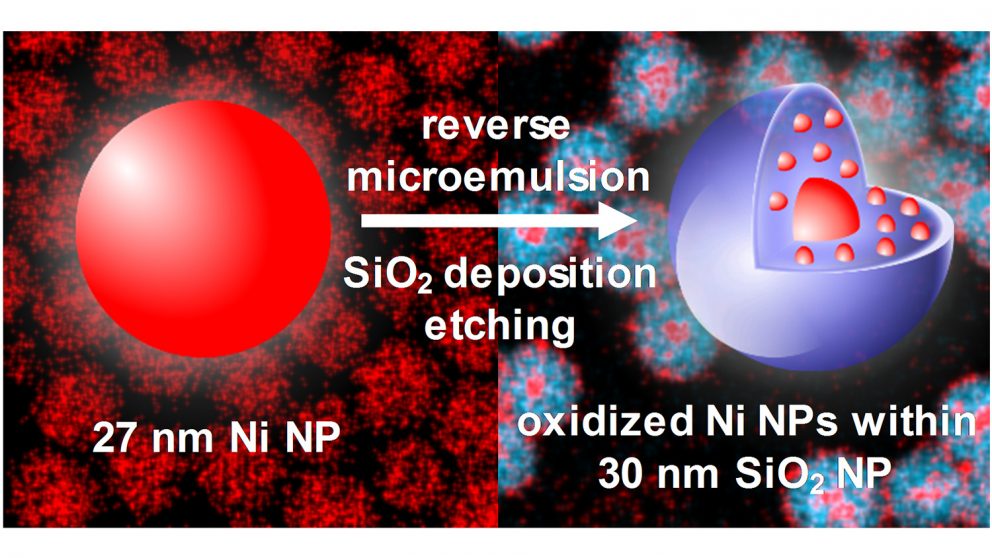
During deposition of a silica shell onto Ni nanoparticles, they are etched, oxidized, and embedded in the silica, which stabilizes the structure during oxidation and reduction. Image: Brian Lynch. Reproduced by permission of The Royal Society of Chemistry.

Researchers from North Carolina State University and the Air Force Research Laboratory have discovered that a technique designed to coat nickel nanoparticles with silica shells actually fragments the material — creating a small core of oxidized nickel surrounded by smaller satellites embedded in a silica shell. The surprising result may prove useful by increasing the surface area of nickel available for catalyzing chemical reactions.

“Nickel is noteworthy for its widespread applications in catalysis,” says Joe Tracy, an associate professor of materials science and engineering at NC State and corresponding author of a paper on the work. “One reason you’d want to coat nickel nanoparticles in porous silica is to embed them in a neutral substrate to maintain their efficiency as catalysts in chemical reactions. So the fact that this process could increase their surface area at the same time could prove to be beneficial.”

The researchers employed a widely used approach called reverse microemulsion, or reverse micelle, to apply a silica coating to nickel nanoparticles that were approximately 27 nanometers (nm) in diameter. But they found that the technique results in an oxidized nickel core that was 7 nm in diameter, surrounded by oxidized nickel satellites only 2 nm in diameter — all enclosed in a silica shell that was 30 nm in diameter.

“At first we thought we’d made a mistake, but we were able to reproduce the result over and over again,” says Brian Lynch, a Ph.D. student at NC State and lead author of a paper on the work.

“When oxidized and reduced at high temperatures, we found that the core-and-satellite nickel nanoparticles did not significantly change size or shape, suggesting that they would function well in the environments needed to catalyze chemical reactions,” Tracy says.

“This was an unexpected discovery, but we’re happy with how it turned out.”

The paper, “Synthesis and Chemical Transformation of Ni Nanoparticles Embedded in Silica,” is published in the journal Nanoscale. The paper was co-authored by Bryan Anderson, a former Ph.D. student at NC State, and Joshua Kennedy of the Air Force Research Laboratory. The work was done with support from the National Science Foundation, under grants CBET-1605699 and DMR-1056653; the Air Force Research Laboratory Materials and Manufacturing Directorate, and the Air Force Office of Scientific Research, under grant 16RXCOR324.

Source: North Carolina State University
Related Articles Read More >

Researchers developed quantum nanosensors that can measure the temperature of a single cell
Overcoming the 100-nanometer barrier: New microbottle resonators scale up optical trapping
R&D 100 winner LLNL achieves 1,000x speed boost in 3D nanofabrication
CEA-Leti achieves 400°C CMOS fabrication milestone for 3D chip stacking
rd newsletter
EXPAND YOUR KNOWLEDGE AND STAY CONNECTED
Get the latest info on technologies, trends, and strategies in Research & Development.

R&D World Digital Issues

Fall 2025 issue

Browse the most current issue of R&D World and back issues in an easy to use high quality format. Clip, share and download with the leading R&D magazine today.

R&D 100 Awards
Research & Development World
  • Subscribe to R&D World Magazine
  • Sign up for R&D World’s newsletter
  • Contact Us
  • About Us
  • Drug Discovery & Development
  • Pharmaceutical Processing
  • Global Funding Forecast

Copyright © 2026 Arrowfly LLC. All Rights Reserved. The material on this site may not be reproduced, distributed, transmitted, cached or otherwise used, except with the prior written permission of Arrowfly
Privacy Policy | Advertising | About Us

Search R&D World

  • R&D World Home
  • Topics
    • Aerospace
    • Automotive
    • Biotech
    • Careers
    • Chemistry
    • Environment
    • Energy
    • Life Science
    • Material Science
    • R&D Management
    • Physics
  • Technology
    • 3D Printing
    • A.I./Robotics
    • Software
    • Battery Technology
    • Controlled Environments
      • Cleanrooms
      • Graphene
      • Lasers
      • Regulations/Standards
      • Sensors
    • Imaging
    • Nanotechnology
    • Scientific Computing
      • Big Data
      • HPC/Supercomputing
      • Informatics
      • Security
    • Semiconductors
  • R&D Market Pulse
  • R&D 100
    • 2026 R&D 100 Award Winners
    • 2026 Professional Award Winners
    • 2026 Special Recognition Winners
    • R&D 100 Awards Event
    • R&D 100 Submissions
    • Winner Archive
  • Resources
    • Research Reports
    • Digital Issues
    • Educational Assets
    • Subscribe
    • Video
    • Webinars
    • PharmSci360
    • Content submission guidelines for R&D World
  • Global Funding Forecast
  • Top Labs
  • Advertise
  • SUBSCRIBE