Research & Development World

  • R&D World Home
  • Topics
    • Aerospace
    • Automotive
    • Biotech
    • Careers
    • Chemistry
    • Environment
    • Energy
    • Life Science
    • Material Science
    • R&D Management
    • Physics
  • Technology
    • 3D Printing
    • A.I./Robotics
    • Software
    • Battery Technology
    • Controlled Environments
      • Cleanrooms
      • Graphene
      • Lasers
      • Regulations/Standards
      • Sensors
    • Imaging
    • Nanotechnology
    • Scientific Computing
      • Big Data
      • HPC/Supercomputing
      • Informatics
      • Security
    • Semiconductors
  • R&D Market Pulse
  • R&D 100
    • 2025 R&D 100 Award Winners
    • 2025 Professional Award Winners
    • 2025 Special Recognition Winners
    • R&D 100 Awards Event
    • R&D 100 Submissions
    • Winner Archive
  • Resources
    • Research Reports
    • Digital Issues
    • Educational Assets
    • Subscribe
    • Video
    • Webinars
    • PharmSci360
    • Content submission guidelines for R&D World
  • Global Funding Forecast
  • Top Labs
  • Advertise
  • SUBSCRIBE

Researchers Put Single Molecules in Super-Fridge

By University of Leicester | November 10, 2016

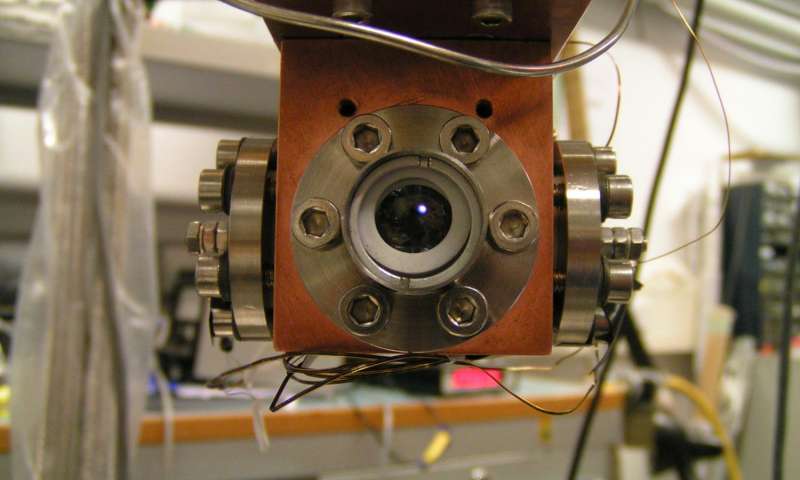
In this test experiment fluorescence light emitted from the discharge can be seen in the center. (Credit: Dr. Klaus von Haeften)

An international team of researchers led by the University of Leicester has for the first time observed how a single two-atom-large molecule rotates in the coldest liquid known in nature.

The team consists of researchers from the Department of Physics and Astronomy at the University of Leicester, the Centre National de la Recherche Scientifique (CNRS), Grenoble, France and the Department of Physics in Kerbala, Iraq.

The interactions of molecules in liquids determines chemical reactions and biological processes.

In ordinary liquids the interactions between the molecules is too strong and overshadows the subtle features of rotations.

By choosing a very special liquid composed of helium atoms the researchers reduced the strength of the molecular interactions so that they had the chance to see single molecules rotating.

Lead author Dr Klaus von Haeften from the University of Leicester Department of Physics and Astronomy said: “To introduce molecules into the liquid helium we had to excite the helium using a discharge.

“This was necessary because ordinary molecules would freeze once they are introduced into liquid helium. By exciting helium in the discharge tiny gas bubbles were formed.”

The researchers observed that by applying pressure the molecules within these bubbles would collide with the ultra-cold liquid and begin to cool and slow down their rotations.

This happened at a rate of more than 100 billion degrees Kelvin (centigrade) per second. At pressures of several atmospheres the molecules reached the slowest possible rotational speed.

The researchers believe that with these molecules they can investigate liquid helium at even lower temperatures.

At these temperatures friction disappears, and the team expects to be able to measure with great precision how molecules respond to this ‘superfluid’ state.

Dr von Haeften added: “The results of these studies in liquid helium will also be important to understand ordinary liquids, where such observations are impossible to make.

“This may trigger new applications of drugs for diagnostics and therapy and the development of new materials.”

Two of the international researchers involved in the project have conducted their PhD studies at the University of Leicester.

Mrs Nagham Shiltagh (Iraq) is currently investigating how the technology developed in this project could be applied in other areas and Luis Guillermo Mendoza-Luna (Mexico) was involved in setting up the experiment and recording the data and has now assumed an academic position in Mexico.
Related Articles Read More >

Princeton researchers uncover hidden mathematical link between origami and structural design
NTT Research taps Tetsuomi Sogawa to lead PHI Lab as optical-computing work advances
IBM physicist and Montreal computer scientist share Turing Award for quantum information breakthroughs
Research team shows nanoparticles adhere to quantum mechanics
rd newsletter
EXPAND YOUR KNOWLEDGE AND STAY CONNECTED
Get the latest info on technologies, trends, and strategies in Research & Development.

R&D World Digital Issues

Fall 2025 issue

Browse the most current issue of R&D World and back issues in an easy to use high quality format. Clip, share and download with the leading R&D magazine today.

R&D 100 Awards
Research & Development World
  • Subscribe to R&D World Magazine
  • Sign up for R&D World’s newsletter
  • Contact Us
  • About Us
  • Drug Discovery & Development
  • Pharmaceutical Processing
  • Global Funding Forecast

Copyright © 2026 Arrowfly LLC. All Rights Reserved. The material on this site may not be reproduced, distributed, transmitted, cached or otherwise used, except with the prior written permission of Arrowfly
Privacy Policy | Advertising | About Us

Search R&D World

  • R&D World Home
  • Topics
    • Aerospace
    • Automotive
    • Biotech
    • Careers
    • Chemistry
    • Environment
    • Energy
    • Life Science
    • Material Science
    • R&D Management
    • Physics
  • Technology
    • 3D Printing
    • A.I./Robotics
    • Software
    • Battery Technology
    • Controlled Environments
      • Cleanrooms
      • Graphene
      • Lasers
      • Regulations/Standards
      • Sensors
    • Imaging
    • Nanotechnology
    • Scientific Computing
      • Big Data
      • HPC/Supercomputing
      • Informatics
      • Security
    • Semiconductors
  • R&D Market Pulse
  • R&D 100
    • 2025 R&D 100 Award Winners
    • 2025 Professional Award Winners
    • 2025 Special Recognition Winners
    • R&D 100 Awards Event
    • R&D 100 Submissions
    • Winner Archive
  • Resources
    • Research Reports
    • Digital Issues
    • Educational Assets
    • Subscribe
    • Video
    • Webinars
    • PharmSci360
    • Content submission guidelines for R&D World
  • Global Funding Forecast
  • Top Labs
  • Advertise
  • SUBSCRIBE