Research & Development World

  • R&D World Home
  • Topics
    • Aerospace
    • Automotive
    • Biotech
    • Careers
    • Chemistry
    • Environment
    • Energy
    • Life Science
    • Material Science
    • R&D Management
    • Physics
  • Technology
    • 3D Printing
    • A.I./Robotics
    • Software
    • Battery Technology
    • Controlled Environments
      • Cleanrooms
      • Graphene
      • Lasers
      • Regulations/Standards
      • Sensors
    • Imaging
    • Nanotechnology
    • Scientific Computing
      • Big Data
      • HPC/Supercomputing
      • Informatics
      • Security
    • Semiconductors
  • R&D Market Pulse
  • R&D 100
    • 2025 R&D 100 Award Winners
    • 2025 Professional Award Winners
    • 2025 Special Recognition Winners
    • R&D 100 Awards Event
    • R&D 100 Submissions
    • Winner Archive
  • Resources
    • Research Reports
    • Digital Issues
    • Educational Assets
    • Subscribe
    • Video
    • Webinars
    • Content submission guidelines for R&D World
  • Global Funding Forecast
  • Top Labs
  • Advertise
  • SUBSCRIBE

Researchers Teach Computer to Recognize Emotions in Speech

By National Research University Higher School of Economics | November 8, 2017

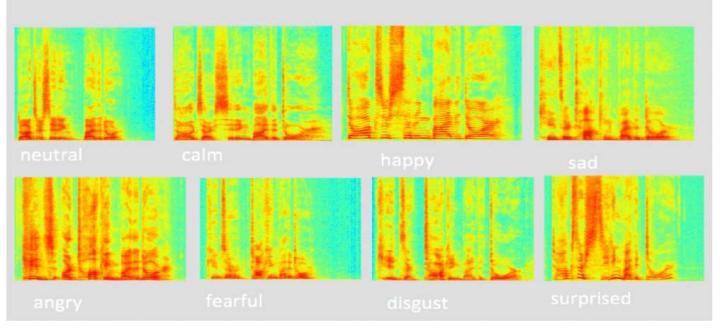
Spectrograms of the phrase ‘Kids are talking by the door’ pronounced with different emotions.

Experts of the Faculty of Informatics, Mathematics, and Computer Science at the Higher School of Economics have created an automatic system capable of identifying emotions in the sound of a voice. Their report was presented at a major international conference, Neuroinformatics-2017.

For a long time, computers have successfully converted speech into text. However, the emotional component, which is important for conveying meaning, has been neglected. For example, for the same question ‘Is everything okay?’, people can answer ‘Of course it is!’ with different intonations: calm, provoking, cheerful, etc. And the reactions will be completely different.

Neural networks are processors connected with each other and capable of learning, analysis and synthesis. This smart system surpasses traditional algorithms in that the interaction between a person and computer becomes more interactive.

HSE researchers Anastasia Popova, Alexander Rassadin and Alexander Ponomarenko have trained a neural network to recognize eight different emotions: neutral, calm, happy, sad, angry, scared, disgusted, and surprised. In 70% of cases the computer identified the emotion correctly, say the researchers.

The researchers have transformed the sound into images – spectrograms – which allowed them to work with sound using the methods applied for image recognition. A deep learning convolutional neural network with VGG-16 architecture was used in the research.

The researchers note that the programme successfully distinguishes neutral and calm tones, while happiness and surprise are not always recognized well. Happiness is often perceived as fear and sadness, and surprise is interpreted as disgust.

Related Articles Read More >

Who has access to Claude Mythos-tier models (and beyond) will redefine cybersecurity, including in R&D
Abstract of modern high tech internet data center room with rows of racks with network and server hardware. 3d rendering
A startup says it found hidden memory behavior in NVIDIA GPUs and is building a security layer around it
NTT Research launches Scale Academy with SaltGrain, a zero-trust data security suite
LabWare advances SaaS LIMS strategy at Pittcon 2026, one year after ASSURE launch
rd newsletter
EXPAND YOUR KNOWLEDGE AND STAY CONNECTED
Get the latest info on technologies, trends, and strategies in Research & Development.

R&D World Digital Issues

Fall 2025 issue

Browse the most current issue of R&D World and back issues in an easy to use high quality format. Clip, share and download with the leading R&D magazine today.

R&D 100 Awards
Research & Development World
  • Subscribe to R&D World Magazine
  • Sign up for R&D World’s newsletter
  • Contact Us
  • About Us
  • Drug Discovery & Development
  • Pharmaceutical Processing
  • Global Funding Forecast

Copyright © 2026 WTWH Media LLC. All Rights Reserved. The material on this site may not be reproduced, distributed, transmitted, cached or otherwise used, except with the prior written permission of WTWH Media
Privacy Policy | Advertising | About Us

Search R&D World

  • R&D World Home
  • Topics
    • Aerospace
    • Automotive
    • Biotech
    • Careers
    • Chemistry
    • Environment
    • Energy
    • Life Science
    • Material Science
    • R&D Management
    • Physics
  • Technology
    • 3D Printing
    • A.I./Robotics
    • Software
    • Battery Technology
    • Controlled Environments
      • Cleanrooms
      • Graphene
      • Lasers
      • Regulations/Standards
      • Sensors
    • Imaging
    • Nanotechnology
    • Scientific Computing
      • Big Data
      • HPC/Supercomputing
      • Informatics
      • Security
    • Semiconductors
  • R&D Market Pulse
  • R&D 100
    • 2025 R&D 100 Award Winners
    • 2025 Professional Award Winners
    • 2025 Special Recognition Winners
    • R&D 100 Awards Event
    • R&D 100 Submissions
    • Winner Archive
  • Resources
    • Research Reports
    • Digital Issues
    • Educational Assets
    • Subscribe
    • Video
    • Webinars
    • Content submission guidelines for R&D World
  • Global Funding Forecast
  • Top Labs
  • Advertise
  • SUBSCRIBE