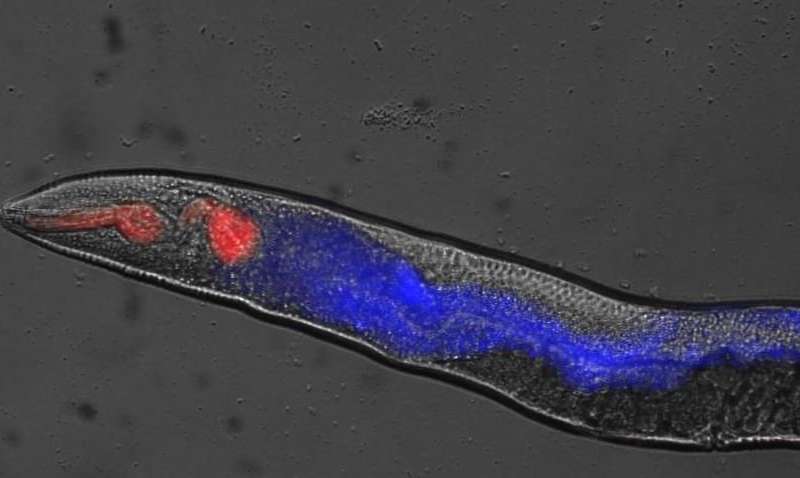
Cellular necrosis in C. elegans. Credit: David Gems, UCL
A dying worm experiences rigor mortis early in the death process, rather than after the main event as it is for humans, according to a new study by an international team of scientists at UCL and Washington University.
The study, published in the journal Cell Reports, is the first discovery of rigor mortis in worms and provides new insight into the process of ‘organismal’ death.
In legal and medical terms, death is defined as the moment at which the heart ceases to beat, or the brain to function. But from a biological perspective, death involves a series of events that begin long before and end sometime after a person is declared dead.
A group of scientists have used a tiny roundworm called C. elegans to discover the mechanisms involved when multicellular organisms die, particularly as a result of old age.
“Cell death has been widely studied but much less is known about death of whole organisms, how it happens, what triggers it, and when it begins and ends. But it’s extremely important for understanding fatal diseases in humans, especially those caused by ageing,” said Professor David Gems (UCL Institute of Healthy Ageing), who led the team of researchers.
The new findings show how death spreads through the organism via the process of cellular necrosis. In C. elegans, dying cells trigger the death of their neighbours through the release of calcium. This happens first in muscle, leading to muscle hypercontraction and rigor mortis, and then spreads to the intestine, where it triggers a wave of blue death fluorescence that renders visible the passage of death through the organism.
“The way death spreads from cell to cell by calcium is like a house burning down,” said lead author Dr Evgeniy Galimov (UCL Institute of Healthy Ageing).
n humans, rigor mortis (or stiffness of death) occurs sometime after death, and is followed by necrotic degeneration where the muscles become soft again. Such necrosis is important in the meat industry, as it leads to meat tenderization; this is why hunters hang dead rabbits and pheasants for several days prior to cooking. It is also used to estimate time of death from corpses, in forensic investigations. The new study shows how a similar process of muscle contraction and relaxation occurs at death in C. elegans.
“What really surprised us at first was that rigor mortis in worms begins while they are still alive. But then we realized that death from circulatory failure, as in mammals, doesn’t happen in C. elegans. The worms are so small they don’t need a circulatory system to get oxygen for respiration,” said Dr Galimov.
“Dying C. elegans also undergo what we term a ‘belly punch’ phenomenon where death contraction in the head drives the pharynx backwards into the intestine, and the impact triggers cell death,” added Professor Gems.
The work forms part of a wider study of the biology of senescence, the process of deterioration with age, which is now the main cause of disease and death worldwide.
Evidence from the study suggests that old age decline is related to cells losing the ability to generate energy in the form of ATP. When cells lose the ability to generate this energy, they can no longer hold calcium within the muscle. That calcium then floods out of the muscles, causing necrosis.
“Discovering rigor mortis in worms is exciting as it highlights a key step in the chain of events leading from healthy adulthood to death from old age. It helps us to understand death in humans, and perhaps in the future to prevent death in mortally ill patients,” concluded Professor Gems.
A critical next step for this work is to understand how senescent changes in late life trigger such destructive waves of cellular necrosis.