Research & Development World

  • R&D World Home
  • Topics
    • Aerospace
    • Automotive
    • Biotech
    • Careers
    • Chemistry
    • Environment
    • Energy
    • Life Science
    • Material Science
    • R&D Management
    • Physics
  • Technology
    • 3D Printing
    • A.I./Robotics
    • Software
    • Battery Technology
    • Controlled Environments
      • Cleanrooms
      • Graphene
      • Lasers
      • Regulations/Standards
      • Sensors
    • Imaging
    • Nanotechnology
    • Scientific Computing
      • Big Data
      • HPC/Supercomputing
      • Informatics
      • Security
    • Semiconductors
  • R&D Market Pulse
  • R&D 100
    • 2025 R&D 100 Award Winners
    • 2025 Professional Award Winners
    • 2025 Special Recognition Winners
    • R&D 100 Awards Event
    • R&D 100 Submissions
    • Winner Archive
  • Resources
    • Research Reports
    • Digital Issues
    • Educational Assets
    • Subscribe
    • Video
    • Webinars
    • Content submission guidelines for R&D World
  • Global Funding Forecast
  • Top Labs
  • Advertise
  • SUBSCRIBE

Robot Teaches Itself How to Dress People

By Georgia Institute of Technology | May 15, 2018

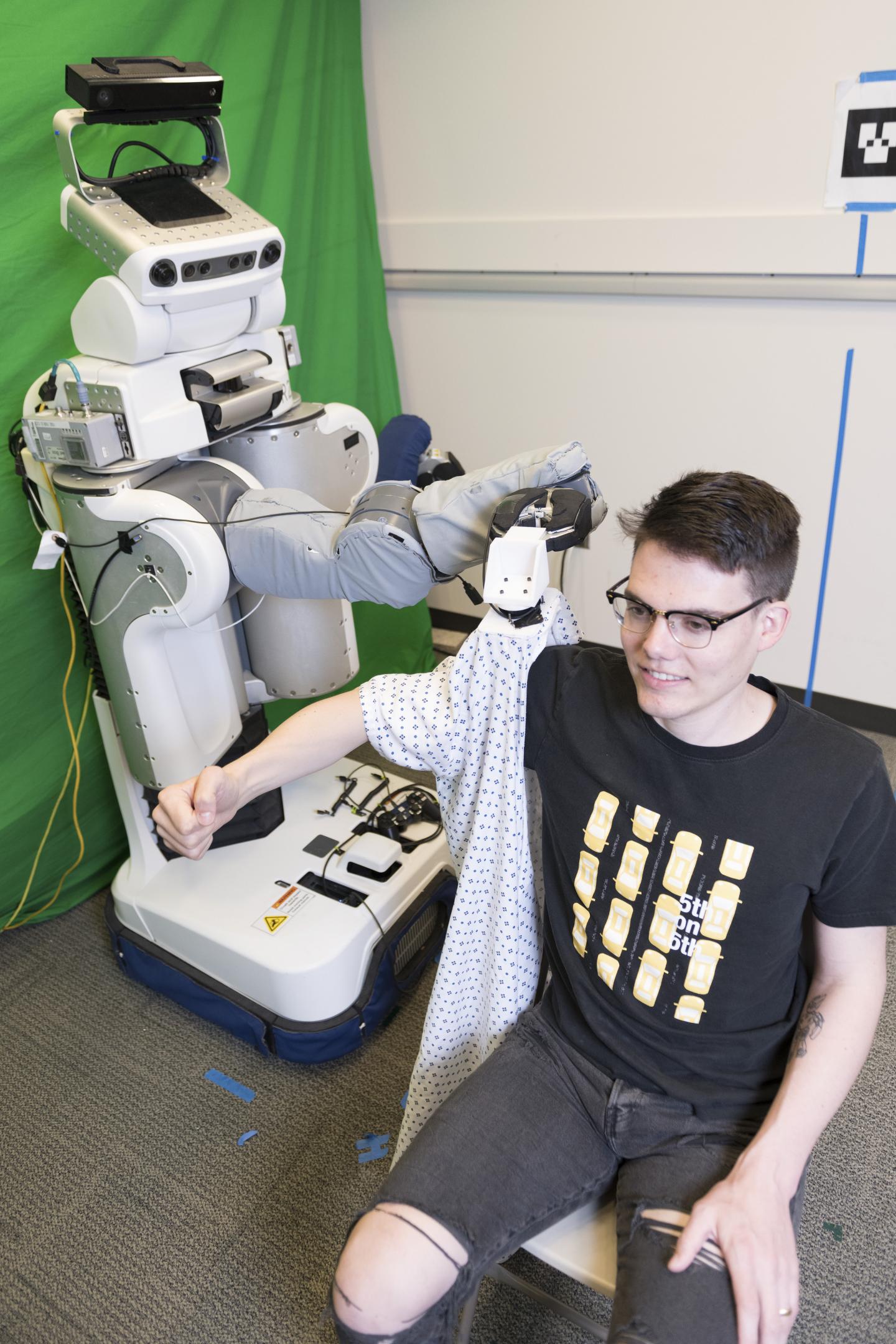
A PR2 robot puts a gown on Henry Clever, a member of the research team. Credit: Georgia Tech

More than 1 million Americans require daily physical assistance to get dressed because of injury, disease and advanced age. Robots could potentially help, but cloth and the human body are complex.

To help address this need, a robot at the Georgia Institute of Technology is successfully sliding hospital gowns on people’s arms. The machine doesn’t use its eyes as it pulls the cloth. Instead, it relies on the forces it feels as it guides the garment onto a person’s hand, around the elbow and onto the shoulder.

The machine, a PR2, taught itself in one day, by analyzing nearly 11,000 simulated examples of a robot putting a gown onto a human arm. Some of those attempts were flawless. Others were spectacular failures — the simulated robot applied dangerous forces to the arm when the cloth would catch on the person’s hand or elbow.

From these examples, the PR2’s neural network learned to estimate the forces applied to the human. In a sense, the simulations allowed the robot to learn what it feels like to be the human receiving assistance.

“People learn new skills using trial and error. We gave the PR2 the same opportunity,” said Zackory Erickson, the lead Georgia Tech Ph.D. student on the research team. “Doing thousands of trials on a human would have been dangerous, let alone impossibly tedious. But in just one day, using simulations, the robot learned what a person may physically feel while getting dressed.”

The robot also learned to predict the consequences of moving the gown in different ways. Some motions made the gown taut, pulling hard against the person’s body. Other movements slid the gown smoothly along the person’s arm. The robot uses these predictions to select motions that comfortably dress the arm.

After success in simulation, the PR2 attempted to dress people. Participants sat in front of the robot and watched as it held a gown and slid it onto their arms. Rather than vision, the robot used its sense of touch to perform the task based on what it learned about forces during the simulations.

“The key is that the robot is always thinking ahead,” said Charlie Kemp, an associate professor in the Wallace H. Coulter Department of Biomedical Engineering at Georgia Tech and Emory University and the lead faculty member. “It asks itself, ‘if I pull the gown this way, will it cause more or less force on the person’s arm? What would happen if I go that way instead?'”

The researchers varied the robot’s timing and allowed it to think as much as a fifth of a second into the future while strategizing about its next move. Less than that caused the robot to fail more often.

“The more robots can understand about us, the more they’ll be able to help us,” Kemp said. “By predicting the physical implications of their actions, robots can provide assistance that is safer, more comfortable and more effective.”

The robot is currently putting the gown on one arm. The entire process takes about 10 seconds. The team says fully dressing a person is something that is many steps away from this work.


Related Articles Read More >

Boltz built its drug-discovery API ‘for agents as much as for people’
NVIDIA Announces BioNeMo Agent Toolkit with traction from nearly 50 partners, including Lilly, Thermo Fisher and Dassault
OpenAI and Molecule.one report a near-autonomous AI chemist that improved a stubborn coupling reaction
MilliporeSigma’s CTO on AI retrosynthesis, the Merck KGaA–Siemens deal and the chemistry that runs the autonomous lab
rd newsletter
EXPAND YOUR KNOWLEDGE AND STAY CONNECTED
Get the latest info on technologies, trends, and strategies in Research & Development.

R&D World Digital Issues

Fall 2025 issue

Browse the most current issue of R&D World and back issues in an easy to use high quality format. Clip, share and download with the leading R&D magazine today.

R&D 100 Awards
Research & Development World
  • Subscribe to R&D World Magazine
  • Sign up for R&D World’s newsletter
  • Contact Us
  • About Us
  • Drug Discovery & Development
  • Pharmaceutical Processing
  • Global Funding Forecast

Copyright © 2026 WTWH Media LLC. All Rights Reserved. The material on this site may not be reproduced, distributed, transmitted, cached or otherwise used, except with the prior written permission of WTWH Media
Privacy Policy | Advertising | About Us

Search R&D World

  • R&D World Home
  • Topics
    • Aerospace
    • Automotive
    • Biotech
    • Careers
    • Chemistry
    • Environment
    • Energy
    • Life Science
    • Material Science
    • R&D Management
    • Physics
  • Technology
    • 3D Printing
    • A.I./Robotics
    • Software
    • Battery Technology
    • Controlled Environments
      • Cleanrooms
      • Graphene
      • Lasers
      • Regulations/Standards
      • Sensors
    • Imaging
    • Nanotechnology
    • Scientific Computing
      • Big Data
      • HPC/Supercomputing
      • Informatics
      • Security
    • Semiconductors
  • R&D Market Pulse
  • R&D 100
    • 2025 R&D 100 Award Winners
    • 2025 Professional Award Winners
    • 2025 Special Recognition Winners
    • R&D 100 Awards Event
    • R&D 100 Submissions
    • Winner Archive
  • Resources
    • Research Reports
    • Digital Issues
    • Educational Assets
    • Subscribe
    • Video
    • Webinars
    • Content submission guidelines for R&D World
  • Global Funding Forecast
  • Top Labs
  • Advertise
  • SUBSCRIBE