 Salesforce and Veeva Systems are heading toward a historic separation after nearly two decades of partnership. Veeva will not renew its Salesforce platform agreement after September 2025. Veeva CRM on Salesforce is in stability mode and supported through September 2030. Vault CRM has been their proposed go-forward plan for new customers since April 2025, giving pharmaceutical companies a five-year window to choose sides in what’s shaping up to be the industry’s biggest platform migration.
The split matters because Veeva CRM, which commands roughly 80% of the life sciences CRM market, has run on Salesforce’s platform since 2007. Now thousands of life sciences teams must revisit their entire tech stack: roadmaps, integrations, data strategies, and vendor relationships.
Salesforce’s counter-offensive centers on Life Sciences Cloud, with clinical-trial and patient-services features live today and the Customer Engagement component scheduled for GA in October 2025. Big pharma companies including Takeda have signed on as early adopters, while IQVIA, a prominent life sciences data provider, have joined forces with Salesforce. The IQVIA partnership allows for seamless activation of IQVIA’s analytics, data, and insights informed by deep industry expertise into Salesforce’s purpose-built digital labor Platform, bringing in HCP insights and helping streamline the upgrade to Life Sciences Cloud.

Frank Defesche
Helping lead Salesforce’s clinical, medical, and commercial product play is Frank Defesche, SVP & GM of Life Sciences, who spent 16 years helping build Veeva into a market leader before returning to Salesforce two years ago after an earlier seven-year stint with the company from 2000 to 2007. His message is that the end of the Salesforce–Veeva partnership opens the door for direct competition. He believes that competition will improve the market. “This competition is good for the market,” Defesche tells R&D World. “At the end of the day, most of the efficiency gains from AI require the data to be connected. Data Cloud is the secret sauce for all of it, because it’s what feeds the data to the agent.”
The stakes are considerable. Health data accounts for an estimated 36% of the world’s data while life sciences companies operate across a maze of systems. Both platforms are betting that whoever best connects this sprawl—and layers intelligent automation on top—will define the next era of life sciences platforms.
The migration clock is already ticking
While the 2030 support deadline might seem distant, Defesche clarifies that “the real deadline is 2030: that’s when the five-year wind-down period ends.” But the practical timeline is much shorter for large enterprises. “Nobody wants to wait because they realize the pressures life sciences companies face today require an offset, and AI can provide that.”
The math is forcing decisions now. As Defesche notes, “A large global pharma implementation can take two to three years, versus three months for a small biotech,” a timeline differential that’s creating urgency among the biggest players. According to Defesche’s assessment, “a majority of the top-30 life sciences companies will have made a selection this year. A third of them already have.”
Agentforce takes on clinical trials
At the heart of Salesforce’s strategy is Agentforce, its AI agent platform that promises to transform how pharmaceutical companies run clinical trials, a common pain point where delays cost millions and can mean the difference between market leadership and obsolescence. “The faster you can run clinical trials, the faster you can get therapies to market,” Defesche explains.
Salesforce’s answer is the Intelligent Clinical Engagement Platform, which attacks the fragmentation problem head-on. The platform pulls together what Defesche describes as “all the systems of record used by the site, the CRO, and the sponsor” into Data Cloud, then deploys a collaborative AI agent layer on top. “Anyone—a patient, a clinical investigator, a sponsor—can ask a question, and an agent can get the answer from across these previously disconnected systems,” he explains.
This helps address common bottlenecks throughout the trial process. “This helps us get patients enrolled faster, set up sites faster, and help ensure protocol adherence during the trial. To me, AI is your personal assistant and your personal research team,” Defesche says.
The migration timeline
September 2025: Veeva’s original Salesforce platform agreement ends; Veeva CRM on Salesforce is in stability mode
October 2025: Salesforce Life Sciences Cloud for Customer Engagement GA
2025-2027: Peak migration period for large pharma (typical 2-3 years), while small biotechs can migrate in roughly 3 months
September 2030: Support for Veeva CRM on Salesforce ends
Historically, trials have had arthritic systems and processes—both old and painful.
—Defesche
For an industry where patient recruitment alone can consume a significant chunk of a trial’s timeline, and where many trials fail to meet enrollment targets, the promise of intelligent orchestration could be transformative. The platform uses generative AI to match patients to trials based on prescreening and eligibility criteria, with clinical research coordinators able to use Agentforce to generate segments of eligible patients near trial sites using EHR and other connected data.
Where AI delivers ROI today
While much of the industry’s attention is on AI’s long-term potential, Defesche emphasizes that measurable results are already appearing. “The ones we see most in production are around patient engagement: automating benefits verification and providing real-time patient outcome recommendations,” he says.
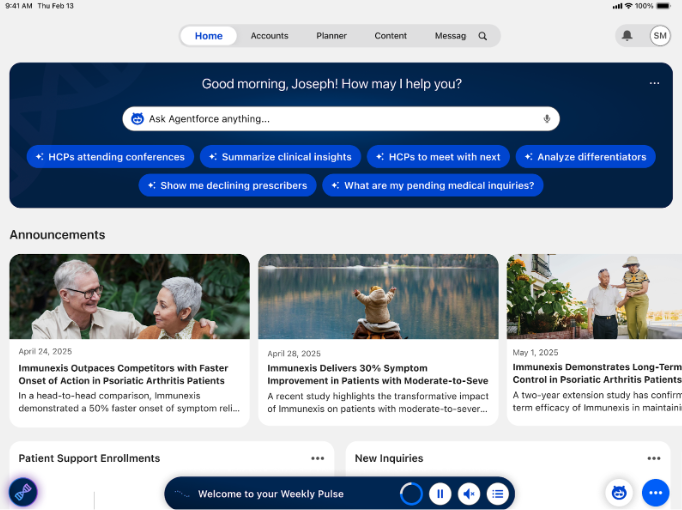
For clinical operations, AI agents are handling participant recruiting, enrollment, and site selection, attacking the chronic delays that plague trial timelines. The commercial and medical teams are seeing dramatic changes. “The commercial and medical space is using AI to synthesize everything going on with an account and make it consumable for a rep through an audio readout, then generate the right engagement plan,” Defesche said.
Among the features slated for October 2025 is a field-ready mobile experience in Life Sciences Cloud for Customer Engagement that ties Data Cloud insights and Agentforce into reps’ workflows. In Salesforce demos, reps capture visit notes on mobile and receive auto-summaries, compliance checks, and next-best-action recommendations. Reps can even ask Agentforce “How do I increase my visit plan attainment?” and receive specific recommendations with automated visit planning.
Salesforce sees agents transforming even mundane tasks. “There are also valuable use cases like data governance and state license verification that agents can handle,” Defesche said.
These capabilities illustrate how Salesforce is positioning AI agents as practical tools for day-to-day work, not just future promises. “There’s so much rhetoric around AI,” Defesche notes, emphasizing that seeing actual demonstrations provides clarity about what’s possible today versus what remains aspirational.
The open ecosystem gambit
Salesforce is betting that pharmaceutical companies will prefer flexibility over vertical integration—a direct challenge to Veeva’s more closed approach. “Salesforce has this massive, open ecosystem because there is strength in numbers and value in options,” Defesche argues. “The future isn’t future-proof; you need to be future-ready, and an open ecosystem is critical for that.”
The IQVIA partnership exemplifies this strategy: rather than building competing data assets, Salesforce enables customers to bring IQVIA data directly into Data Cloud for activation. But the ecosystem play goes deeper than traditional integrations.
Key partners include athenahealth for EHR data exchange, H1 for comprehensive HCP profiles, Infinitus.ai for real-time insurance verification, and Honeywell for quality management. Migration partners like Accenture, Deloitte, and PwC are helping guide 2–3 year enterprise transitions.
AI is your personal assistant and your personal research team.
—Defesche
Defesche describes an emerging paradigm of agent-to-agent collaboration, citing partnerships with companies like Viz.ai, which applies AI to help healthcare providers better understand medical scans. “They have agents, we have agents, and our agents are talking to each other,” he explains. “The narrative is shifting from integrating multiple platforms to having different AI capabilities and agents that talk to each other.”
This distributed agent architecture brings its own challenges. Defesche warns of “agentic technical debt”—the risk that proliferating AI agents without proper governance could create new forms of complexity. “A lot of what you see coming from Salesforce is about agent-to-agent collaboration and governance,” he says, suggesting that managing the interplay between multiple AI systems will become as important as the individual agents themselves.
Competing on focus and execution
Defesche brings unique perspective to the battle, having spent 16 years at Veeva building the very systems Salesforce now aims to displace. He joined Veeva when it had no customers, led the professional services team that implemented the first Veeva CRM deployments, and built the global organization managing those implementations.
His experience shaped two core principles now driving Salesforce’s approach. “Focus pays off,” he says, explaining how success requires “going deep” rather than “going wide” in life sciences, with unwavering commitment to industry-specific needs and regulations. The second: “Execution matters most. There are great ideas everywhere, especially with every company talking about AI. But executing on those ideas is usually what’s in short supply. Customer success is the top priority. You want to be known for reliable, trusted execution.”
What comes next
Salesforce’s Life Sciences Cloud for Customer Engagement launches in October 2025, marking the first real alternative to Veeva’s migration path to Vault CRM. The success or failure of early adopters like Takeda will likely influence how quickly—or slowly—the rest of the industry moves.
For pharmaceutical companies, the decision transcends typical vendor selection. The choice between Salesforce and Veeva increasingly looks like a choice between two different visions of pharmaceutical technology: one betting on open ecosystems and agent collaboration, the other on deep vertical specialization.
Defesche remains optimistic about competition’s benefits: “This competition is good for the market.” After years of limited options in life sciences CRM, pharmaceutical companies finally have leverage—and a reason to think strategically about their technology foundations.
As for the data fragmentation that plagues the industry? “At the end of the day, most of the efficiency gains from AI require the data to be connected,” Defesche reiterates. Whether Salesforce’s Data Cloud proves to be the “secret sauce” he claims, or whether Veeva’s deep industry focus wins out, one thing is certain: the next five years will reshape how pharmaceutical companies manage everything from molecule to market.