Research & Development World

  • R&D World Home
  • Topics
    • Aerospace
    • Automotive
    • Biotech
    • Careers
    • Chemistry
    • Environment
    • Energy
    • Life Science
    • Material Science
    • R&D Management
    • Physics
  • Technology
    • 3D Printing
    • A.I./Robotics
    • Software
    • Battery Technology
    • Controlled Environments
      • Cleanrooms
      • Graphene
      • Lasers
      • Regulations/Standards
      • Sensors
    • Imaging
    • Nanotechnology
    • Scientific Computing
      • Big Data
      • HPC/Supercomputing
      • Informatics
      • Security
    • Semiconductors
  • R&D Market Pulse
  • R&D 100
    • 2025 R&D 100 Award Winners
    • 2025 Professional Award Winners
    • 2025 Special Recognition Winners
    • R&D 100 Awards Event
    • R&D 100 Submissions
    • Winner Archive
  • Resources
    • Research Reports
    • Digital Issues
    • Educational Assets
    • R&D Index
    • Subscribe
    • Video
    • Webinars
    • Content submission guidelines for R&D World
  • Global Funding Forecast
  • Top Labs
  • Advertise
  • SUBSCRIBE

Scientists Design Solar Cell That Captures Nearly All Energy of Solar Spectrum

By GW School of Engineering and Applied Science | July 11, 2017

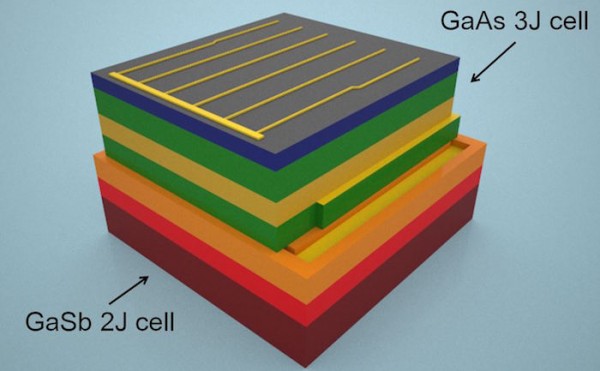
Scientists have designed and constructed a prototype for a new solar cell that integrates multiple cells stacked into a single device capable of capturing nearly all of the energy in the solar spectrum. The new design converts direct sunlight to electricity with 44.5 percent efficiency, giving it the potential to become the most efficient solar cell in the world.

The approach is different from the solar panels one might commonly see on rooftops or in fields. The new device uses concentrator photovoltaic (CPV) panels that employ lenses to concentrate sunlight onto tiny, micro-scale solar cells. Because of their small size—less than one millimeter square—solar cells utilizing more sophisticated materials can be developed cost effectively.

The stacked cell acts almost like a sieve for sunlight, with the specialized materials in each layer absorbing the energy of a specific set of wavelengths. By the time the light is funneled through the stack, just under half of the available energy has been converted into electricity. By comparison, the most common solar cell today converts only a quarter of the available energy into electricity.

“Around 99 percent of the power contained in direct sunlight reaching the surface of Earth falls between wavelengths of 250 nm and 2500 nm, but conventional materials for high-efficiency multi-junction solar cells cannot capture this entire spectral range,” said Matthew Lumb, lead author of the study and a research scientist at the GW School of Engineering and Applied Science. “Our new device is able to unlock the energy stored in the long-wavelength photons, which are lost in conventional solar cells, and therefore provides a pathway to realizing the ultimate multi-junction solar cell.”

While scientists have worked towards more efficient solar cells for years, this approach has two novel aspects. First, it uses a family of materials based on gallium antimonide (GaSb) substrates, which are usually found in applications for infra-red lasers and photodetectors. The novel GaSb-based solar cells are assembled into a stacked structure along with high efficiency solar cells grown on conventional substrates that capture shorter wavelength solar photons. In addition, the stacking procedure uses a technique known as transfer-printing, which enables three dimensional assembly of these tiny devices with a high degree of precision.

This particular solar cell is very expensive, however researchers believe it was important to show the upper limit of what is possible in terms of efficiency. Despite the current costs of the materials involved, the technique used to create the cells shows much promise. Eventually a similar product may be brought to market, enabled by cost reductions from very high solar concentration levels and technology to recycle the expensive growth substrates.

The research builds off of the advancements made by the MOSAIC Program, a $24 million research project funded by the Advanced Research Projects Agency-Energy (ARPA-E) that funds 11 separate teams across the U.S., each seeking to develop technologies and concepts to revolutionize photovoltaic performance and reduce costs. The researchers note that funding for this type of research is essential for developing viable commercial technology in the future.

The study, “GaSb-based Solar Cells for Full Solar Spectrum Energy Harvesting,” was published in Advanced Energy Materials.
Related Articles Read More >

U.S.–China pause eases rare-earth shock risk, but supply security questions remain
Materials driving the next phase in semiconductor performance
An easier way to separate rare earth elements
ORNL named on 20 R&D 100 Awards, including carbon-capture and AM tools
rd newsletter
EXPAND YOUR KNOWLEDGE AND STAY CONNECTED
Get the latest info on technologies, trends, and strategies in Research & Development.
RD 25 Power Index

R&D World Digital Issues

Fall 2024 issue

Browse the most current issue of R&D World and back issues in an easy to use high quality format. Clip, share and download with the leading R&D magazine today.

Research & Development World
  • Subscribe to R&D World Magazine
  • Sign up for R&D World’s newsletter
  • Contact Us
  • About Us
  • Drug Discovery & Development
  • Pharmaceutical Processing
  • Global Funding Forecast

Copyright © 2025 WTWH Media LLC. All Rights Reserved. The material on this site may not be reproduced, distributed, transmitted, cached or otherwise used, except with the prior written permission of WTWH Media
Privacy Policy | Advertising | About Us

Search R&D World

  • R&D World Home
  • Topics
    • Aerospace
    • Automotive
    • Biotech
    • Careers
    • Chemistry
    • Environment
    • Energy
    • Life Science
    • Material Science
    • R&D Management
    • Physics
  • Technology
    • 3D Printing
    • A.I./Robotics
    • Software
    • Battery Technology
    • Controlled Environments
      • Cleanrooms
      • Graphene
      • Lasers
      • Regulations/Standards
      • Sensors
    • Imaging
    • Nanotechnology
    • Scientific Computing
      • Big Data
      • HPC/Supercomputing
      • Informatics
      • Security
    • Semiconductors
  • R&D Market Pulse
  • R&D 100
    • 2025 R&D 100 Award Winners
    • 2025 Professional Award Winners
    • 2025 Special Recognition Winners
    • R&D 100 Awards Event
    • R&D 100 Submissions
    • Winner Archive
  • Resources
    • Research Reports
    • Digital Issues
    • Educational Assets
    • R&D Index
    • Subscribe
    • Video
    • Webinars
    • Content submission guidelines for R&D World
  • Global Funding Forecast
  • Top Labs
  • Advertise
  • SUBSCRIBE