Scientists using NASA’s James Webb Space Telescope (JWST) spotted the farthest galaxy, called MoM-z14, detected to date, NASA announced last week. The galaxy existed just 280 million years after the Big Bang. In comparison, the Milky Way formed 800 million years after the Big Bang. The scientists published a paper on the galaxy in the Open Journal of Astrophysics.
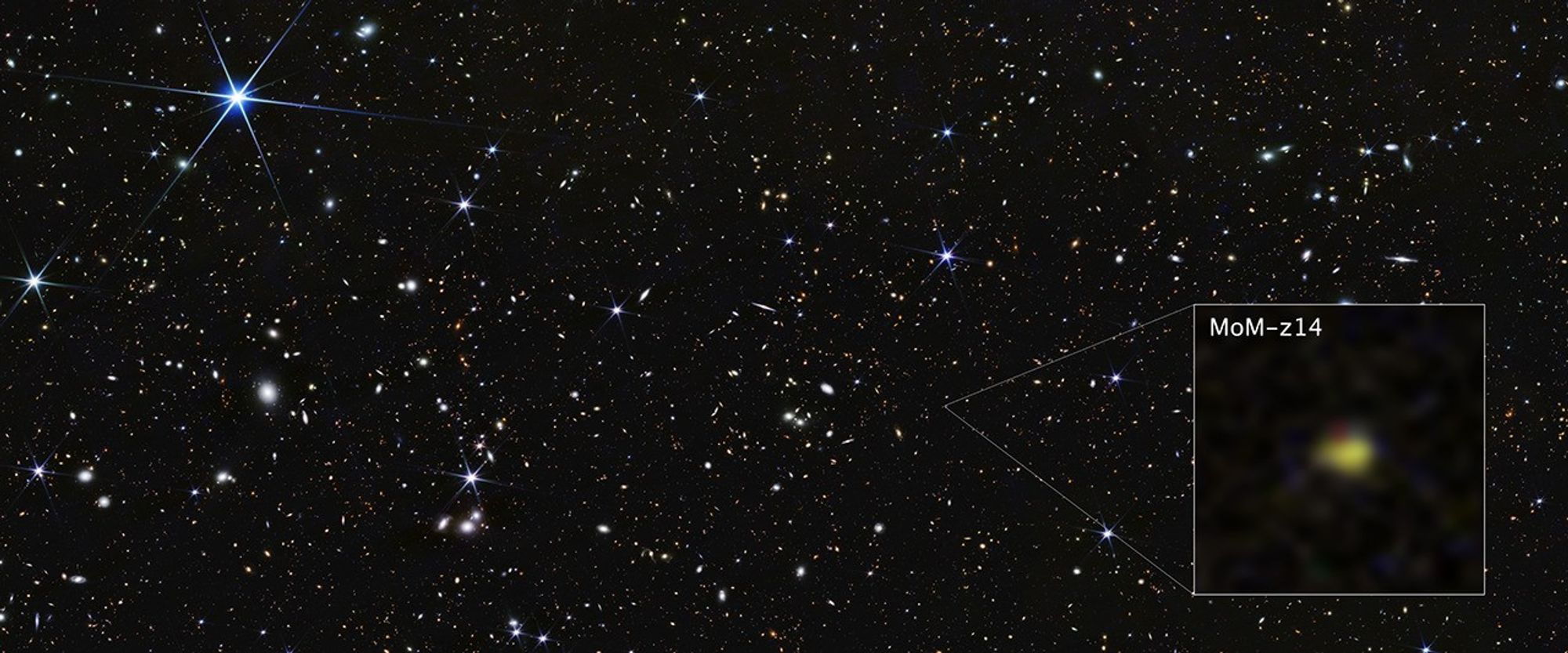
NASA’s James Webb Space Telescope shows galaxy MoM-z14 as it appeared in the distant past, only 280 million years after the universe began in the big bang. Image: NASA, ESA, CSA, STScI, Rohan Naidu (MIT); Image Processing: Joseph DePasquale (STScI)
The scientists were able to date the galaxy using Webb’s near-infrared spectrograph (NIRSpec) instrument. They confirmed that MoM-z14 has a cosmological redshift of 14.44, meaning that its light has been traveling through space for about 13.5 billion years of the universe’s estimated 13.8 billion years of existence. This means that scientists are seeing MoM-z14 as it existed 13 billion years ago, 280 million years after the Big Bang.
“With Webb, we are able to see farther than humans ever have before, and it looks nothing like what we predicted, which is both challenging and exciting,” Rohan Naidu of the Massachusetts Institute of Technology’s Kavli Institute for Astrophysics and Space Research, lead author of the paper, said in the NASA announcement.
The galaxy is unexpectedly bright for one so young. The number density of bright galaxies at this distance is 182 times larger than what JWST models predicted. This is odd because the galaxy shouldn’t have had enough time for stars to form and die or accumulate enough mass to shine so brightly.
There are several possible explanations. One is that early galaxies’ stars might sputter, resulting in a variable luminosity that scientists sometimes see at its peak. It is also possible that early galaxies might convert gas into stars far more efficiently than galaxies do today.
Alternatively, the different conditions of the early universe might have something to do with this phenomenon. These different conditions could have changed the star formation processes from the ones scientists have observed today. Early galaxies also had less dust, possibly allowing more light to escape, making them appear brighter than expected.
Interestingly, a small percentage of the stars in MoM-z14 show high amounts of nitrogen, which is also evident in some of the oldest stars of the Milky Way. With MoM-z14 existing only 280 million years after the Big Bang, there was not enough time for stars to produce this high amount of nitrogen in the way astronomers would expect. One theory is that the dense environment of the early universe produced supermassive stars capable of producing more nitrogen than stars observed in the local universe.
MoM-z14 also shows signs of clearing the thick hydrogen fog of the early universe in the space surrounding the galaxy. This process is called reionization, and the Webb telescope was originally built with a goal of defining the timeline of reionization. It occurred when early stars produced light with enough energy to break through the hydrogen gas and begin travelling through space. Detecting MoM-z14 is an important step toward accomplishing this goal.

Tell Us What You Think!
You must be logged in to post a comment.