Research & Development World

  • R&D World Home
  • Topics
    • Aerospace
    • Automotive
    • Biotech
    • Careers
    • Chemistry
    • Environment
    • Energy
    • Life Science
    • Material Science
    • R&D Management
    • Physics
  • Technology
    • 3D Printing
    • A.I./Robotics
    • Software
    • Battery Technology
    • Controlled Environments
      • Cleanrooms
      • Graphene
      • Lasers
      • Regulations/Standards
      • Sensors
    • Imaging
    • Nanotechnology
    • Scientific Computing
      • Big Data
      • HPC/Supercomputing
      • Informatics
      • Security
    • Semiconductors
  • R&D Market Pulse
  • R&D 100
    • 2025 R&D 100 Award Winners
    • 2025 Professional Award Winners
    • 2025 Special Recognition Winners
    • R&D 100 Awards Event
    • R&D 100 Submissions
    • Winner Archive
  • Resources
    • Research Reports
    • Digital Issues
    • Educational Assets
    • R&D Index
    • Subscribe
    • Video
    • Webinars
    • Content submission guidelines for R&D World
  • Global Funding Forecast
  • Top Labs
  • Advertise
  • SUBSCRIBE

Researchers discover new form of water

By Julia Rock-Torcivia | January 16, 2026

An international research team led by scientists from the University of Rostock, CNRS-École Polytechnique in France, and Helmholtz-Zentrum Dresden-Rossendorf has discovered a previously unknown form of superionic water. The team experimentally discovered a highly electrically conductive phase at the European XFEL X-ray laser near Hamburg, Germany, and the Linac Coherent Light Source (LCLS) at SLAC National Accelerator Laboratory in California. The phase may occur inside ice giants such as Uranus and Neptune. 

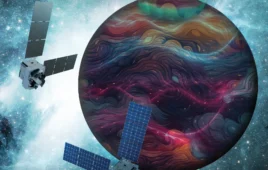
Schematic representation of the microscopic structure of superionic water, in which the oxygen atoms form a solid crystal lattice, while hydrogen ions are virtually free to move within it. With the aid of powerful lasers, this extreme state, which otherwise only occurs inside large planets, could be measured experimentally.
(Greg Stewart / SLAC National Accelerator Laboratory)

Superionic water

Superionic water only forms under extreme conditions at temperatures of several thousand degrees Celsius and pressures of 1.5 million atmospheres. The conditions transform water into an unusual state in which hydrogen ions move freely through a solid lattice of oxygen atoms, representing a new state of matter that is neither strictly solid nor liquid. 

In the 1980s, the Voyager 2 spacecraft revealed that Uranus and Neptune have off-center magnetic fields. Because the phase conducts electrical current, researchers believe that it could be associated with the formation of the magnetic fields of ice giants. The flow of hydrogen ions within the superionic ice acts like an electrical current, which could generate the strange, multipolar magnetic fields observed by Voyager 2. Additionally, due to the large amounts of water in Uranus and Neptune, superionic water could be the most abundant form of water in the solar system. 

Although superionic water has already been produced in previous experiments, its detailed structure remained unclear until now. Previous studies have suggested that the oxygen atoms in superionic ice arrange themselves in either of the two variants of a cube lattice. However, the new study suggests that the structure of superionic water combines both face-centered cubic and hexagonal close-packed stacking. 

The latter describes a layering of closely packed atoms in hexagonal patterns and leads to significant stacking errors. Instead of arranging in a regular configuration, the oxygen atoms form a hybrid, misstructured sequence that is only visible by high-precision measurements from X-ray lasers.

The team conducted two experiments on the instruments in both facilities, which enable researchers to compress water to pressures of more than 1.5 million atmospheres and heat it to several thousand degrees Celsius while recording its atomic structure. 

The results show that superionic water can exhibit structural diversity similar to that of ice, which forms a variety of different crystal structures depending on the temperature and pressure. The findings provide valuable information for improved models of the interiors of ice giants, which are common throughout the universe. 
Related Articles Read More >

Scientists find farthest galaxy ever detected
NASA tests AI route planning for Perseverance rover drives on Mars
Dec 8, 2019 Hawthorne / Los Angeles / CA / USA - close up of SpaceX (Space Exploration Technologies Corp.) sign at their headquarters; SpaceX is a private American aerospace manufacturer
The 12-year quest behind the SpaceX-xAI merger: From a 2012 warning about AI destroying Mars colonies to a $1.25 trillion deal
Buildings on Mars could be made of ice
rd newsletter
EXPAND YOUR KNOWLEDGE AND STAY CONNECTED
Get the latest info on technologies, trends, and strategies in Research & Development.
RD 25 Power Index

R&D World Digital Issues

Fall 2025 issue

Browse the most current issue of R&D World and back issues in an easy to use high quality format. Clip, share and download with the leading R&D magazine today.

R&D 100 Awards
Research & Development World
  • Subscribe to R&D World Magazine
  • Sign up for R&D World’s newsletter
  • Contact Us
  • About Us
  • Drug Discovery & Development
  • Pharmaceutical Processing
  • Global Funding Forecast

Copyright © 2026 WTWH Media LLC. All Rights Reserved. The material on this site may not be reproduced, distributed, transmitted, cached or otherwise used, except with the prior written permission of WTWH Media
Privacy Policy | Advertising | About Us

Search R&D World

  • R&D World Home
  • Topics
    • Aerospace
    • Automotive
    • Biotech
    • Careers
    • Chemistry
    • Environment
    • Energy
    • Life Science
    • Material Science
    • R&D Management
    • Physics
  • Technology
    • 3D Printing
    • A.I./Robotics
    • Software
    • Battery Technology
    • Controlled Environments
      • Cleanrooms
      • Graphene
      • Lasers
      • Regulations/Standards
      • Sensors
    • Imaging
    • Nanotechnology
    • Scientific Computing
      • Big Data
      • HPC/Supercomputing
      • Informatics
      • Security
    • Semiconductors
  • R&D Market Pulse
  • R&D 100
    • 2025 R&D 100 Award Winners
    • 2025 Professional Award Winners
    • 2025 Special Recognition Winners
    • R&D 100 Awards Event
    • R&D 100 Submissions
    • Winner Archive
  • Resources
    • Research Reports
    • Digital Issues
    • Educational Assets
    • R&D Index
    • Subscribe
    • Video
    • Webinars
    • Content submission guidelines for R&D World
  • Global Funding Forecast
  • Top Labs
  • Advertise
  • SUBSCRIBE