Sustaining life on Mars has been a dream for many generations. While Mars has some similarities with Earth, such as polar ice caps and seasons, it is far too cold for humans to live comfortably. The atmosphere is 100 times thinner than Earth’s and is mostly made up of carbon dioxide.
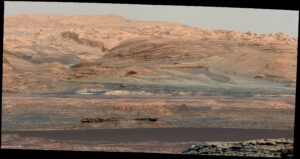
Picture of Mars surface from Perseverance Rover
Still, many think Mars is humanity’s best shot at a second home. Researchers might have just brought us one step closer to that reality. At the annual meeting of the American Geophysical Union, a research team showed that ice, which Mars has in abundance, could be molded into insulated, durable structures that could shield humans from harmful sun rays.
Over 5 million cubic kilometers of ice exist on or near Mars’ surface, and scientists predict there is more beneath the crust. Scientists from Harvard University investigated whether it could be of use for sustaining life on Mars, finding that using ice as a building material would decrease the number of supply trips from Earth as well as provide other benefits. Ice naturally blocks ultraviolet light, meaning it would protect humans from radiation while still allowing light and heat to enter.
The scientists modeled ice habitats as domes with chambers for living and agriculture. They found that a layer of ice a few meters thick could raise the internal temperature from about minus 120 degrees Celsius to minus 20 degrees Celsius without melting the ice.
The team modeled ice’s structural properties, utilizing previous research that found that lacing ice with organic materials could increase its resistance and flexibility. They also determined how to keep the ice structures from dissipating into the atmosphere due to sublimation, which is when a solid transitions directly into a gas. The team concluded that a water-resistant coating, likely brought from Earth, could solve that problem.
The scientists determined that about 15 square meters of ice — about the size of a parking spot — could be processed per day with a power source equivalent to the International Space Station, approximately 84 to 120 kilowatts when solar arrays are fully illuminated by the sun. Even extracting the ice from the surface would require drilling systems and equipment from Earth, as well as energy to power these processes. Additionally, Mars’ frequent dust storms would gradually decrease the ice’s transparency and block out light, according to Adomas Valantinas, a postdoctoral planetary scientist at ETH Zürich, who has studied the use of ice and dust on Mars but was not involved in the new research.
Still, this research provides a possible building material for structures on Mars that wouldn’t have to be transported from Earth and exists in abundance, with some questions remaining to be answered.