By simulating the life cycle of a minimal bacterial cell from DNA replication to protein translation to metabolism and cell division, scientists from the University of Illinois Urbana-Champaign have opened a new frontier of computational modeling into the essential processes of life. The researchers published their findings in the journal Cell.
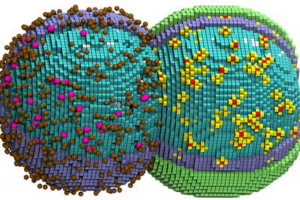
A simulated cell in the early stages of division. Left half shows cytoplasm (blue cubes), mRNA degradation machinery molecules (pink), and sugar transporters (brown). Right half adds the membrane (green) and ribosomes (yellow/red). (Graphic by Zane Thornburg, as part of Figure 1 of the paper, “Bringing the genetically minimal cell to life on a computer in 4D.” Journal: Cell. DOI: 10.1016/j.cell.2026.02.009.)
The research team simulated a living cell at nanoscale resolution, recapitulating how every molecule within the cell behaved over the course of a full cell cycle. They accounted for every gene, protein, RNA molecule and chemical reaction occurring in the cell to recreate the timing of cellular events.
The JCVI-syn3A: A living cell with a bare-bones genome
The team used a living “minimal cell” developed at the J. Craig Venter Institute in California. The version of the cell used in the new study, JCVI-syn3A — “Syn3A” for short — is a modified bacterium with a pared-down genome that carries only the genes needed to replicate its DNA, grow, divide and perform most of the other functions that make life possible. The Syn3A cell has 493 genes, all residing on a single circular strand of DNA.
Andrew Maytin, a graduate student in the lab, realized that chromosome replication was slowing the simulation, nearly doubling the time it took to capture the cell cycle. He determined that efficiently simulating the cell’s DNA replication process required its own dedicated graphics processing unit (GPU), while another handled the other cellular dynamics. This solution allowed the team to simulate the full 105 minute cell cycle in six days of computer time.
“I can’t overstate how hard it is to simulate things that are moving — and doing it in 3D for an entire cell was … triumphant,” said Zane Thornburg, a postdoctoral fellow who performed the simulations with Maytin. “One of the last big hurdles that Andrew and I had to solve was understanding how the membrane and the DNA talk to one another when both are moving.”
Simulating the timing of life through molecular averaging
The simulation was not an atom-by-atom simulation. Instead, it averaged the dynamics of individual molecules, yielding an accurate accounting of the timing of cellular processes. In repeated simulations involving individual cells with slightly varying start conditions, the simulated cell cycle occurred, on average, within two minutes of the real-world cell cycle.
The ability to accurately capture the ever-changing conditions within a living cell opens a new window on the foundations of living systems, said Zan Luthey-Schulten, who led the research.
“We have a whole-cell model that predicts many cellular properties simultaneously,” she said. “If you want to know what’s going on, say, in nucleotide metabolism, you can also look at what’s going on in DNA replication and the biogenesis of ribosomes. So the simulations can give you the results of hundreds of experiments simultaneously.”