Research & Development World

  • R&D World Home
  • Topics
    • Aerospace
    • Automotive
    • Biotech
    • Careers
    • Chemistry
    • Environment
    • Energy
    • Life Science
    • Material Science
    • R&D Management
    • Physics
  • Technology
    • 3D Printing
    • A.I./Robotics
    • Software
    • Battery Technology
    • Controlled Environments
      • Cleanrooms
      • Graphene
      • Lasers
      • Regulations/Standards
      • Sensors
    • Imaging
    • Nanotechnology
    • Scientific Computing
      • Big Data
      • HPC/Supercomputing
      • Informatics
      • Security
    • Semiconductors
  • R&D Market Pulse
  • R&D 100
    • 2026 R&D 100 Award Winners
    • 2026 Professional Award Winners
    • 2026 Special Recognition Winners
    • R&D 100 Awards Event
    • R&D 100 Submissions
    • Winner Archive
  • Resources
    • Research Reports
    • Digital Issues
    • Educational Assets
    • Subscribe
    • Video
    • Webinars
    • PharmSci360
    • Content submission guidelines for R&D World
  • Global Funding Forecast
  • Top Labs
  • Advertise
  • SUBSCRIBE

Secrets of Carbon Nanotubes Unlocked

By Ural Federal University | December 19, 2017

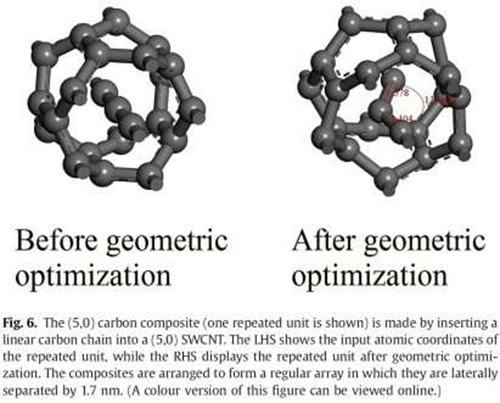
The geometric structure ‘a carbon chain in a tube’ before and after optimization. Image: Chi Ho Wong

Scientists from Ural Federal University (UrFU), together with their colleagues from Lomonosov Moscow State University, have discovered a mathematical method to calculate the temperature at which single-walled carbon nanotubes became superconductors and have developed a way to increase it, thus opening new prospects for superconductive materials application. The work was published in the journal Carbon.

Superconducting materials that are able to conduct electricity without resistance are used in cyclotrons, magnetic trains, power lines, and super-sensitive magnetometers (devices used to measure the Earth’s magnetic field). Still, the main issue with superconductivity is that it is expressed at temperatures slightly above absolute zero (-273°C). If a material is superconductive around -70°C, it is aiming at a record. The leader among all materials is hydrogen sulfide frozen under incredible pressure — it becomes a superconductor at -70°C.

“Room temperature superconductivity is the dream of humanity. For example, your mobile phone would not need to recharge anymore, and electricity can run forever,” says Dr. Chi Ho Wong, a postdoc of Ural Federal University and a co-author of the work.

The ability of carbon to form flat, one-atom-thick graphene sheets (separate graphite layers) has attracted the attention of scientists. Rolling such a sheet to make a tube produces another interesting structure — a single-walled carbon nanotube (SWCNT). These structures are highly tensile, refract light in an unusual manner, and may be used in many areas from electronics to biomedicine. Atoms inserted in the walls of such tubes may change their properties, including conductivity. It may depend on the orientation of hexagons that form the carbon layer, on the filling of the tube, or on additionally inserted or attached atoms of other elements.

Single-walled carbon nanotubes are actively studied as prospective superconductors. However, their diameter equals only 4 angstroms (four-tenths of a nanometer), therefore they are close to 1-D materials. At temperatures close to absolute zero, so-called Cooper pairs of electrons form within them. In the absence of curvature, Cooper pairs do not form, and no superconductivity is observed.

“Our task was to change the 1-D structure in order to increase the temperature of superconductive transition,” says Anatoly Zatsepin, the head of a scientific research laboratory at Institute of Physics and Technology, UrFU. “It turned out that if you pile SWCNTs up, Cooper pairs stabilize, and a superconductor is formed.” Still, even such piles require quite low temperatures to exhibit superconductive properties — only 15 degrees above absolute zero.

Physicists found a solution for this issue. They added a one-atom-wide carbon “wire” inside an SWCNT. The chain itself does not form bonds with the atoms of the tube, but it makes the tube change its own geometry and flex.

When the team from UrFU changed the shape of the internal carbon chain from straight to zigzag-like, they managed to increase the temperature of superconductivity transition by 45 degrees. To achieve the best effect, the angles of zigzags were mathematically calculated, and the predictions proved to be correct.

Source: Ural Federal University
Related Articles Read More >

Researchers developed quantum nanosensors that can measure the temperature of a single cell
Overcoming the 100-nanometer barrier: New microbottle resonators scale up optical trapping
R&D 100 winner LLNL achieves 1,000x speed boost in 3D nanofabrication
CEA-Leti achieves 400°C CMOS fabrication milestone for 3D chip stacking
rd newsletter
EXPAND YOUR KNOWLEDGE AND STAY CONNECTED
Get the latest info on technologies, trends, and strategies in Research & Development.

R&D World Digital Issues

Fall 2025 issue

Browse the most current issue of R&D World and back issues in an easy to use high quality format. Clip, share and download with the leading R&D magazine today.

R&D 100 Awards
Research & Development World
  • Subscribe to R&D World Magazine
  • Sign up for R&D World’s newsletter
  • Contact Us
  • About Us
  • Drug Discovery & Development
  • Pharmaceutical Processing
  • Global Funding Forecast

Copyright © 2026 Arrowfly LLC. All Rights Reserved. The material on this site may not be reproduced, distributed, transmitted, cached or otherwise used, except with the prior written permission of Arrowfly
Privacy Policy | Advertising | About Us

Search R&D World

  • R&D World Home
  • Topics
    • Aerospace
    • Automotive
    • Biotech
    • Careers
    • Chemistry
    • Environment
    • Energy
    • Life Science
    • Material Science
    • R&D Management
    • Physics
  • Technology
    • 3D Printing
    • A.I./Robotics
    • Software
    • Battery Technology
    • Controlled Environments
      • Cleanrooms
      • Graphene
      • Lasers
      • Regulations/Standards
      • Sensors
    • Imaging
    • Nanotechnology
    • Scientific Computing
      • Big Data
      • HPC/Supercomputing
      • Informatics
      • Security
    • Semiconductors
  • R&D Market Pulse
  • R&D 100
    • 2026 R&D 100 Award Winners
    • 2026 Professional Award Winners
    • 2026 Special Recognition Winners
    • R&D 100 Awards Event
    • R&D 100 Submissions
    • Winner Archive
  • Resources
    • Research Reports
    • Digital Issues
    • Educational Assets
    • Subscribe
    • Video
    • Webinars
    • PharmSci360
    • Content submission guidelines for R&D World
  • Global Funding Forecast
  • Top Labs
  • Advertise
  • SUBSCRIBE