Research & Development World

  • R&D World Home
  • Topics
    • Aerospace
    • Automotive
    • Biotech
    • Careers
    • Chemistry
    • Environment
    • Energy
    • Life Science
    • Material Science
    • R&D Management
    • Physics
  • Technology
    • 3D Printing
    • A.I./Robotics
    • Software
    • Battery Technology
    • Controlled Environments
      • Cleanrooms
      • Graphene
      • Lasers
      • Regulations/Standards
      • Sensors
    • Imaging
    • Nanotechnology
    • Scientific Computing
      • Big Data
      • HPC/Supercomputing
      • Informatics
      • Security
    • Semiconductors
  • R&D Market Pulse
  • R&D 100
    • 2025 R&D 100 Award Winners
    • 2025 Professional Award Winners
    • 2025 Special Recognition Winners
    • R&D 100 Awards Event
    • R&D 100 Submissions
    • Winner Archive
  • Resources
    • Research Reports
    • Digital Issues
    • Educational Assets
    • R&D Index
    • Subscribe
    • Video
    • Webinars
    • Content submission guidelines for R&D World
  • Global Funding Forecast
  • Top Labs
  • Advertise
  • SUBSCRIBE

Sensor Tracks Gas Emitting from Skin and Breath

By Australian National University | June 7, 2018

Australian National University

Scientists from Australian National University have designed tiny optical sensors that open the door to developing a wearable device that allows doctors to medically diagnose people’s health in real time.

Associate Professor Antonio Tricoli says the sensors, which are 50 times thinner than a human hair, promised to one day help doctors detect diseases such as diabetes much earlier than is possible today, and better manage a range of chronic diseases.

“These ultra-small sensors could be integrated into a watch to literally provide a window on our health,” says Tricoli, leader of the Nanotechnology Research Laboratory at the ANU Research School of Engineering.

“This exciting invention shows that we are on the cusp of designing the next generation of wearable devices that will help people to stay well for longer and lead better lives.”

Tricoli says the sensors could measure very small concentrations of gases coming through your skin and breath called metabolites, allowing doctors to keep track of people’s health in real time.

“You could simply use a pulse of light to track these biomarkers of disease — there’d be no need for batteries, wires or large and expensive lab equipment,” he says.

“A wearable medical diagnostic device using our optical sensors may one day eliminate the need for blood tests and many other invasive procedures.”
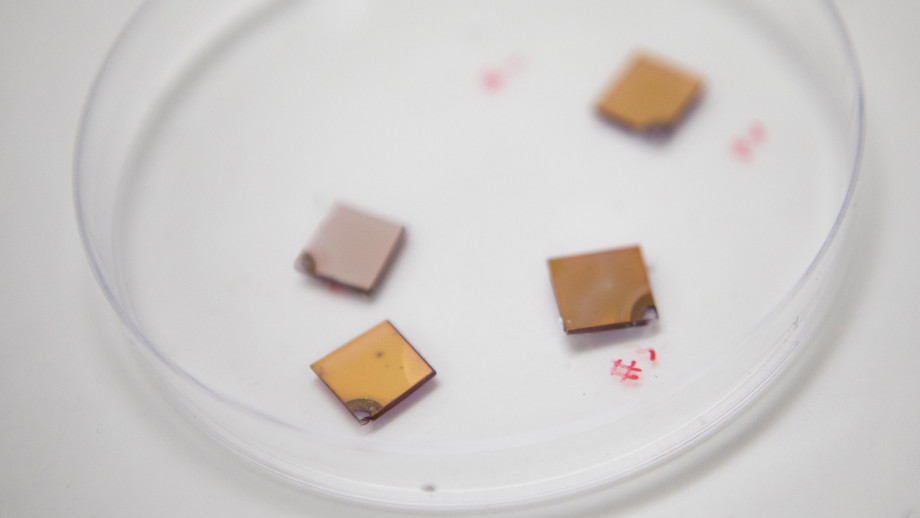
Optical sensors with a combination of very small gold nanostructures and semiconductors. Image: Lannon Harley, ANU

Zelio Fusco, a PhD scholar in Tricoli’s lab, says the new sensors had advantages over other types being developed for wearable medical devices because they could detect metabolites in much smaller concentrations and operate at room temperature.

“The beauty of our sensors is that they are super versatile and can be integrated into different technologies for applications ranging from medical diagnosis, farming and space exploration,” says Fusco.

“Our sensors could be developed to detect whether a plant has a particular disease or a fruit is ripe, for example.”

Co-researcher Dr. Mohsen Rahmani says the sensors combined very small gold nanostructures with semiconductors in a way that created unique properties to enable the detection of gas molecules at very low concentrations.

“As the sensors are ultra-small and ultra-light, they could potentially be fitted to micro-satellites or tiny spacecraft that could help in the hunt for life on distant planets, by telling us if there are trace organic molecules of living organisms on distant planets,” says Rahmani, an Australian Research Council (ARC) Discovery Early Career Research Fellow at the Nonlinear Physics Centre the ANU Research School of Physics and Engineering.  

The Queensland University of Technology and the Chalmers University of Technology in Sweden supported ANU to conduct this research.

The research is published in Advanced Materials.

Source: Australian National University
Related Articles Read More >

R&D 100 winner flags even unknown fentanyl analogs
New nanopore sensor paves the way for fast, accurate, low-cost DNA sequencing
IoT
Sensor data, reimagined: When 90% less data can fuel 100x gains in efficiency in AI projects
Sandia Labs joins with other institutions to tackle AI energy challenges with microelectronics research
rd newsletter
EXPAND YOUR KNOWLEDGE AND STAY CONNECTED
Get the latest info on technologies, trends, and strategies in Research & Development.
RD 25 Power Index

R&D World Digital Issues

Fall 2025 issue

Browse the most current issue of R&D World and back issues in an easy to use high quality format. Clip, share and download with the leading R&D magazine today.

R&D 100 Awards
Research & Development World
  • Subscribe to R&D World Magazine
  • Sign up for R&D World’s newsletter
  • Contact Us
  • About Us
  • Drug Discovery & Development
  • Pharmaceutical Processing
  • Global Funding Forecast

Copyright © 2025 WTWH Media LLC. All Rights Reserved. The material on this site may not be reproduced, distributed, transmitted, cached or otherwise used, except with the prior written permission of WTWH Media
Privacy Policy | Advertising | About Us

Search R&D World

  • R&D World Home
  • Topics
    • Aerospace
    • Automotive
    • Biotech
    • Careers
    • Chemistry
    • Environment
    • Energy
    • Life Science
    • Material Science
    • R&D Management
    • Physics
  • Technology
    • 3D Printing
    • A.I./Robotics
    • Software
    • Battery Technology
    • Controlled Environments
      • Cleanrooms
      • Graphene
      • Lasers
      • Regulations/Standards
      • Sensors
    • Imaging
    • Nanotechnology
    • Scientific Computing
      • Big Data
      • HPC/Supercomputing
      • Informatics
      • Security
    • Semiconductors
  • R&D Market Pulse
  • R&D 100
    • 2025 R&D 100 Award Winners
    • 2025 Professional Award Winners
    • 2025 Special Recognition Winners
    • R&D 100 Awards Event
    • R&D 100 Submissions
    • Winner Archive
  • Resources
    • Research Reports
    • Digital Issues
    • Educational Assets
    • R&D Index
    • Subscribe
    • Video
    • Webinars
    • Content submission guidelines for R&D World
  • Global Funding Forecast
  • Top Labs
  • Advertise
  • SUBSCRIBE