Research & Development World

  • R&D World Home
  • Topics
    • Aerospace
    • Automotive
    • Biotech
    • Careers
    • Chemistry
    • Environment
    • Energy
    • Life Science
    • Material Science
    • R&D Management
    • Physics
  • Technology
    • 3D Printing
    • A.I./Robotics
    • Software
    • Battery Technology
    • Controlled Environments
      • Cleanrooms
      • Graphene
      • Lasers
      • Regulations/Standards
      • Sensors
    • Imaging
    • Nanotechnology
    • Scientific Computing
      • Big Data
      • HPC/Supercomputing
      • Informatics
      • Security
    • Semiconductors
  • R&D Market Pulse
  • R&D 100
    • 2026 R&D 100 Award Winners
    • 2026 Professional Award Winners
    • 2026 Special Recognition Winners
    • R&D 100 Awards Event
    • R&D 100 Submissions
    • Winner Archive
  • Resources
    • Research Reports
    • Digital Issues
    • Educational Assets
    • Subscribe
    • Video
    • Webinars
    • PharmSci360
    • Content submission guidelines for R&D World
  • Global Funding Forecast
  • Top Labs
  • Advertisers
    • Advertise
    • PR Submissions
    • Eblast Submissions
  • SUBSCRIBE

Skin Patches Track Dehydration Levels

By Emil Venere, Purdue University | December 7, 2016

Purdue University researchers show off a newly developed skin patch that changes color to indicate different levels of hydration, representing a potential new medical technology. As sweat secretion increases, the strips are activated sequentially, changing from blue to red and providing easily identifiable levels of moisture loss. Here, the patch is shown recording hydration at specific time intervals. Image: Purdue University photo/Vaibhav Jain, Manuel Ochoa

Researchers have developed a low-cost skin patch that changes color to indicate different levels of hydration, representing a potential new medical technology.

Such an innovation might be used by marathon runners, military personnel, and others to help prevent dehydration.

“Hydration in humans is a delicate parameter,” says Babak Ziaie, a professor of biomedical engineering and electrical and computer engineering at Purdue University. “Even small deviations such as 2 percent from normal levels can affect a person’s cognitive and physical performance by more than 30 percent.”

The palm-size patch consists of filter paper that is laser-machined to create a radial array of strips, which are laminated with a water-impermeable film to form microchannels. The channels are loaded with a water-activated dye at one end. As sweat secretion increases, the strips are activated sequentially, changing from blue to red and providing easily identifiable levels of moisture loss.

Findings were detailed in a research paper presented during the MicroTAS 2016 Conference in October.

“We have talked to many experts including marathon directors, the Ironman World Championship, Olympic triathlon athletes and many collegiate and professional coaches, athletes, race directors and EMTs to validate the need for this kind of product,” says graduate student Vaibhav Jain. “Also, two industrial companies have shown interest in our technology, and we are in talks with them.”

Conventional methods for monitoring hydration are either invasive, require non-portable equipment or do not yield results immediately.

“In comparison, our approach is a fast, user-friendly dermal patch for collecting and measuring sweat secretion,” Ziaie says. “And our fabrication process could be scaled up to large-volume manufacturing.”

The patch was tested at a sweating rate of 90 microliters per hour over a square centimeter of skin, which corresponds to normal human sweat rates.

The researchers have filed a patent application for the concept through the Office of Technology Commercialization of the Purdue Research Foundation.

Funding for this work was provided in part by the National Science Foundation. The research is based at the Birck Nanotechnology Center in Purdue’s Discovery Park.

During the MicroTAS conference, Jain was awarded a Ninth Annual Art in Science Award, sponsored by National Institute of Standards and Technology and Lab on a Chip magazine. The paper was co-authored by Jain; postdoctoral research associate Manuel Ochoa; and Ziaie.

Source: Purdue University
Related Articles Read More >

Smart contact lenses move from glucose to stress and mood
ORNL plans to integrate an AI-enhanced algorithm into its radiation detection device 
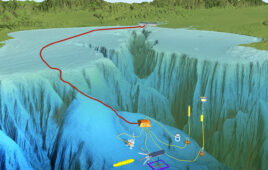
MBARI's Monterey Accelerated Research System (MARS) connects seafloor instruments to shore through a roughly 51-kilometer power and fiber-optic cable (red line) ending at a node about 891 meters down. The Geo-Sense system described in the new paper takes the opposite approach: a portable, battery-powered cable that records locally with no link to shore. Researchers used MARS's own fiber data to cross-check Geo-Sense's earthquake detections. Credit: MBARI
How lightweight AI startup Lightscline helped turn one to two years of seafloor data analysis into a two-month sprint
UC Riverside’s $5 fake drug detector uses toy robot sensors to catch counterfeit medications
rd newsletter
EXPAND YOUR KNOWLEDGE AND STAY CONNECTED
Get the latest info on technologies, trends, and strategies in Research & Development.

R&D World Digital Issues

Fall 2026 issue

Browse the most current issue of R&D World and back issues in an easy to use high quality format. Clip, share and download with the leading R&D magazine today.

R&D 100 Awards
Research & Development World
  • Subscribe to R&D World Magazine
  • Sign up for R&D World’s newsletter
  • Contact Us
  • About Us
  • Drug Discovery & Development
  • Pharmaceutical Processing
  • Global Funding Forecast

Copyright © 2026 Arrowfly LLC. All Rights Reserved. The material on this site may not be reproduced, distributed, transmitted, cached or otherwise used, except with the prior written permission of Arrowfly
Privacy Policy | Advertising | About Us

Search R&D World

  • R&D World Home
  • Topics
    • Aerospace
    • Automotive
    • Biotech
    • Careers
    • Chemistry
    • Environment
    • Energy
    • Life Science
    • Material Science
    • R&D Management
    • Physics
  • Technology
    • 3D Printing
    • A.I./Robotics
    • Software
    • Battery Technology
    • Controlled Environments
      • Cleanrooms
      • Graphene
      • Lasers
      • Regulations/Standards
      • Sensors
    • Imaging
    • Nanotechnology
    • Scientific Computing
      • Big Data
      • HPC/Supercomputing
      • Informatics
      • Security
    • Semiconductors
  • R&D Market Pulse
  • R&D 100
    • 2026 R&D 100 Award Winners
    • 2026 Professional Award Winners
    • 2026 Special Recognition Winners
    • R&D 100 Awards Event
    • R&D 100 Submissions
    • Winner Archive
  • Resources
    • Research Reports
    • Digital Issues
    • Educational Assets
    • Subscribe
    • Video
    • Webinars
    • PharmSci360
    • Content submission guidelines for R&D World
  • Global Funding Forecast
  • Top Labs
  • Advertisers
    • Advertise
    • PR Submissions
    • Eblast Submissions
  • SUBSCRIBE