Research & Development World

  • R&D World Home
  • Topics
    • Aerospace
    • Automotive
    • Biotech
    • Careers
    • Chemistry
    • Environment
    • Energy
    • Life Science
    • Material Science
    • R&D Management
    • Physics
  • Technology
    • 3D Printing
    • A.I./Robotics
    • Software
    • Battery Technology
    • Controlled Environments
      • Cleanrooms
      • Graphene
      • Lasers
      • Regulations/Standards
      • Sensors
    • Imaging
    • Nanotechnology
    • Scientific Computing
      • Big Data
      • HPC/Supercomputing
      • Informatics
      • Security
    • Semiconductors
  • R&D Market Pulse
  • R&D 100
    • 2025 R&D 100 Award Winners
    • 2025 Professional Award Winners
    • 2025 Special Recognition Winners
    • R&D 100 Awards Event
    • R&D 100 Submissions
    • Winner Archive
  • Resources
    • Research Reports
    • Digital Issues
    • Educational Assets
    • Subscribe
    • Video
    • Webinars
    • PharmSci360
    • Content submission guidelines for R&D World
  • Global Funding Forecast
  • Top Labs
  • Advertise
  • SUBSCRIBE

Skin’s built-in “stretch sensor” helps tissue grow in mouse study

By Brian Buntz | September 5, 2025

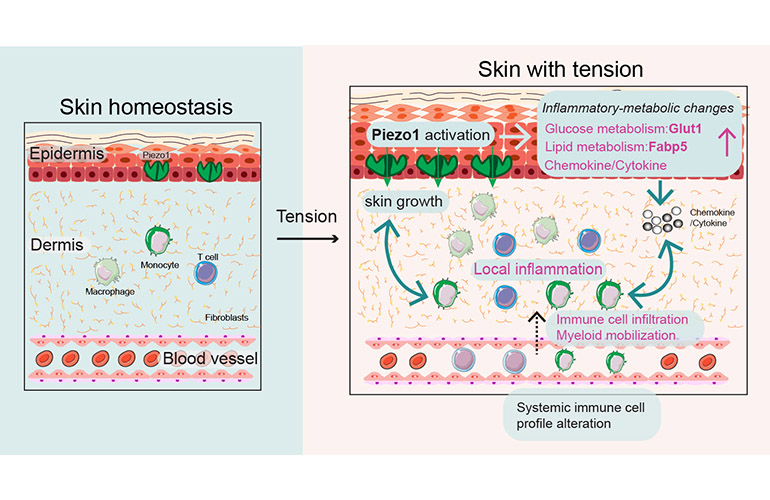
Skin under tension isn’t passive: the Piezo1 protein detects stretch and triggers the changes needed for tissue growth.

Skin under tension isn’t passive: the Piezo1 protein detects stretch and triggers the changes needed for tissue growth. Credit: Nature Communications, Yingchao Xue, Luis A. Garza

A stretch-sensing protein called Piezo1 (a membrane ion channel that lets calcium into skin cells when they are pulled) appears to coordinate the immune and metabolic programs that let skin grow under tension, Johns Hopkins researchers report in Nature Communications. In mice, chemically activating Piezo1 during tissue expansion significantly increased skin surface area and epidermal thickness compared with untreated controls (AUC P=0.005; thickness P<0.0001), while deleting Piezo1 (a mechanosensitive ion channel protein) in skin blunted these measures. The findings suggest a potential pharmacologic alternative to surgical expanders for generating graftable skin, pending human data.

The research builds on a decade of Piezo1 research, first identified in 2010 as a mechanosensitive ion channel that gates calcium influx under force. In skin, early studies linked it to touch sensation and epithelial homeostasis, with a 2021 eLife paper showing that epidermal Piezo1 slowed wound closure when enhanced and sped closure when deleted. A 2022 study found Piezo1’s shear stress response depends on extracellular matrix proteins like fibronectin, collagen and laminin, which regulate channel sensitivity.

Piezo1’s dual role in healing and scarring

Wound healing research overlaps heavily. A 2024 review summarizes Piezo1 roles across platelets (for clotting), neutrophils and macrophages (inflammation control), endothelial cells (angiogenesis), keratinocytes (re-epithelialization) and fibroblasts (remodeling), noting it prevents excessive scarring by fine-tuning inflammation. In fibrosis, a 2021 Cell Death & Disease paper showed that mechanical stretch promotes hypertrophic scar formation via Piezo1, linking stiff substrates to metabolic shifts that promote TGF-beta signaling—a pathway also upregulated in the Hopkins tension model for immune and growth regulation.

Expanding Piezo1’s reach across tissues

Beyond wounds, Piezo1 influences regeneration elsewhere. A 2024 Theranostics review covered its effects on mesenchymal stem cells, driving differentiation under force in bone, muscle and vascular tissues—patterns mirrored in skin expansion. The Hopkins paper reports heightened CXCL/CCL/TNF/TGF-β signaling during expansion, supporting the immune and growth-control framework.

The Hopkins paper stands out by focusing on non-injury tension growth, using spatial transcriptomics to map systemic responses like immune infiltration and glucose shifts, with Piezo1 as the trigger. It differentiates from wound models (often fibrotic) by emphasizing regenerative expansion. Gaps include human relevance, off-target effects of the chemical activator and full circuit mapping, but it advances toward pharmacologic alternatives to invasive tissue expanders.


Related Articles Read More >

How EcoBOT’s automated plant lab knows where it’s guessing 
We are still likely years away from a hantavirus vaccine
Artemis II experiment uses organ chips to prepare for long-duration missions
New brain-computer interface allows monkeys to navigate 3D virtual reality
rd newsletter
EXPAND YOUR KNOWLEDGE AND STAY CONNECTED
Get the latest info on technologies, trends, and strategies in Research & Development.

R&D World Digital Issues

Fall 2025 issue

Browse the most current issue of R&D World and back issues in an easy to use high quality format. Clip, share and download with the leading R&D magazine today.

R&D 100 Awards
Research & Development World
  • Subscribe to R&D World Magazine
  • Sign up for R&D World’s newsletter
  • Contact Us
  • About Us
  • Drug Discovery & Development
  • Pharmaceutical Processing
  • Global Funding Forecast

Copyright © 2026 Arrowfly LLC. All Rights Reserved. The material on this site may not be reproduced, distributed, transmitted, cached or otherwise used, except with the prior written permission of Arrowfly
Privacy Policy | Advertising | About Us

Search R&D World

  • R&D World Home
  • Topics
    • Aerospace
    • Automotive
    • Biotech
    • Careers
    • Chemistry
    • Environment
    • Energy
    • Life Science
    • Material Science
    • R&D Management
    • Physics
  • Technology
    • 3D Printing
    • A.I./Robotics
    • Software
    • Battery Technology
    • Controlled Environments
      • Cleanrooms
      • Graphene
      • Lasers
      • Regulations/Standards
      • Sensors
    • Imaging
    • Nanotechnology
    • Scientific Computing
      • Big Data
      • HPC/Supercomputing
      • Informatics
      • Security
    • Semiconductors
  • R&D Market Pulse
  • R&D 100
    • 2025 R&D 100 Award Winners
    • 2025 Professional Award Winners
    • 2025 Special Recognition Winners
    • R&D 100 Awards Event
    • R&D 100 Submissions
    • Winner Archive
  • Resources
    • Research Reports
    • Digital Issues
    • Educational Assets
    • Subscribe
    • Video
    • Webinars
    • PharmSci360
    • Content submission guidelines for R&D World
  • Global Funding Forecast
  • Top Labs
  • Advertise
  • SUBSCRIBE