A limitation in widely used protein engineering algorithms could be undermining commercial applications from biosensors to industrial catalysts, according to new research published in Nature Communications. The problem: current computational tools ignore the critical role of water molecules at solid-liquid interfaces.
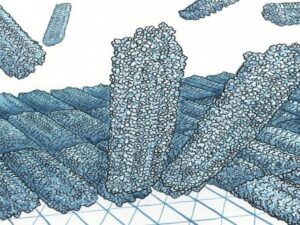
Scientist’s rendering of nanoribbon assembly on mica, based on imaging data. Credit: Image courtesy of Amy Stegmann | Pacific Northwest National Laboratory
Two parallel experiments in protein self-assembly produced different results, demonstrating the consequences of the physical forces missing from protein design algorithms. The team was led by researchers from Pacific Northwest National Laboratory (PNNL) and the Center for Science of Synthesis Across Scales (CSSAS).
The scientists studied how protein “nanoribbons” designed by Nobel Prize-winning scientist David Baker and his team, participants in CSSAS at the University of Washington, assemble on mineral surfaces.
AtomAI reveals unexpected alignment patterns
The breakthrough relied on AtomAI, an open-source machine learning tool that could have applications beyond protein design. The trained model allowed the team to track where each nanorod was, how it was oriented and how aligned the rods became over time, quantifying both orientation and organization.
The original plan was to track how negative charges on the nanoribbons arranged themselves to match the regular lattice of positively charged potassium ions on the surface of the natural mineral mica. In principle, the lattice matching should have allowed the protein to array in any of three different directions. Instead, orderly arrays of ribbons, all pointing in one direction, appeared in the AI-assisted microscope analysis.
Two types of mica produce strikingly different results
To better understand the unexpected organization, the researchers compared protein assembly on two types of mica. Both have identical lattices of potassium but possess other differences that change the way water arranges itself on the mica surface, leading to a hexagonal pattern of water on one and a striped pattern on the other.
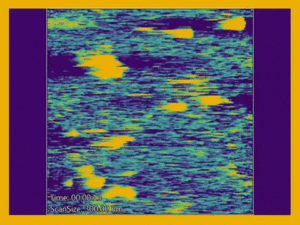
Designer nanoribbons attach to mica in a regular striped pattern in an elapsed time of 18 seconds. Credit: Video courtesy of the authors | Pacific Northwest National Laboratory.
Experimentally, the two surfaces produced strikingly different outcomes that resembled the arrangement of the water: On one kind of mica, the nanoribbons pointed randomly in three directions, while on the other, they aligned in a single direction and organized into parallel rows. Thus, the results suggested that it is actually the water on the mica guiding the protein alignment.
Water layers, not mineral lattice, guide protein organization
The team then confirmed the experimental results with a computational simulation of the experiments. The simulation reproduced the experimental results when the interactions that guide the nanoribbons reflected the arrangement of the water layers rather than the underlying lattice of potassium.
“Water molecules at solid-liquid interfaces display many important behaviors, well beyond those we initially considered,” said co-lead Shuai Zhang, a materials scientist at PNNL. “It does play a quite critical role in defining the materials’ behaviors.”
The study authors concluded that proteins designed to assemble on surfaces must explicitly include the role of solvents. Some examples of proteins arrayed on a solid surface include industrially important catalysts, biosensors and biomedical devices. This discovery could affect industries including biosensors, catalysis, biomedical devices and electronics.
The study suggests that designing protein assemblies on inorganic surfaces requires physics-informed machine learning to account for solvent effects.