Electric vehicles have been rising in popularity in recent years, likely owing to lower fuel costs and emissions than gasoline vehicles. However, one major barrier to widespread adoption remains. While some people have the freedom, space and financial ability to install a charging station at their home, many do not. Additionally, the lack of publicly available charging stations hinders the convenience of driving an EV long distances.
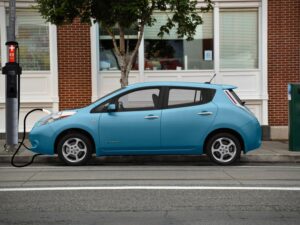
A team of Penn State researchers created a scalable framework to develop, analyze and evaluate using streetlights as a low-cost, equitable EV charging option. Credit: Provided by XB Hu/Penn State
In cities, where most people live in apartment buildings and space is scarce, owning an EV is nearly impossible due to the lack of charging options. Researchers at Penn State set out to solve this problem by integrating EV chargers into existing streetlights. They published their findings in the Journal of Urban Planning and Development.
Test subject: Kansas City
The research team created a scalable framework to develop and analyze the possibility of using streetlights as EV chargers. They installed 23 streetlight charging units in Kansas City, Missouri, and collected data over one year.
The researchers found that their charging stations were more cost- and time-efficient, had less environmental impact and were more convenient and accessible than traditional EV chargers.
“Streetlight poles are already powered and typically owned by municipalities, making them relatively easy to work with. Their placement – often near on-street parking and in high-traffic areas – makes them well positioned to serve both local residents and visitors,” said Xianbiao Hu, an associate professor of civil and environmental engineering at Penn State.
The project was funded by the U.S. Department of Energy and conducted in partnership with the non-profit organization Metro Energy Center, local utilities companies and the National Renewable Energy Lab.
Scaling up
The team created a three-pronged approach for other communities to use to install and use their own streetlight charging stations. The plan is focused on demand, feasibility and benefits. Researchers determined demand by evaluating land use, station density, nearby points of interest and traffic volume. They used this data to train AI models to make demand predictions.
“The scalability was a huge part of what makes this framework important,” said corresponding author Yang Song, a doctoral student at Penn State at the time of the research, “Creating something that works not just in one specific city but that can be adopted by many communities easily is critical for increasing EV use across the country.”
The model helped the researchers choose the 23 streetlights that became charging stations in Kansas City. The streetlight chargers had significantly shorter charging times, likely because they drew power from the dedicated municipal electrical lines and had less competition from charging multiple vehicles simultaneously.
The streetlight chargers were also less expensive to install since the infrastructure was already in place. The researchers found that the chargers contributed to a 11.94% greater avoided gasoline consumption and 11.24% higher GHG reductions compared to traditional EV charging stations.
The team is working on refining their predictive models to incorporate socio-economic data and weather information.
A slowing US market
Bloomberg reports that global sales of EVs continue to rise and are estimated to represent one in four cars sold in 2025. Electrification is also rising in buses and two- and three-wheelers. Almost half of bus and two- and three-wheeler sales were from electric vehicles.
Globally, China dominates the EV market. Over half of the vehicles sold in China are electric. Battery manufacturing is also heavily concentrated in China.
Meanwhile, sales in the U.S. are slowing, possibly due to policy changes and uncertainty. Bloomberg lowered their prediction for the number of EVs in 2030 from over 35 million to under 25 million.
Adoption of plans for more chargers, like the Penn State project, could help support lowering sales in the U.S. by making EV ownership more convenient and cheaper than traditional vehicles.