Dozens of ambitious scientific investigations — including projects aiming to improve cancer detection, advance treatments for neurodegenerative diseases, and enhance respiratory therapy — have safely returned to Earth from the International Space Station (ISS). The nearly 50 experiments, sponsored by the ISS National Laboratory, were transported back on SpaceX’s 31st Commercial Resupply Services (CRS) mission for NASA, splashing down off the Florida coast.
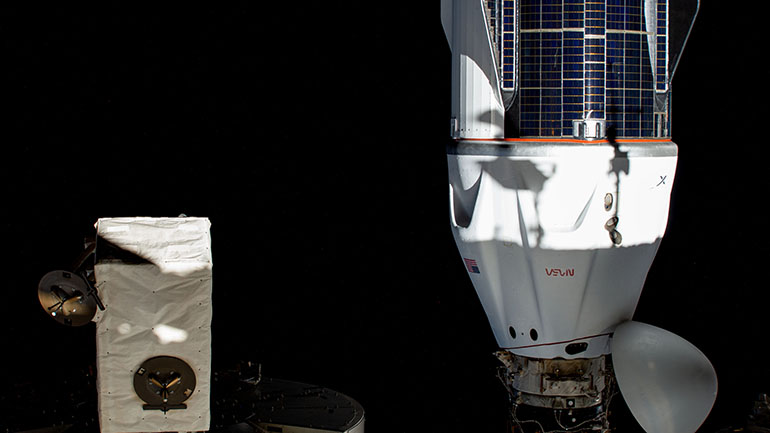
The SpaceX Dragon Freedom spacecraft is pictured docked to the space-facing port on the International Space Station’s Harmony module. Image courtesy of the International Space Station (ISS)
These payloads used the station’s unique microgravity environment to yield insights that could translate to meaningful benefits on the ground. Among the returned investigations are:
- Accelerating therapeutic development:
Pharmaceutical company Bristol Myers Squibb, working with ISS National Lab Commercial Service Provider Redwire Space, conducted protein crystallization experiments involving model small molecule compounds. Crystals grown in space often exhibit superior structure and clarity, potentially aiding the design and production of more effective medicines. - Improving respiratory drug delivery:
Supported by the U.S. National Science Foundation (NSF), researchers at the University of California, Santa Barbara, studied how mucus in the human airway affects medication delivery to the lungs. Gel-coated tubes in microgravity simulated real-world conditions, helping scientists better understand how mucus impacts the transport of tiny liquid plugs containing medicine. Such knowledge could refine drug delivery methods, improving treatments like surfactant replacement therapy for infants with respiratory distress syndrome. - Early cancer detection strategies:
Another NSF-funded University of Notre Dame investigation built on previous space station studies of how bubbles form in microgravity. In this project, bubbles generated by light were used to concentrate trace substances from a fluid onto a surface for analysis. The findings may one day lead to advanced biosensors capable of detecting early cancer markers in blood samples or trace compounds in other liquids. - Tackling neurodegenerative conditions:
The ISS National Lab and NASA also supported projects exploring in-space production applications. One such effort by Sachi Bioworks, in collaboration with ISS National Lab Commercial Service Provider Space Tango, tested innovative gene-targeting drugs on brain organoids. The goal: developing new therapies for debilitating neurological diseases like Alzheimer’s, Parkinson’s, Lou Gehrig’s disease, and the aggressive brain cancer glioblastoma. - Engaging future researchers:
Nearly 40 student teams participated in the Student Spaceflight Experiments Program (SSEP) Mission 18. Young researchers from Ohio, for instance, examined the effects of Liquid I.V. hydration solution on plant cells in microgravity. More than 35 communities engaged hundreds of students — from grade school to undergraduate level — in real-world research to shape a future workforce skilled in space-based science and exploration.
The ISS National Laboratory continues to provide researchers with the unparalleled opportunity to harness the station’s microgravity conditions for discoveries that could transform industries and improve life on Earth. To learn more about ISS National Lab-sponsored investigations from NASA’s SpaceX CRS-31 mission, visit the program’s official launch page.