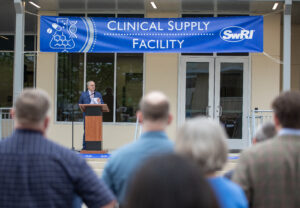
Southwest Research Institute staff and guest attend the ribbon cutting Monday, March 23, 2026, of the Chemistry and Chemical Engineering Division (01) Clinical Supply Facility.
Southwest Research Institute has opened a new 21,000-square-foot Clinical Supply Facility in San Antonio, nearly doubling its cGMP pharmaceutical production capacity as demand grows for U.S.-based drug development and manufacturing services.
The facility consolidates clean rooms, analytical labs and controlled storage into a single site designed to reduce bottlenecks in clinical supply production. SwRI says the expansion will help it support a wider range of clients, from startups and universities to biotech companies developing small molecules, biologics, vaccines and regenerative medicine products.
The expansion comes amid a broader push to reshore pharma work to the U.S. States. Darrel Johnston, director of Pharmaceuticals and Bioengineering at SwRI, said the institute is seeing rising interest from organizations that previously would have outsourced drug development overseas.
“There’s a real desire for the United States to be able to make its own drug supplies, silicon chips, fine chemicals, and so on,” Johnston said. “People are explicitly saying they would rather do this locally in San Antonio or in the United States than send it overseas.”
Engineering-driven drug development
SwRI, which has won 46 R&D 100 awards from 1979 to 2025, positions itself as something different from a traditional contract development and manufacturing organization.
Johnston pointed to a case where a pharma researcher needed to push a viscous, non-Newtonian drug emulsion through a 19-gauge needle for an auto-injector. The solution came not from a geophysicist who overheard the problem in a break room and recognized the physics of magma flow.
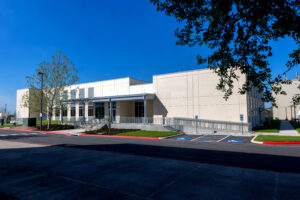
Clinical Supply Facility at SwRI
“Once the material starts moving, it shear-thins and flows through the needle just fine,” Johnston said. “When we reach the border of what we know and what someone else on campus knows, you have to develop a common vocabulary and explain things through analogies so both sides understand each other.”
That cross-pollination extends to other projects as well. When SwRI needed to dial in a specific droplet size for a nasal spray formulation, the team turned to colleagues who design fuel injectors for engines. “We knew the droplet size we wanted and the rheological properties of the solution, and then we realized we had another group onsite that designs engines,” Johnston said. “Two of their people specialize in fuel injectors all day long.”
Reducing bottlenecks and client stress
The new facility includes 4,200 square feet of ISO-rated production space and 2,700 square feet of analytical support laboratories, along with controlled storage environments ranging from room temperature down to cryogenic conditions. An on-site backup power generator ensures uninterrupted operations.
Before the new building, SwRI’s pharmaceutical operations were spread across multiple structures. Johnston said the consolidation is as much about client confidence as it is about workflow.
“It presents much better than going from building to building,” he said. “Not that the old setup was terrible, but it certainly looks better to push your cart across a polished floor instead of across gravel or asphalt between buildings.”
More importantly, the added capacity reduces scheduling conflicts that can ripple through a client’s development timeline.
“Every client wants risk reduction, but they also want stress reduction,” Johnston said. “Telling a client that their clean room access has been pushed back by weeks, or even just five days because another run went over, is not a fun conversation. This building helps lower that stress for everyone.”
Market headwinds, persistent demand
Johnston acknowledged that the opening comes during a challenging stretch for the broader life sciences market. Still, he said the underlying research interest has not slowed. Many of SwRI’s clients are driven by long-term commitments to their science, whether venture capital is flowing freely or not.
“Whether venture funding is flowing freely or not, the research still goes on. They pivot, and we pivot with them,” Johnston said.
A flexible entry point
SwRI says the facility is designed to serve clients at any stage of the development pipeline. A company might arrive with an early-stage compound, or it might need to transfer an entire program from a CRO that is exiting a therapeutic area. The new building’s integrated layout is intended to make either scenario more manageable.
“A client can come in anywhere along that path,” Johnston said. “They may already have a CRO, or they may come to us with a whole program and say, ‘Our CRO is getting out of biologicals, and we need you to replicate what they were doing and take it forward.’”
For Johnston, the work carries a personal dimension too. “The idea that what you’re doing might save someone’s life someday is intoxicating,” he said. “You get to come to work on something really cool, and that makes you feel good getting out of bed and driving in.”