Imagine this: a biology lab at 2 a.m. No researchers are present, but the lab is far from stalled. Robots are hard at work pipetting, incubating and running assays. An AI model is analyzing the results of the last experimental cycle as it queues up the next round. When the team arrives in the morning, the data is there waiting for them, with interpreted findings and a suggested next experiment.
Adobe
The question is no longer whether labs can automate, but how far they should go — and how much control scientists should relinquish. The building blocks for this lab exist, and a new framework published in SLAS Technology outlines how to get there.
The cognitive shift in lab automation
Automation in the lab isn’t new; the first automated laboratory system was a blood analyzer introduced in the 1950s, and life science labs have been adopting specialized automation tools since the 1980s.
Now, these labs don’t just execute preprogrammed steps. AI systems analyze data, identify patterns and inform decisions. This is the shift from mechanical automation to what the authors call cognitive automation. This transition is especially important for one of biology’s most ambitious frontiers: synthetic biology.
Synthetic biology applies engineering principles to biology, treating living organisms as systems. The central workflow is the DBTL cycle: design, build, test, learn. Each cycle involves dozens of precise, repetitive manual steps. A single project can require hundreds of cycles over months or years.
The vision: four agents for automation
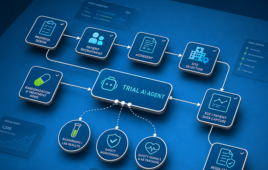
The paper’s authors propose a conceptual framework for a Total Laboratory Automation system: a lab that can run the entire DBTL cycle autonomously, driven by three specialized AI agents and one coordinating agent.
The first agent is the generator, an AI that designs new virtual organisms on a computer, using a set of desired characteristics to produce a genome sequence that will serve as a blueprint. The builder works as the physical arm of the system, autonomous robots that follow the blueprint to actually construct the organism using DNA synthesis and assembly technologies, then interface with instruments like PCR machines, plate readers and DNA sequencers to gather data.
The analyzer is the third agent, which interprets the experimental data from the builder, assessing whether the constructed organism meets the defined criteria and passing insights up the chain. The final agent is the coordinator, the system’s lab director. This is a central AI that oversees the whole cycle, synthesizes the data, guides the generator and analyzer and builds a digital twin that grows more accurate with each experimental cycle.
The software standard, Synthetic Biology Open Language (SBOL), aims to make these agents interoperable across platforms and labs, acting as a common language for automated biology. A version of this already exists. Systems like automated recommendation tool (ART) and self-driving protein fitness labs have demonstrated that intelligent agents can predict, design and optimize biological functions.
However, total automation is expensive and complex, out of reach for most labs. This is where the paper’s second framework comes into play.
The progressive automation model
Full automation doesn’t have to happen all at once. The authors propose a graduated model that lets labs start where they are and build incrementally. The framework organizes automation along two dimensions: what is being automated and how far it has been automated.
The framework organizes three areas of scientific work, method, analysis and hypothesis, and three levels of automation, assistance, partial automation and complete automation. Assistance covers tools that extend human capabilities but require human operation. Partial automation describes systems that handle discrete tasks or sequences autonomously, but with human involvement between steps. Complete automation is fully autonomous execution with humans in a supervisory or validation role.
The framework’s key feature is that it is non-linear. A lab doesn’t have to climb each rung in sequence. A lab might be at level three for data analysis, but level one for hypothesis generation, and it can still follow the framework.
The ethical line
As automation advances into AI systems that generate hypotheses and interpret results, accountability becomes a pressing question. If an AI-driven lab produces a flawed or harmful conclusion, who is responsible?
The authors draw a hard line: fully blind automation is ethically unacceptable. Even at the highest degree of autonomy, human validation checkpoints must be built into every transition point in the DBTL cycle.
This means that AI can assist with and contribute to hypothesis generation, but humans must retain final authority. As autonomous systems run complex protocols, humans should oversee resource allocation, biosafety compliance and regulatory alignment. AI systems can identify patterns and propose models, but humans must be able to audit and understand the reasoning, the authors argue.
The framework reinforces the idea that the autonomous lab is not a replacement for human scientists, but rather a force multiplier. The system can handle the repetitive tasks so researchers can focus on meaningful contributions.
The future of research automation isn’t about removing humans from science; it’s about determining where humans belong and where automation can pick up the slack.