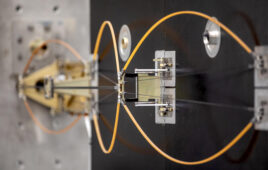
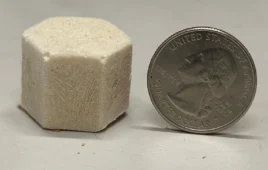
Dr. Mohammad Naraghi holds ATSP, the carbon-fiber smart plastic. [Credit: Dr. Mohammad Naraghi/Texas A&M University College of Engineering’
What’s new in the data
In the Macromolecules study, the Texas A&M research team introduced a “novel cyclical creep” protocol to probe the network’s behavior when exposed to “topology freezing temperature.” They demonstrated bond-exchange activity even below the glass-transition temperature (Tg). The university reports that periodic thermal “healing” at 160°C more than tripled fatigue life in deep-cycle bending: from about 160 cycles to more than 500 cycles.
The self-healing process requires external heat at temperatures typically ranging from 160°C to 280°C depending on damage mode and geometry. In other words, this is not a room-temperature autonomous healing process.
A companion paper in Journal of Composite Materials analyzes why healing efficiency gradually declines with repeated damage-heal cycling. High-resolution imaging ties the decay to localized mechanical fatigue and manufacturing defects. In short, the mechanism is robust, but processing quality still governs long-term performance.
What’s really exciting is that this material isn’t just ultra-durable — it’s also adaptive. From on-demand healing in damaged aircraft to enhancing passenger safety in vehicles, these properties make it incredibly valuable for future materials and design innovations.—Naraghi in the press release
How it works
ATSP belongs to the vitrimer/CAN (covalent adaptive network) family: permanent networks with dynamic, associative bond exchanges. Above a material-specific “topology-freezing” temperature (Tv), the network can rearrange without losing crosslink density, enabling reshaping and thermally assisted crack closure; below Tv, it behaves like a conventional thermoset. This framework is well-established in vitrimer literature and explains ATSP’s combination of stiffness at service temperatures and reprocessability when heated.
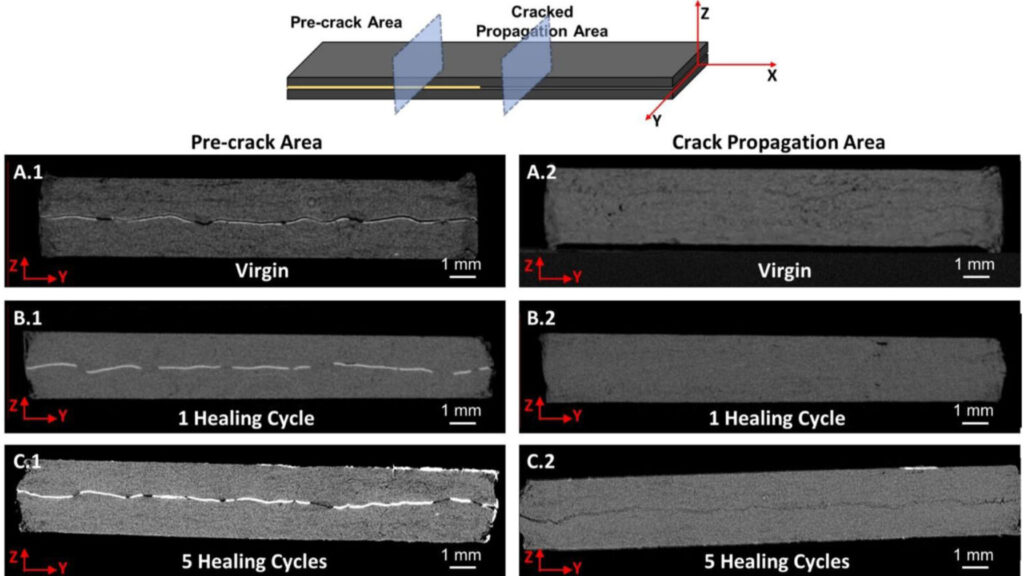
X-ray images of ATSP over five damage-healing cycles. In the first cycle, ATSP fully healed and regained its shape and strength. By the fifth, mechanical fatigue appeared, but durability and chemical stability remained intact. Credit: Dr. Mohammad Naraghi/Texas A&M University. https://doi.org/10.1177/00219983251362394
Carbon-fiber/thermoset structures are difficult to repair or recycle. Demonstrating quantified life extension via thermal healing (hundreds of additional fatigue cycles) points to maintainable composites with fewer part swaps and lower downtime, especially in aerospace and defense fleets where inspection and repair drive total cost of ownership.
Vitrimeric networks can be reshaped and reprocessed repeatedly, offering a potential path to divert cured composites from landfill, an issue traditional thermosets struggle with. ATSP’s recyclability aligns with broader vitrimer evidence on reprocessability via bond exchange.
The same chemistry that closes cracks also enables controlled shape recovery under heat. For engineers, that suggests damage-tolerant designs and thermally triggered reset modes (e.g., returning deformed components toward nominal geometries after transient overloads). The Texas A&M protocols provide concrete temperature windows and cycling approaches that can inform early design envelopes.