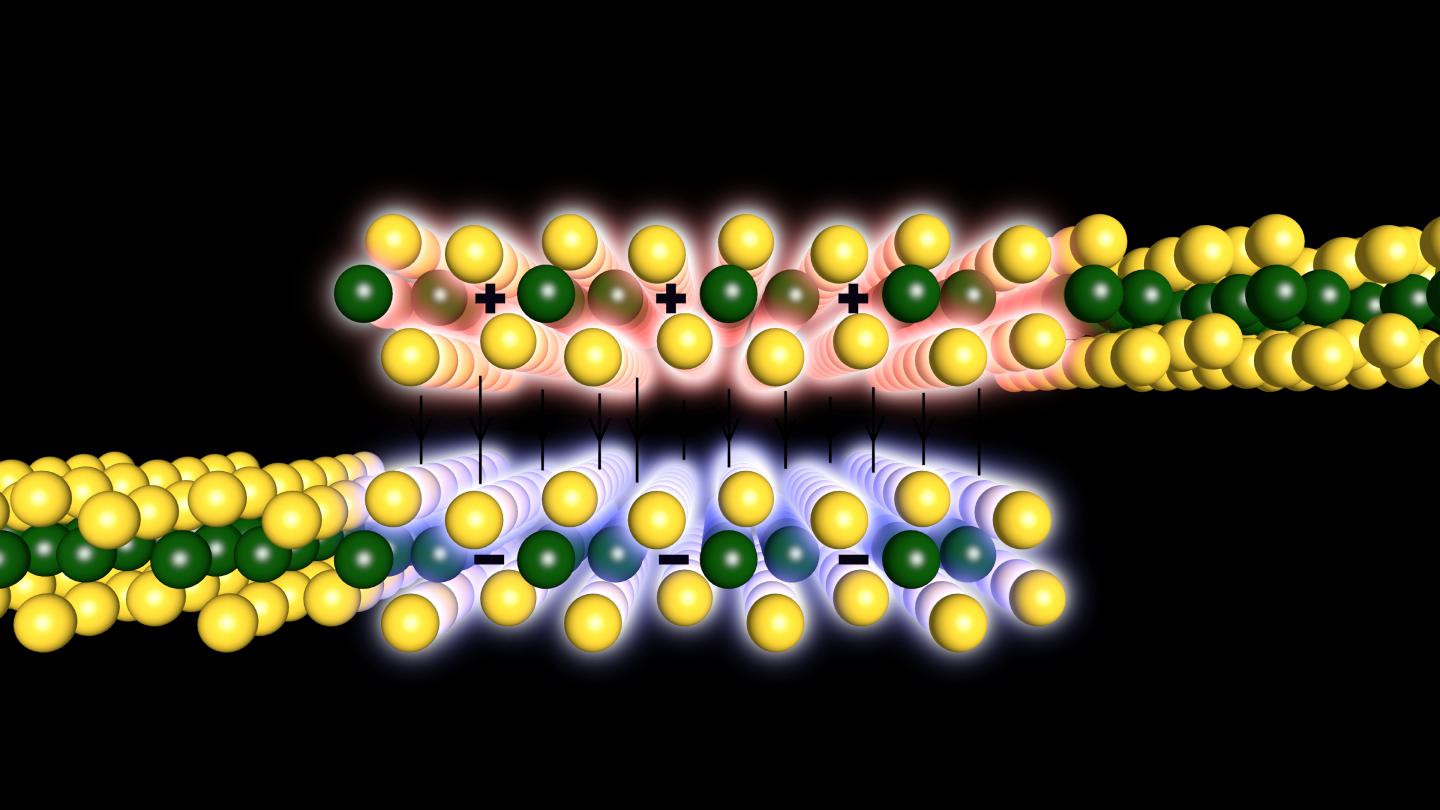
When two monolayers of WTe2 are stacked into a bilayer, a spontaneous electrical polarization appears, one layer becoming positively charged and the other negatively charged. This polarization can be flipped by applying an electric field. Credit: Joshua Kahn
The general public might think of the 21st century as an era of revolutionary technological platforms, such as smartphones or social media. But for many scientists, this century is the era of another type of platform: two-dimensional materials, and their unexpected secrets.
These 2-D materials can be prepared in crystalline sheets as thin as a single monolayer, only one or a few atoms thick. Within a monolayer, electrons are restricted in how they can move: Like pieces on a board game, they can move front to back, side to side or diagonally — but not up or down. This constraint makes monolayers functionally two-dimensional.
The 2-D realm exposes properties predicted by quantum mechanics — the probability-wave-based rules that underlie the behavior of all matter. Since graphene — the first monolayer — debuted in 2004, scientists have isolated many other 2-D materials and shown that they harbor unique physical and chemical properties that could revolutionize computing and telecommunications, among other fields.
For a team led by scientists at the University of Washington, the 2-D form of one metallic compound — tungsten ditelluride, or WTe2 — is a bevy of quantum revelations. In a paper published online July 23 in the journal Nature, researchers report their latest discovery about WTe2: Its 2-D form can undergo “ferroelectric switching.” They found that when two monolayers are combined, the resulting “bilayer” develops a spontaneous electrical polarization. This polarization can be flipped between two opposite states by an applied electric field.
“Finding ferroelectric switching in this 2-D material was a complete surprise,” said senior author David Cobden, a UW professor of physics. “We weren’t looking for it, but we saw odd behavior, and after making a hypothesis about its nature we designed some experiments that confirmed it nicely.”
Materials with ferroelectric properties can have applications in memory storage, capacitors, RFID card technologies and even medical sensors.
“Think of ferroelectrics as nature’s switch,” said Cobden. “The polarized state of the ferroelectric material means that you have an uneven distribution of charges within the material — and when the ferroelectric switching occurs, the charges move collectively, rather as they would in an artificial electronic switch based on transistors.”
The UW team created WTe2 monolayers from its the 3-D crystalline form, which was grown by co-authors Jiaqiang Yan at Oak Ridge National Laboratory and Zhiying Zhao at the University of Tennessee, Knoxville. Then the UW team, working in an oxygen-free isolation box to prevent WTe2 from degrading, used Scotch Tape to exfoliate thin sheets of WTe2 from the crystal — a technique widely used to isolate graphene and other 2-D materials. With these sheets isolated, they could measure their physical and chemical properties, which led to the discovery of the ferroelectric characteristics.
WTe2 is the first exfoliated 2-D material known to undergo ferroelectric switching. Before this discovery, scientists had only seen ferroelectric switching in electrical insulators. But WTe2 isn’t an electrical insulator; it is actually a metal, albeit not a very good one. WTe2 also maintains the ferroelectric switching at room temperature, and its switching is reliable and doesn’t degrade over time, unlike many conventional 3-D ferroelectric materials, according to Cobden. These characteristics may make WTe2 a promising material for smaller, more robust technological applications than other ferroelectric compounds.
“The unique combination of physical characteristics we saw in WTe2 is a reminder that all sorts of new phenomena can be observed in 2-D materials,” said Cobden.
Ferroelectric switching is the second major discovery Cobden and his team have made about monolayer WTe2. In a 2017 paper in Nature Physics, the team reported that this material is also a “topological insulator,” the first 2-D material with this exotic property.
In a topological insulator, the electrons’ wave functions — mathematical summaries of their quantum mechanical states — have a kind of built-in twist. Thanks to the difficulty of removing this twist, topological insulators could have applications in quantum computing — a field that seeks to exploit the quantum-mechanical properties of electrons, atoms or crystals to generate computing power that is exponentially faster than today’s technology. The UW team’s discovery also stemmed from theories developed by David J. Thouless, a UW professor emeritus of physics who shared the 2016 Nobel Prize in Physics in part for his work on topology in the 2-D realm.
Cobden and his colleagues plan to keep exploring monolayer WTe2 to see what else they can learn.
“Everything we have measured so far about WTe2 has some surprise in it,” said Cobden. “It’s exciting to think what we might find next.”