Talk2Me Inc., a licensed celebrity digital twin platform, announced the launch of the Dr. Karan Rajan Talk2Me Twin, an AI-powered version of Rajan’s persona that enables private, one-on-one health education conversations with the doctor.
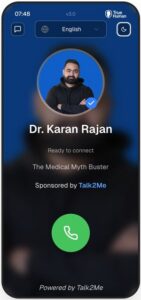
Dr. Karan’s Talk2Me Twin is a free service that allows users to engage in interactive conversations about his many health related podcasts. Credit: Talk2Me
The digital twin is powered by Talk2Me’s proprietary TrueHuman persona modeling platform and enforced by its Guardian Layer medical oversight framework. The Guardian layer acts as an oversight framework that filters output through a non-diagnostic, non-prescriptive lens.
The twin delivers real-time, evidence-based health education on a variety of topics, in private conversations with verified, consent-based authenticity. The twin is designed as a non-diagnostic, non-prescriptive source for health education as a counterweight to medical deepfakes and misinformation.
The twin is a fully authenticated digital extension of Rajan’s voice, values and clinical knowledge, built with his direct participation and ongoing oversight.
High-Fidelity Persona Modeling and Authorized Data Ingestion
Talk2Me twins are built on creator-authorized data, meaning the AI is trained on thousands of hours of authorized recordings, podcasts, vetted scripts, peer-reviewed publications and direct interviews. This ensures that the AI only knows and synthesizes what the human creator feeds it.
Once the data is ingested, it is processed by the TrueHuman platform. This platform replicates the specific cadence, vocabulary and rhetorical style of the creator. The digital twin is modeled to reflect the specific mindset and decision-making of the creator.
Through the Talk2Me platform, users can also talk to Tim Draper, a venture capitalist, and Kelsey Plum, an Olympic gold medalist in basketball.
The twin refused to diagnose me — here’s why that’s a good thing
Trust in AI is low, and for good reason. LLMs regularly hallucinate and make mistakes. Even so, AI use in hospitals and medical settings is expanding.
An independent study by the University of Michigan found that a proprietary mode from Epic failed to identify sepsis in 67% of cases, while flagging healthy patients as having the disease. This could lead to delayed treatment, which is especially harmful for a condition where every hour of delay increases the risk of death by 4% to 9%.
In addition to diagnosis, AI models also present risks in medical devices. A 2025 study published in JAMA Health Forum found that 60 AI-enabled medical devices were the subjects of 182 recall events between 2017 and 2024. Most of these recalls were due to diagnostic or measurement errors.
When tested on a query regarding a metabolic disorder, the Rajan twin did not attempt to correlate symptoms into a diagnosis. Instead, it defaulted to its safety protocol, advising a clinical workup. This safeguard will protect users from misdiagnoses. This is especially important for a chatbot model that is fed user data, not from a doctor or medical tests.
As AI integration in healthcare accelerates, the industry must grapple with the risks of deploying generative AI models in high-stakes environments. Until probabilistic models can guarantee deterministic clinical accuracy, hardcoded fail safes should be a prerequisite for trust and safety.