Research & Development World

  • R&D World Home
  • Topics
    • Aerospace
    • Automotive
    • Biotech
    • Careers
    • Chemistry
    • Environment
    • Energy
    • Life Science
    • Material Science
    • R&D Management
    • Physics
  • Technology
    • 3D Printing
    • A.I./Robotics
    • Software
    • Battery Technology
    • Controlled Environments
      • Cleanrooms
      • Graphene
      • Lasers
      • Regulations/Standards
      • Sensors
    • Imaging
    • Nanotechnology
    • Scientific Computing
      • Big Data
      • HPC/Supercomputing
      • Informatics
      • Security
    • Semiconductors
  • R&D Market Pulse
  • R&D 100
    • 2025 R&D 100 Award Winners
    • 2025 Professional Award Winners
    • 2025 Special Recognition Winners
    • R&D 100 Awards Event
    • R&D 100 Submissions
    • Winner Archive
  • Resources
    • Research Reports
    • Digital Issues
    • Educational Assets
    • R&D Index
    • Subscribe
    • Video
    • Webinars
    • Content submission guidelines for R&D World
  • Global Funding Forecast
  • Top Labs
  • Advertise
  • SUBSCRIBE

The Milky Way is glowing: these scientists think dark matter may be the cause

By Julia Rock-Torcivia | October 17, 2025

Researchers from Johns Hopkins published a study providing evidence for the theory that mysterious gamma rays emanating from the center of the Milky Way originate from dark matter particles colliding. 
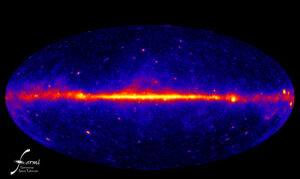
This view of the gamma-ray sky constructed from one year of Fermi LAT observations is the best view of the extreme universe to date. The map shows the rate at which the LAT detects gamma rays with energies above 300 million electron volts from different sky directions. Brighter colors equal higher rates. Credit: NASA/DOE/Fermi LAT Collaboration

Steps towards solving decades-long mystery

These gamma rays were first detected in 2009, and their origins have stumped scientists ever since. Some have theorized that the rays came from quickly spinning neutron stars, others that they come from dark matter particles. The study, published Thursday in Physical Review Letters, may provide proof of the latter. 

The researchers used supercomputers to create maps that predicted where dark matter should be based on the history of how the Milky Way galaxy formed. When the Milky Way was first formed, smaller systems made of dark matter and other materials entered, becoming the building blocks of the galaxy. The dark matter particles clustered together in the center of the young galaxy, increasing the rate of dark matter collisions. 

The scientists’ maps matched actual gamma ray maps made with the Fermi Gamma-ray Space Telescope. The researchers said the gamma rays being observed have the same properties as those that would be produced by dark matter particles colliding. 

However, this is not definitive proof. The rays could also be emitted from old neutron stars spinning with a rotational period of less than 10 milliseconds, called millisecond pulsars. The researchers from Johns Hopkins found a flaw in this theory. For this to be true, there would have to be more millisecond pulsars than the number that have been observed.

Energy could be the key

The team is now planning a second experiment that will provide more definitive proof, testing whether the rays have high energy – indicating that they come from millisecond pulsars – or lower energy – indicating that they come from dark matter. 

“It’s possible we will see the new data and confirm one theory over the other,” said co-author Joseph Silk, a professor of physics and astronomy at Johns Hopkins, in a press release, “Or maybe we’ll find nothing, in which case it’ll be an even greater mystery to resolve.”


Related Articles Read More >

Researchers could be one step closer to understanding the origin of matter thanks to a new study
Three scientists awarded Nobel Prize in physics for showing quantum properties could exist in large-scale systems
ORNL named on 20 R&D 100 Awards, including carbon-capture and AM tools
Revealing the 2025 R&D 100 Awards Winners
rd newsletter
EXPAND YOUR KNOWLEDGE AND STAY CONNECTED
Get the latest info on technologies, trends, and strategies in Research & Development.
RD 25 Power Index

R&D World Digital Issues

Fall 2024 issue

Browse the most current issue of R&D World and back issues in an easy to use high quality format. Clip, share and download with the leading R&D magazine today.

Research & Development World
  • Subscribe to R&D World Magazine
  • Sign up for R&D World’s newsletter
  • Contact Us
  • About Us
  • Drug Discovery & Development
  • Pharmaceutical Processing
  • Global Funding Forecast

Copyright © 2025 WTWH Media LLC. All Rights Reserved. The material on this site may not be reproduced, distributed, transmitted, cached or otherwise used, except with the prior written permission of WTWH Media
Privacy Policy | Advertising | About Us

Search R&D World

  • R&D World Home
  • Topics
    • Aerospace
    • Automotive
    • Biotech
    • Careers
    • Chemistry
    • Environment
    • Energy
    • Life Science
    • Material Science
    • R&D Management
    • Physics
  • Technology
    • 3D Printing
    • A.I./Robotics
    • Software
    • Battery Technology
    • Controlled Environments
      • Cleanrooms
      • Graphene
      • Lasers
      • Regulations/Standards
      • Sensors
    • Imaging
    • Nanotechnology
    • Scientific Computing
      • Big Data
      • HPC/Supercomputing
      • Informatics
      • Security
    • Semiconductors
  • R&D Market Pulse
  • R&D 100
    • 2025 R&D 100 Award Winners
    • 2025 Professional Award Winners
    • 2025 Special Recognition Winners
    • R&D 100 Awards Event
    • R&D 100 Submissions
    • Winner Archive
  • Resources
    • Research Reports
    • Digital Issues
    • Educational Assets
    • R&D Index
    • Subscribe
    • Video
    • Webinars
    • Content submission guidelines for R&D World
  • Global Funding Forecast
  • Top Labs
  • Advertise
  • SUBSCRIBE