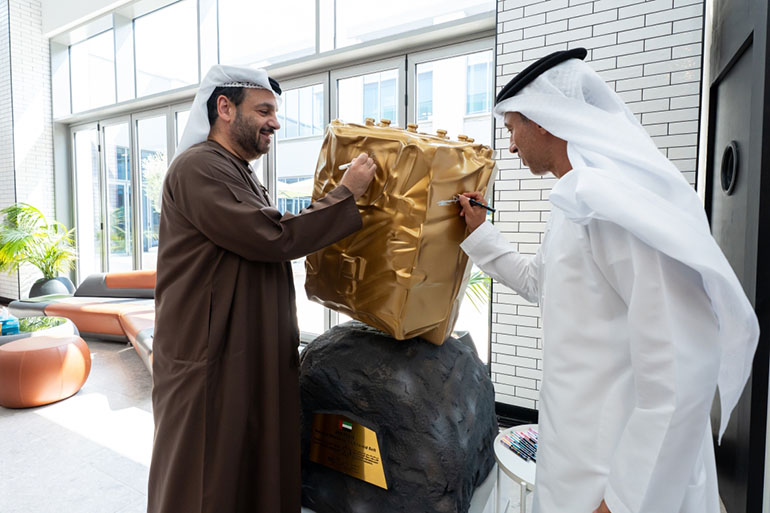
Two signatories add their marks to a gold-wrapped model of TII’s probe, which will travel aboard the MBR Explorer to 269 Justitia. Designed, built and tested in Abu Dhabi, it is the mission’s only deployable payload. Source: TTI
The United Arab Emirate’s Technology Innovation Institute (TII) calls its new probe “asteroid-landing,” but its engineers don’t expect it to survive hitting the asteroid 269 Justitia, a 58-kilometer-wide rock between Mars and Jupiter that is among the reddest in the main belt and may have formed near or beyond Neptune. Anton Ivanov, executive director of TII’s Propulsion and Space Research Center, said the team briefly called the probe an “impactor.”
TII unveiled the probe it built in partnership with the UAE Space Agency, HEX20, Khalifa University and UAE University’s National Space Science and Technology Center for the UAE’s Emirates Mission to the Asteroid Belt (EMA) at an Oct. 1 press conference in Abu Dhabi. The probe will ride the MBR Explorer, the mission’s main spacecraft, about 5 billion kilometers over eight years.
Designing for a crash, hoping for survival
The main spacecraft cannot safely approach within a few kilometers of Justitia’s surface, TII said, so the Explorer will release the probe to descend, and crash, alone.
The mission is scheduled to launch in March 2028 from Japan. After reaching Justitia, the MBR Explorer spacecraft will orbit the asteroid for about seven months before releasing the probe in early 2036. The probe will fall for a few hours toward the asteroid as it captures images. If the probe survives the impact, it will have enough battery for 20 to 50 minutes on the surface, enough to send a final picture, which Ivanov called “the most important close-up picture.”
TII engineers expect the probe to hit the asteroid at 15 to 27 meters per second with no way to slow down. The probe’s requirements ruled out propulsion and solar panels, and a strict mass limit ruled out the soft-landing design the team had considered.
“We actually had a great idea of how to land softly without using propulsion. But we were very strongly constrained by mass, so we could not afford to do anything, let’s say, fancy. But inshallah, next time,” Ivanov said.
As the probe falls, an attitude-control system, which orients the probe, will keep the two cameras, a wide-angle and a narrow-angle, pointed at Justitia. The team said they checked this through simulation and testing in the lab.
The team plans to use the crater the probe will create to look below Justitia’s surface.
“All of the instruments on the spacecraft, they can only look at the very thin surface layer. Now the probe will provide an opportunity… by excavating a little crater to peek a little bit underneath… and we don’t know what we’re going to find,” Ivanov said. No other mission has investigated under the surface of an asteroid of this size, he said. The two missions that deliberately struck asteroids, Japan’s Hayabusa2 and NASA’s DART, hit bodies less than 1 km across. Justitia is about 58 km wide.
Why Justitia?
Justitia is among the reddest bodies in the main asteroid belt, with a spectrum closer to objects in the Kuiper Belt, the region of icy bodies beyond Neptune, according to TII. A 2021 study suggests it may have formed near or beyond Neptune and then moved inward. Elias Tsoutsanis, chief researcher at TII’s Propulsion and Space Research Center, said that its modest orbital inclination saves fuel on a route past several asteroids.
Researchers have proposed that very red objects in the outer solar system get their color from organic material formed when surface ice is irradiated, and TII says Justitia’s surface may carry such material. The EMA mission’s own scientists published a paper finding that a mix of carbonaceous material and heavily space-weathered silicates, rocky minerals altered by long exposure to space, best matches Justitia’s spectra, though the authors couldn’t rule out complex organics. The mission could help determine what makes up Justitia’s surface, and, possibly, what lurks beneath.
While the probe can only detect shape and texture, the main spacecraft will carry spectrometers that can measure surface composition, including organic molecules, Ivanov said.
As of Oct. 1, the probe was undergoing thermal-vacuum testing, which simulates the temperatures and vacuum of space. After that, it will undergo a full descent run on a three-axis attitude rig, a test stand that rotates the probe to simulate descent, and a flight readiness review.
The probe is scheduled to ship to Colorado later this month for integration with the MBR Explorer, Ivanov said.


Tell Us What You Think!
You must be logged in to post a comment.