
Artist’s rendition of Moon Base. Credit: NASA
On Nov. 7 at the MAX POWER aerospace expo at Kennedy Space Center in Florida, NASA said it is moving ahead with PROMISE (Polar Rover for Observation, Mapping and In-Situ Exploration), a nuclear-powered rover built largely from Curiosity and Perseverance hardware.
NASA also awarded Blue Origin $94 million to land the rover at the lunar south pole, targeting a late 2028 launch.
The rover was one of a slate of Moon Base awards NASA announced at the event. The largest contracting framework is Commercial Lunar Payload Services (CLPS) 2, a 10-year framework with a combined ceiling of $10 billion under which eight companies, including Blue Origin and SpaceX, can compete for future NASA cargo deliveries to the lunar surface. NASA also awarded about $1.3 billion in launch and transport orders and selected companies to develop components for a planned power and communications tower.
NASA also raised the ceiling on the original CLPS contract from $2.6 billion to $4.2 billion. That contract will remain in place through November 2028, with an additional five-year period to complete awarded lunar deliveries through November 2033.
A Mars rover, rebuilt for the moon
PROMISE is the scout for NASA’s Moon Base program, the agency’s plan to build a permanent outpost at the lunar south pole. The rover reuses proven Mars hardware, NASA said, and its nuclear power lets it keep working through long lunar nights and inside permanently shadowed regions thought to hold ice. PROMISE will use a flight-spare multi-mission radioisotope thermoelectric generator (MMRTG), which converts heat from radioactive decay into electricity.
NASA first floated sending a spare Mars rover to the moon on June 30. Now, the agency is targeting late 2028 for its launch and planning an 18-month mission.
The six-wheeled rover will characterize the surface and subsurface of the lunar south pole, assess resource potential and provide data to assist landing-site selection. It will be equipped with a drill that can reach about 1 meter (3 feet) below the surface, spectrometers, temperature and radiation sensors and visible-light cameras. It will also test NASA’s High Performance Spaceflight Computing technology, paired with lidar-based mapping and autonomous navigation software for traveling through dark, difficult terrain.
NASA’s Jet Propulsion Laboratory, a division of Caltech, will manage the mission and build the rover around Curiosity’s ground-based engineering test vehicle, incorporating spare flight and test components from Curiosity and Perseverance.
Blue Origin won a $94 million base contract, with an option period worth an additional $140 million based on performance, to land the rover with its Mark 1 lander. The award expands a May 2026 task order worth $188 million, with an option of up to $280.4 million, to land two lunar terrain vehicles (LTVs). NASA has not set launch dates for the two LTVs but has said both will reach the surface by 2028.
$1.3 billion in launch and transport orders
Also at the event, NASA awarded six task orders as part of the Venture-Class Acquisition of Dedicated and Rideshare (VADR) launch services contract to Arrow Science and Technology, Blue Origin and Impulse Space.
The agency outlined three mission types for the orders: missions to reduce risks of future long-term human spaceflight, to prepare the lunar south pole for human exploration with drones and to test navigation technologies and operations in multiple orbits in cislunar space, the region between Earth and the moon.
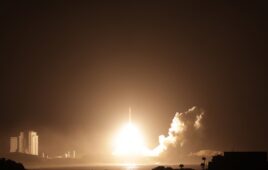
Blue Origin will fly three of the missions on New Glenn, according to Payload. One will carry Firefly Aerospace’s Elytra orbital transfer vehicle, which will transport NASA’s MoonFall scout drones. The other two will use Blue Origin’s Blue Ring spacecraft to carry cargo NASA has not yet selected.
Arrow Science and Technology leads a team that will send NASA’s two CAPSTONE 02 spacecraft to lunar orbit on a Falcon 9 using Quantum Space’s Ranger transfer vehicle. The spacecraft will test navigation, communications and close-proximity maneuvers around the moon, Quantum Space said. Impulse Space won the other two orders, the company said: one on a Falcon 9 carrying a NASA payload, and one on Relativity Space’s Terran R that will use Impulse’s Helios kick stage, a small upper stage that boosts payloads to higher orbits, and a lander to drop payloads into cislunar orbits before attempting a descent to the lunar surface. Impulse said its missions begin in 2028.
The task orders are worth about $1.3 billion combined and fall under VADR’s 10-year contract, which has a maximum total value of $5 billion across all contracts.
NASA also selected SpaceX for the Cislunar Communications Deployment Demonstration, under which the company will launch communications satellites aboard a Starship to cislunar space in 2028.
A power and communications tower for the lunar surface
NASA selected companies to develop components for a planned Mini-Communications and Solar Tower (miniCAST): Honeybee Robotics, a Blue Origin company, for energy storage; Redwire for power generation; and Yank Technologies for wireless power transfer.
The space agency said it expects work to begin within months and that its Marshall Space Flight Center in Alabama will assemble and test the systems before deployment. NASA also expects to solicit proposals for fully integrated power systems in early 2027.
NASA also intends to release a directed call under its Next Space Technologies for Exploration Partnerships (NextSTEP-3B) solicitation to help “close architecture-driven, high-priority data gaps for Moon Base development.”
“We are building the Moon Base mission by mission,” NASA Administrator Jared Isaacman said in a statement. He added, “When our astronauts return to the moon, they will arrive with the first elements of the Moon Base already waiting for them on the surface.”


Tell Us What You Think!
You must be logged in to post a comment.