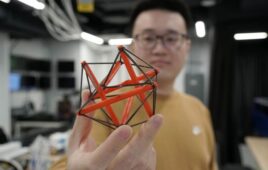
John Clarke, Michel H. Devoret and John M. Martinis were awarded the Nobel Prize in Physics for their work in quantum mechanics on Tuesday. The scientists showed that two properties of quantum mechanics could be observed in a system large enough to see with the naked eye. They will share a prize of 11 million Swedish kroner, about $1.17 million.

Top: John Clarke and Michel Devoret
Bottom: John Martinis
The laureates’ discoveries paved the way for technology such as the cellphone, cameras and fiber optic cables. “There is no advanced technology today that does not rely on quantum mechanics,” said Olle Eriksson, chairman of the Nobel Committee for Physics.
Quantum properties on a macroscopic scale
The scientists were recognized for a series of experiments conducted in 1984 and 1985 that proved the existence of two quantum properties in a system visible to the human eye. Quantum tunneling, one of the properties, allows quantum particles to move through a barrier even if they do not have enough energy. Previously, this had only been seen at the atomic scale.
The second property is the quantization of energy, which describes how quantum particles can emit and absorb energy in fixed, discrete amounts. With a greater number of particles, these properties become insignificant.
However, the laureates were able to observe quantum tunneling on a macroscopic scale, also showing that the energy of the system was quantized, meaning that it existed at fixed levels.

Quantum tunnelling had previously been seen only on a small scale. ©Johan Jarnestad/The Royal Swedish Academy of Sciences
They accomplished this by studying a chip with two superconductors, creating a circuit that can conduct current with no electrical resistance. The chip trapped the energy in a flow without any voltage and without enough energy to escape. Then they placed a thin layer of a nonconducting material between the superconductors.
They observed that the charged particles acted in unison as if they were a single particle. The system used quantum tunnelling to escape the zero-voltage state, generating an electrical voltage. The researchers also found that the system only absorbed light at certain frequencies, meaning that its energy was quantized.

The scientists observed the particles acting as one. ©Johan Jarnestad/The Royal Swedish Academy of Sciences
Their findings were published in Science in 1988.
About the laureates
John Clarke is Professor Emeritus of the Graduate School at UC Berkeley. He received his B.A., Ph.D. and Sc.D from Cambridge University. At UC Berkeley, he studies Superconducting Quantum Interference Devices (SQUIDs).
Michel Devoret is Frederick W. Beinecke Professor Emeritus of Applied Physics at Yale University. He is also a professor at the University of California, Santa Barbara and was formerly a Chief Scientist at Google Quantum AI. In 2022, he co-founded the quantum computing startup Qolab. His research focuses on experimental solid-state physics.
John Martinis is Professor Emeritus at UC Santa Barbara and a Chief Scientist for Quantum Hardware at Google Quantum AI. His research interests center on the physics of superconducting devices.
The Nobel Prize in Chemistry will be awarded on Wednesday by the Royal Swedish Academy of Sciences in Stockholm. The prizes for Literature and Peace will also be announced this week.