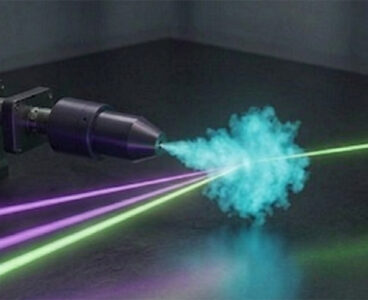
High-power lasers allow researchers to study matter under extreme conditions, pursue fusion energy and support applications from national security to advanced manufacturing. However, the lenses, mirrors and other optical components that guide and shape their beams can be damaged by extreme laser fluence, the amount of laser energy delivered across a given area, or harsh…
AI landmine detection reveals bigger problems in computer vision testing

Researchers at Binghamton University are using computer vision and machine-learning to detect landmines from aerial images. Their results reveal the importance of out-of-sample (OOS) testing, which evaluates a model on independently collected images beyond the dataset used to train and tune it. “It’s easy to get numbers in the 80 or 90 percent range if you’re not doing out-of-sample testing,” said…
NTT Research taps Tetsuomi Sogawa to lead PHI Lab as optical-computing work advances

NTT Research has named Tetsuomi Sogawa director of its Physics & Informatics Lab, effective May 1, succeeding Yoshihisa Yamamoto, the Stanford emeritus professor who has led the lab since NTT Research launched in 2019. The Sunnyvale-based PHI Lab focuses on nonlinear optics and alternative computing architectures, part of NTT’s broader effort to push photonics deeper…
Overcoming the 100-nanometer barrier: New microbottle resonators scale up optical trapping
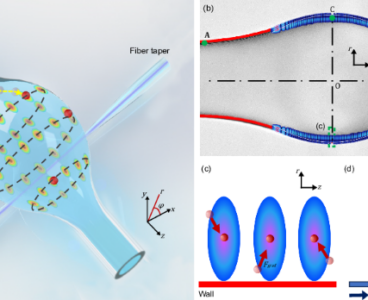
Near-field optical trapping allows for contact-free control of objects, including nanoparticles and living cells. This is traditionally done using whispering-gallery-mode and waveguide-based platforms that rely on evanescent fields that only penetrate about 100 nanometers into the surrounding medium. This shallow interaction restricts trapping efficiency and makes the system highly sensitive to perturbations, limiting the practical…
R&D 100 winner LLNL achieves 1,000x speed boost in 3D nanofabrication
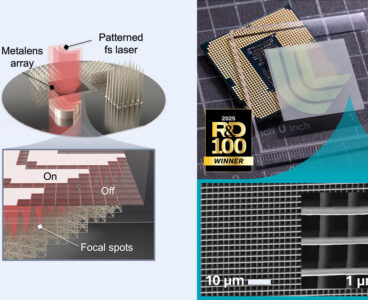
Researchers at Lawrence Livermore National Laboratory and Stanford University say they have built a two-photon lithography system that could push 3D nanofabrication toward manufacturing scale, boosting throughput by more than 1,000 times compared with commercial tools while maintaining minimum feature sizes of 113 nanometers. Two-photon lithography uses ultrafast laser pulses to harden material only at…
World’s largest 3,200-megapixel camera begins capturing 20 billion galaxies at NSF-DOE Rubin Observatory

The NSF-DOE Vera C. Rubin Observatory unveiled its first images today, showcasing a 3,200-megapixel digital camera that promises to capture more data about our universe than all optical telescopes throughout history combined, according to Brian Stone, performing the duties of the NSF director. In 10 hours of test observations from its mountaintop perch in Chile,…
Sandia Truman Fellows advance quantum optics from lab to wafer-scale and field applications
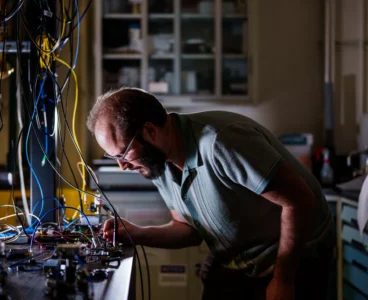
Two Harry S. Truman Fellows are undertaking research to translate advanced quantum optical principles from laboratory concepts into scalable, manufacturable devices. Truman Fellow Sam Peana focuses on quantum photonics research. As a doctoral student, he contributed to a team thaat identified a novel single-photon emitter found in silicon nitride-oxide materials. He subsequently developed techniques for…
R&D 100 winner of the day: Berxel iHawk P100 Polarization Structured Light Camera
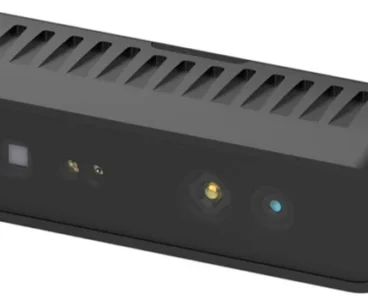
Berxel Photonics Co. Ltd.’s new 3D camera using Polarization-Structured Light (PSL) transforms depth perception in challenging environments. Traditional 3D cameras struggle with reflective surfaces like glass, mirrors, and water, often producing inaccurate depth readings. The PSL 3D camera overcomes these limitations by leveraging the polarization properties of light. It employs high-contrast-grating vertical-cavity surface-emitting lasers (VCSELs)…