Research & Development World

  • R&D World Home
  • Topics
    • Aerospace
    • Automotive
    • Biotech
    • Careers
    • Chemistry
    • Environment
    • Energy
    • Life Science
    • Material Science
    • R&D Management
    • Physics
  • Technology
    • 3D Printing
    • A.I./Robotics
    • Software
    • Battery Technology
    • Controlled Environments
      • Cleanrooms
      • Graphene
      • Lasers
      • Regulations/Standards
      • Sensors
    • Imaging
    • Nanotechnology
    • Scientific Computing
      • Big Data
      • HPC/Supercomputing
      • Informatics
      • Security
    • Semiconductors
  • R&D Market Pulse
  • R&D 100
    • 2025 R&D 100 Award Winners
    • 2025 Professional Award Winners
    • 2025 Special Recognition Winners
    • R&D 100 Awards Event
    • R&D 100 Submissions
    • Winner Archive
  • Resources
    • Research Reports
    • Digital Issues
    • Educational Assets
    • R&D Index
    • Subscribe
    • Video
    • Webinars
    • Content submission guidelines for R&D World
  • Global Funding Forecast
  • Top Labs
  • Advertise
  • SUBSCRIBE

Tracking Hydrogen Movement Using Subatomic Particles

By Osaka University | September 26, 2018

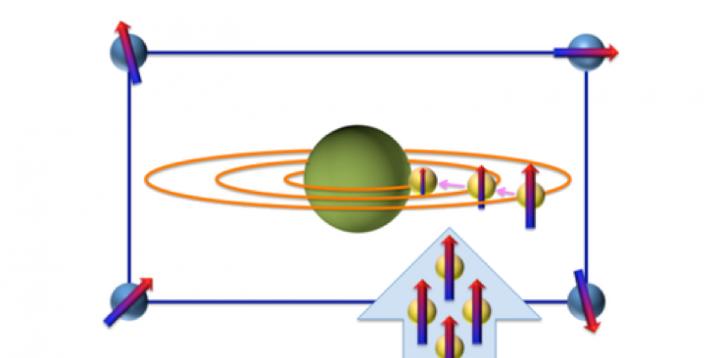
When a negative muon (μ-) is implanted into MgH2, the μ- is trapped by the muon atomic orbitals near a Mg nucleus. Since μ- has a polarized spin, we can obtain information about the magnetic field at the Mg nucleus sites, formed by the hydrogen nucleuses, through the observation of how the μ- spin depolarizes with time. Credit: J. Sugiyama/Toyota Central Research & Development Laboratories Inc.

A muon is an unstable subatomic particle similar to an electron but with much greater mass. The lifetime of a muon is only a couple of microseconds, but this is long compared with the lifetimes of many unstable subatomic particles. Because of their comparatively long lifetime, positive muons are often used to detect internal magnetic fields in solid materials. However, negative muons have seldom been used for this purpose because a large data set is required to obtain reliable results and experimental data collection times are normally limited. Recently, researchers developed a system that can count muon events at a much faster rate, allowing an experiment to be completed in a suitable time frame. Using this system, a Japanese collaboration has realized the long-standing goal of using negative muons to observe the local nuclear magnetic fields in a solid for the first time.

As explained in their article in Physical Review Letters, the team used magnesium hydride as the solid in their experiments. Magnesium hydride has a formula of MgH2 and is a potential candidate as a hydrogen storage material. Magnesium hydride was selected for study in experiments using the negative muon beam because muons initially captured on hydrogen are transferred quickly to magnesium, which allowed the transfer process of hydrogen to be investigated.

“The magnesium atoms exposed to the negative muon beam were effectively converted to sodium,” says first author Jun Sugiyama at Toyota Central Research & Development Laboratories Inc. “The local magnetic field of the hydrogen atoms around these converted atoms was then able to be detected, which meant that we could track hydrogen diffusion.”

The experiments used a high-intensity muon beam and highly integrated positron detector system to detect the local magnetic fields in the magnesium hydride sample. The obtained spectra were consistent with the magnesium atoms having a random magnetic field, agreeing with theoretical predictions. In particular, the results agreed with estimations from dipole field calculations, indicating that the nuclear magnetic fields of hydrogens in magnesium hydride were indeed observed.

“Our approach using negative muons to detect the local behavior of ions is attractive because it allows us to study the dynamics of light elements in a solid from the fixed point of the nucleus,” says co-author Kazuhiko Ninomiya at Osaka University. “This approach is therefore complementary to nuclear magnetic resonance spectroscopy.”

Using this negative muon-based technique, it is now possible to track the movement of hydrogen in a solid, which should aid the development of hydrogen storage materials.


Related Articles Read More >

Chemistry Nobel goes to ‘molecular architecture’ with spaces big enough to trap gases
ORNL named on 20 R&D 100 Awards, including carbon-capture and AM tools
2025 R&D Technician of the Year: Dow’s Richard Tapper pushes flame-retardant limits to curb real-world fire risks
Researchers synthesize first Berkelium-containing molecule
rd newsletter
EXPAND YOUR KNOWLEDGE AND STAY CONNECTED
Get the latest info on technologies, trends, and strategies in Research & Development.
RD 25 Power Index

R&D World Digital Issues

Fall 2024 issue

Browse the most current issue of R&D World and back issues in an easy to use high quality format. Clip, share and download with the leading R&D magazine today.

Research & Development World
  • Subscribe to R&D World Magazine
  • Sign up for R&D World’s newsletter
  • Contact Us
  • About Us
  • Drug Discovery & Development
  • Pharmaceutical Processing
  • Global Funding Forecast

Copyright © 2025 WTWH Media LLC. All Rights Reserved. The material on this site may not be reproduced, distributed, transmitted, cached or otherwise used, except with the prior written permission of WTWH Media
Privacy Policy | Advertising | About Us

Search R&D World

  • R&D World Home
  • Topics
    • Aerospace
    • Automotive
    • Biotech
    • Careers
    • Chemistry
    • Environment
    • Energy
    • Life Science
    • Material Science
    • R&D Management
    • Physics
  • Technology
    • 3D Printing
    • A.I./Robotics
    • Software
    • Battery Technology
    • Controlled Environments
      • Cleanrooms
      • Graphene
      • Lasers
      • Regulations/Standards
      • Sensors
    • Imaging
    • Nanotechnology
    • Scientific Computing
      • Big Data
      • HPC/Supercomputing
      • Informatics
      • Security
    • Semiconductors
  • R&D Market Pulse
  • R&D 100
    • 2025 R&D 100 Award Winners
    • 2025 Professional Award Winners
    • 2025 Special Recognition Winners
    • R&D 100 Awards Event
    • R&D 100 Submissions
    • Winner Archive
  • Resources
    • Research Reports
    • Digital Issues
    • Educational Assets
    • R&D Index
    • Subscribe
    • Video
    • Webinars
    • Content submission guidelines for R&D World
  • Global Funding Forecast
  • Top Labs
  • Advertise
  • SUBSCRIBE