Image: Boom Supersonic
The June 2025 executive order dismantles a regulatory framework that has kept American skies silent of sonic booms since 1973. For over five decades, federal regulations have prohibited any civilian aircraft from flying faster than the speed of sound over U.S. territory, regardless of whether the aircraft actually produced a disruptive sonic boom. This blanket ban made no distinction between the window-rattling 110-decibel booms of early supersonic jets and the “sonic thump” of modern designs. NASA’s X-59, for instance, produces a sound no louder than a car door closing at 75 decibels.
If Boom Supersonic’s Overture aircraft becomes operational as planned, the flight time between New York and London could be reduced to roughly 3.5 hours. This is about half the duration of current subsonic flights, which typically take around 7 hours. At Mach 1.7, passengers could feasibly conduct same-day business trips between continents.
According to The Wall Street Journal, Boom has already demonstrated concrete progress toward this goal. In January 2025, the company successfully tested its XB-1 demonstrator, which broke the sound barrier at Mach 1.1 at 35,290 feet at during a flight over the Southern California desert. Chief test pilot Tristan Brandenburg was at the controls.
Boom’s Greensboro Superfactory, completed in June 2024, positions Boom to manufacture 33 aircraft annually, expandable to 66.
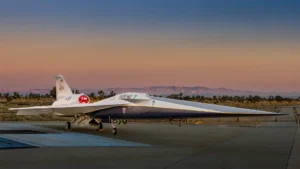
NASA’s X-59 quiet supersonic jet at dawn outside Lockheed Martin’s Skunk Works in Palmdale, California. Image from Lockheed Martin Skunk Works.
A large part of what led to the retirement of the Concorde was its high operating costs, including fuel consumption and maintenance. Additionally, community concerns over the loud sonic booms it generated limited its routes to primarily overwater flights.
Boom’s Overture takes a novel approach to making supersonic flight commercially viable. The Journal reports that where a round-trip Concorde ticket cost upward of $10,000 in the 1990s, Boom says it will bring down the per-seat cost on Overture to that of a regular business cabin, which runs about $1,700 one way between New York City and London. This dramatic price reduction could address one of the Concorde’s fundamental commercial failures.
While NASA focuses on reshaping the aircraft itself to minimize sonic booms through its elongated nose and carefully sculpted aerodynamics, Boom employs atmospheric physics to prevent booms from reaching the ground entirely. The company’s “Boomless Cruise” technology operates at specific altitudes and speeds (typically between Mach 1.1 and 1.2) where temperature gradients in the atmosphere refract sound waves upward.
With major airlines such as United, American, and Japan Airlines signing purchase agreements for the craft, the industry is betting that quieter supersonic flight will finally bring back supersonic commercial flights. Yet not everyone in the aviation industry is convinced. Delta CEO Ed Bastian remains skeptical, calling the jet “a very, very expensive asset” for the roughly 75 travelers it is expected to carry, according to The Wall Street Journal. That’s a fraction of a typical wide-body jet.
Boom’s valuation has reportedly also dipped over the years, falling from $1 billion to $500 million, with workforce reductions of approximately 50% since fall 2024. CEO Blake Scholl is seeking $1–2 billion in additional funding to bring Overture to market. .
Bastian said he remembers the Concorde as a cool experience, but one he partook in only through free upgrades, never with his own money, and has no plans to buy Overture jets.